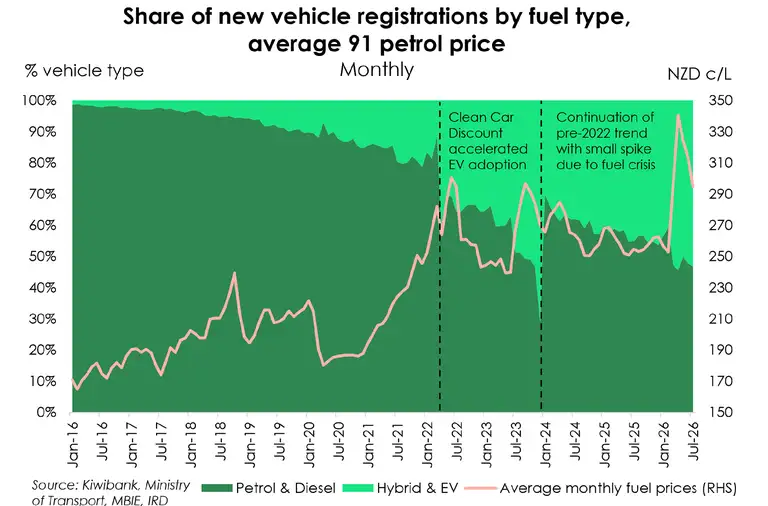

- Inflation data came out last week. The print was high, 4.1%, but not unexpected. Despite being above the Reserve Bank’s target band, the June quarter data was driven by fuel prices which have since eased (and escalated and eased again).
- Some reprieve in price growth came from housing rents, which have slowed down. Domestic prices printed less hot, down from 3.5% in March to 3.4% in the June quarter. Consistent with our view that domestic activity is still soft.
- The hostilities in the Middle East eased over the weekend. We expect the oil price will come back down again. Despite all the volatility (or maybe because of it) Kiwi households have been prioritising savings over spending, according to Kiwibank’s latest State of Savings report.

The inflation numbers are in. To no one’s surprise, it’s high. The highest since December 2023. Last week’s data showed that annual headline inflation for the June quarter was 4.1%. While this is markedly higher than the Reserve Bank’s target band of 1-3%, the headline rate would have snuck within the band printing at 2.9% if petrol and diesel price rises were stripped out. Petrol and diesel rose 20 and 50% respectively over the June quarter. Fuel prices contributed over 30% to the annual rise.
The cost of living crisis continues to drag its heels, much to the dismay of Kiwi households. Energy prices remain high, both for vehicle fuels and household energy. Electricity prices were up 12% on the year and contributed 8.4% of the annual headline inflation increase. Local authority rates continue to climb, increasing 8.8% annually. Food prices are also stinging Kiwi wallets at the grocery store. A surge in international demand for New Zealand meat, particularly from the United States, drove a 6.9% annual increase in meat prices. Compare those increases to the weak 2% wage increases we’ve seen so far this year…
There are, however, bright spots. We see little evidence in the June data that price increases are spreading widely across the economy. Domestic (non-tradeable) inflation also dropped from 3.5% to 3.4%. And that’s despite large increases in electricity and local authority rates. Some prices are not rising as fast as others, which will help keep a lid on future price increases across the economy. Housing rents are continuing to cool. And last month’s card spending data paints a dreary picture of consumer activity. We expect inflation to return to 2% by mid-2027. We see interest rates reaching 3% by the end of 2026 followed by a long hold through 2027.
For more thorough analysis on inflation, check out our review from last week.
Last week saw a flare up of Middle East hostilities which sent Brent Crude oil prices surging back above $100USD/barrel. Prices have eased off over the weekend due to a pause on strikes, but remain well above early-July prices. The spike in the price of refined product coming out of Singapore will, as Minister Willis warns, be felt at the pump in New Zealand in due course. This muddies the inflation picture as prices remain heavily dependent on oil going forward.
Across the Tasman, Australian labour market data surprised to the upside. Employment increased by 76k, although this was offset almost entirely by an increase in the size of the labour force. This means that the unemployment rate remains unchanged at 4.4%, above the RBA’s 4.2% forecast. Australia also recorded strength across services and manufacturing industries.
Back on this side of the Tasman, Kiwibank released its 2026 State of Savings Index for its third year. Kiwi households are showing resilience through tough economic conditions by maintaining good saving and budgeting habits. For more information, check out the report here.
Financial Markets
The comments below were provided by Kiwibank traders. Trader comments may not reflect the view of the research team.
In Markets – CPI was last week, back to offshore data and event watching
Last week rates ended higher. Direction was provided by some key data releases form here and Australia as well as continued reprice of US tightening probabilities alongside further escalation in the Gulf.
The week saw rates start on the back foot. Further escalation in the Gulf over the weekend and firmer US data coupled with hawkish Fed comments around persistently high inflation and this being broad-based ahead of the set the tone. Local data on the day saw merchandise trade released, though with CPI due the following day, impact was limited. Rates were seen holding steady ahead of the CPI release against a backdrop of weakening offshore, where the US curve having traded the prospects of a 2026 tightening back to below certain after their CPI, had been incrementally clawing that back, and an Australian bond futures market lower by a couple. Implied pricing had rallied ahead of release by around a point to imply year-end OCR at about 3.10%.
CPI printed higher than the Reserve Bank expected at +1.5 q/q and +4.1% y/y, though with an in-line non-tradables print was seen as offering a bit of everything for everyone. NZD saw a small initial bid on the headline read, though lacked the explosive follow through you would have expected on an expectations beat. Instead, a continued firming throughout the session. Rates markets initially traded higher post release with the 2-year swap higher by around 3-points working toward 4-points by midday. They reversed over the course of the afternoon, with the market leaning on the non-tradable aspects and later the core element as measured by the RBNZ’s sectorial factor model. Receiving interest was noted, with a concentration around the 2-year part of the curve. This was perhaps with the view that while not derailing the tightening cycle, the print was seen as adding weight to a measured approach by the RBNZ leaving the market to run the accrual calculations across the curve and implied path. The day saw 2-year close at 3.66% -4-points, 10-year at 4.37% -2-points. Wednesday the curve continued to trade higher, though with some relative outperformance. US markets in particular saw a momentum shift to higher yields picking up alongside Gulf tensions, the front of their curve working to erase their post-CPI gains that had seen a further Fed tightening in 2026 priced as a chance shifting back to a tightening fully priced.
Thursday provided another (near) local data print to focus on with the ever-interesting Australian employment data. Our market tracked only marginally higher into the release despite another round of US rates selling. The release was strong, a sharply higher employment change for June beating expectation by a wide margin, 76k against 15k expected. The combination of an increased participation rate, from 66.7% to 67.0%, and unchanged 4.4% unemployment rate seeing this traded as a strong print. The Australian short-curve continued to increase priced probability of another RBA move, pushing pricing through one full 25-point move where this had been seen as only around 40% a week or so prior, while NZ markets similarly continued to maintain a firm pricing path, with year-end OCR seen around 3.10% with 2027 dates pressing on 3.50% out one year. The day saw yields finish higher, 2-year swap just over 3-points higher and 10-year 2-points higher. Friday, and with perhaps potential weekend Gulf developments seen as one risk too many to carry, it was a sharp move higher in rates. Rates opened higher, with players and liquidity fading towards the afternoon, continuing towards the close. Receiving interest that had been evident at stages in the latter part of the week not so obvious on the day. 2-year finishing 11-points higher at 3.81% for +19 w/w, and 10-year +9-points at 4.50% for +15 w/w. The RBNZ’s scheduled GDPnow print sufficed as local data on the day printing mid-afternoon, with this seeing only a minor adjustment to their Q3 prediction and not eliciting a significant move.
Looking forward, if there were to be some stabilisation geopolitically, and with significant local data perhaps a little thin until employment data in early August, there remains the potential for receiving interest from accrual-type players who may view the current curve as pressing on fully priced. This view remains within the context of a broader higher rates view though so will likely see shorter terms targeted of those trades or combinations of such that carry down the curve. For instance, combinations of forward starts of shorter tenors, noting for instance how 1-year 1-year forward start, and 2-year 1-year forward start had been noted near flat. Additionally for this week, Australian CPI may play a little more of an outsized role in any such trade, in so far as the re-rating of the chances of further RBA moves after the employment data to more than one 25-point moved priced has also exerted an influence on NZ rates. So a contained or better print prompting a scaling back of their path could see the front of the curve similarly react seeing rates track back to familiar ranges with a resumption of the view of a measured RBNZ approach. Graham Hughes, Trader – Financial Markets.
In FX – Focus moves offshore for the Kiwi this week
Last week saw broad US dollar outperformance, driven by geopolitical safe-haven demand, renewed US tariff escalation (including measures directed at New Zealand), and positioning ahead of this week's FOMC meeting. NZD/USD traded from a recent high of 0.5873 to a low of 0.5762, falling around 0.8% over the week despite the stronger-than-expected Q2 NZ CPI print. The largely hawkish Kiwi rates outlook, with markets now pricing more than 100bp of tightening over the next year, suggests a high bar for further Kiwi gains from a domestic standpoint, leaving external factors, namely Fed policy, firmly in the driver's seat for now. After trading back below 0.5800 and touching a low of 0.5762 on Thursday, improved sentiment around easing tensions in the Middle East sees the Kiwi open the week back around the 58-cent handle. On the downside, immediate support comes in at 0.5750 and 0.5720 this week. This technical zone is likely to attract buyers should geopolitical concerns continue to fade. While the Fed is widely expected to leave rates unchanged at 3.50%-3.75% this week, recent Middle East tensions and the associated lift in oil prices have heightened market sensitivity to any changes in the Fed's inflation outlook. Investors will be focused on both the FOMC statement and Fed Chair Warsh's press conference for any hints around the future policy path. Outside of the Fed, BOJ, US PCE inflation and GDP data later in the week will also be key events for Kiwi traders.
NZD/AUD cooled slightly last week, declining around 1% as the AUD outperformed despite New Zealand's stronger-than-expected CPI print. The move was largely driven by the front end of the Australian rates market, with Australian OIS pricing moving higher following the firm June employment report and reopening the possibility of another RBA rate hike this year. That said, we continue to favour further upside in NZD/AUD. From a technical perspective, the recent pullback does little to alter the broader bullish picture. Unless we see a sustained break below 0.8233, the 61.8% Fibonacci retracement of the 0.8138-0.8387 move, upside momentum remains intact. This week's key event risk comes from Australian Q2 CPI data on Wednesday, which could prove pivotal for both RBA pricing and the next leg higher in the cross. Hamish Wilkinson – Senior Dealer, Financial Markets.
The Week's Key Events
- Relatively light week domestically data-wise. June 2026 employment indicators and household living-cost price indexes from Stats NZ are out this week. ANZ also release their July Business Outlook and the ANZ-Roy Morgan Consumer Confidence data this week.
- Across the ditch, it’s Aussie’s turn to face the music with their inflation data out this week. The same goes for Japan.
- The US Federal Reserve makes a rate decision this week followed by a press conference. The US also has a slew of other data including core durable goods, goods trade balance and consumer confidence.
All content is general commentary, research and information only and isn’t financial or investment advice. This information doesn’t take into account your objectives, financial situation or needs, and its contents shouldn’t be relied on or used as a basis for entering into any products described in it. The views expressed are those of the authors and are based on information reasonably believed but not warranted to be or remain correct. Any views or information, while given in good faith, aren’t necessarily the views of Kiwibank Limited and are given with an express disclaimer of responsibility. Except where contrary to law, Kiwibank and its related entities aren’t liable for the information and no right of action shall arise or can be taken against any of the authors, Kiwibank Limited or its employees either directly or indirectly as a result of any views expressed from this information.