Faced with higher costs at the pump and uncertainty about where fuel prices will go next, more Kiwi are turning to hybrid and electric vehicles (EVs).
New Zealand has had five consecutive months of hybrids and EVs being more popular than petrol and diesel cars.
While this shift is driven almost entirely by hybrids rather than pure EVs, it highlights something positive about New Zealanders. We adapt when circumstances change.
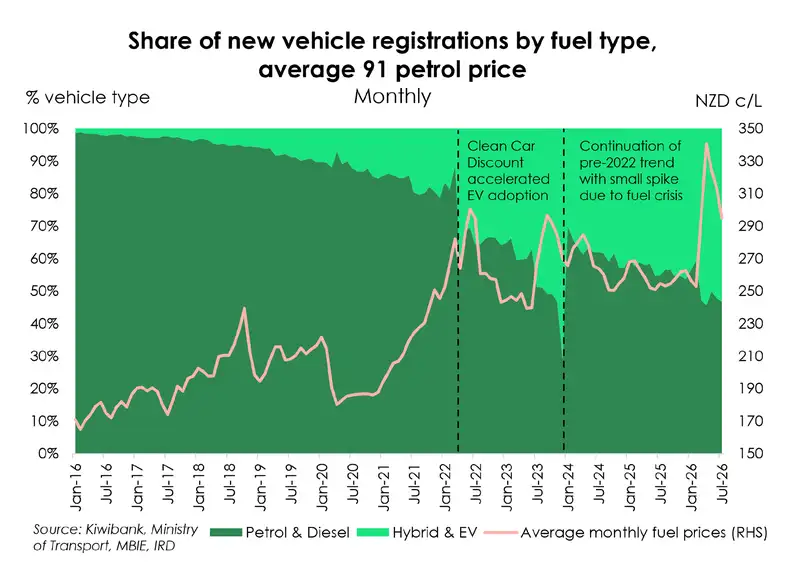
This week’s chart paints a picture of a quiet revolution happening on New Zealand roads. More and more Kiwi, presumably sick of being stung at the pump and uncertainty about future fuel prices, are switching to hybrids and EVs.
Before talking about 2026 fuel prices, there is an elephant in the data that needs addressing...
The Clean Car Discount scheme had a marked impact on people’s choice of vehicle. Between 1 April 2022 and 31 December 2023 when subsidies for hybrids and EVs were in place, there was a step-change in the proportion of hybrid and EV registrations. This was especially noticeable with the rush to buy eligible cars before the subsidy ended.
A whopping 71% of vehicle registrations were for EVs or hybrids in December 2023, versus 29% for petrol or diesel. The next month, in January 2024, it completely flipped. With 30% of registrations being for EVs versus 70% for petrol or diesel. Since then, registrations resumed their pre-subsidy trend.
Back to 2026… Petrol prices went through the roof off the back of the conflict in the Middle East which disrupted fuel shipments through the Strait of Hormuz. Fuel prices surged by an eyewatering 73 cents per litre between the end of February and the peak at the end of May.
At the same time, the share of hybrid and EV vehicle registrations jumped. From 41% of registrations in February, to 53% in March. The share of EV and hybrid registrations exceeded 50% for five consecutive months.
A clearer picture emerges when breaking down hybrids and EVs into sub-categories. When we do, we see that New Zealand’s clean vehicle transition has been propped up almost entirely by hybrids.
By comparison, Australia’s uptake in low emissions vehicles is driven proportionately more by battery electric vehicles (BEVs).
In the second quarter of 2026, 18% of Australian vehicle registrations were for BEVs. In New Zealand, the average proportion over the same period was 11%. When looking at the first quarter of 2026, the contrast is starker. Australia 17%. New Zealand 7%.
So, is New Zealand on the cusp of an EV revolution? Not quite. But although New Zealand’s uptake has been driven predominantly by hybrids rather than BEVs, it highlights something positive about New Zealanders. We adapt when circumstances change.
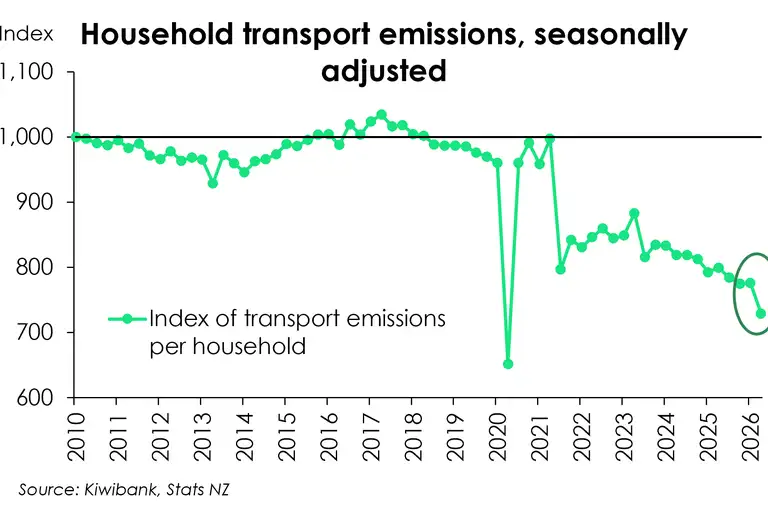
Kiwi are turning to greener technologies in response to changing conditions, reducing their reliance on fossil fuels in the process. This will ultimately drive lower emissions. Stats NZ data shows emissions intensity has fallen slowly but surely since 2010.
While New Zealand may not be world-leading in EV adoption, this year’s vehicle data tells a positive story. Faced with uncertainty, Kiwi motorists are making practical choices that leave them less exposed to fuel volatility and better positioned for the future.
All content is general commentary, research and information only and isn’t financial or investment advice. This information doesn’t take into account your objectives, financial situation or needs, and its contents shouldn’t be relied on or used as a basis for entering into any products described in it. The views expressed are those of the authors and are based on information reasonably believed but not warranted to be or remain correct. Any views or information, while given in good faith, aren’t necessarily the views of Kiwibank Limited and are given with an express disclaimer of responsibility. Except where contrary to law, Kiwibank and its related entities aren’t liable for the information and no right of action shall arise or can be taken against any of the authors, Kiwibank Limited or its employees either directly or indirectly as a result of any views expressed from this information.