

- Markets were taken on a ride last week… US equities took an initial ride higher on the wave of optimism following the US mid-term election. But that wave came crashing down as the election result troubled the tech sector, with increased regulation risk challenging valuations and sending index funds down.
- It’s tough out there in the Kiwi job market. The data showed a worsening of labour market conditions. Unemployment rose to 5.7%, while underutilisation remains stubbornly high and employment fell.
- The word of the weekend was “overhang” but we feel a bit hung-over with no clear election result. The MMP system is definitely making some heads spin.

Last week we had positive signals in the oil market, placing oil output pretty much back to pre-war levels. Negotiations between the US and Middle East also helped to ease the oil price below $100 USD per barrel.
Votes were counted, and the US mid-term election result showed a wave of blue. The result also pushed oil lower, but more importantly, the blue wave into Congress led to a shake-up of the tech sector, sending the VIX up and index funds up initially but then down. Fears of AI regulation increased, many tech companies rolled back plans of expanding and building new data centres due to the increased risk of new regulation.
Some were quick to call it the AI bubble popping, but on market close on Friday it seemed more like a sharp correction. The S&P 500 fell 3.2% between Monday and Friday, the Nasdaq dropped 5.6%. And there’s still a risk of continued selling, with investors now hedging their bets. The NZX50 benefited from the chaos closing the week 1.5% higher. The instability in the tech sector is one of the risks the RBNZ was watching while waiting, noting that “a global downturn could occur abruptly.” Holding the cash rate provides some insulation against a potential shock turning into something deeper.
The RBA delivered on expectations for a cash rate hike to 4.85%, the highest in 18 years. The Bank of England delivered its first hike in three years, taking its rate to 4%.
We closed the week with US non-farm payrolls data, which topped all forecasts. Unemployment came down to 4.1%, and traders increased their bets for a Federal Reserve cash rate hike to 4.25% in December.
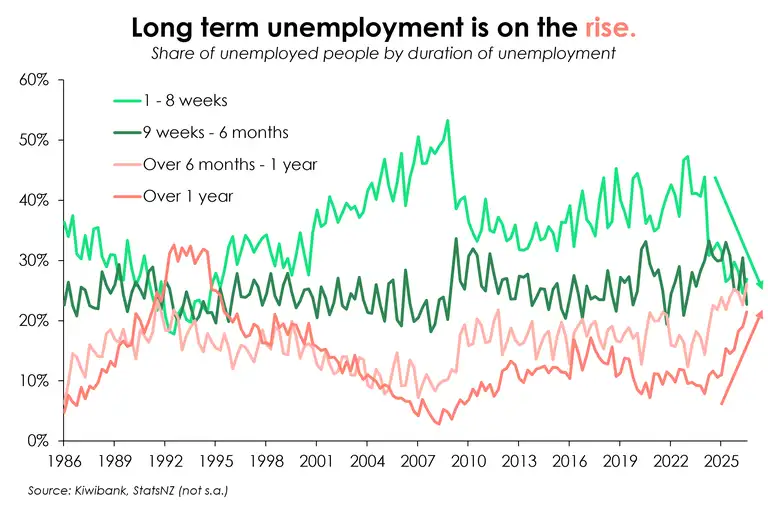
On top of the international moves, NZ generated its own volatility last week. Unlike the US, it’s tough out there in the Kiwi job market. The data defied expectations for improvement, showing a worsening of labour market conditions. The unemployment rate increased to 5.7%, an 11-year high, despite expectations of a labour market tightening. The underutilisation rate also remained uncomfortably elevated. Most worryingly, however, was the 30-year high in the proportion of those unemployed for longer than a year. And that’s what is driving the flight of the Kiwi to Australia. Long-term unemployment is extremely damaging for a worker’s ability to re-enter the market. To add to that, the number of hours worked decreased and the proportion of workers working part-time or in casual roles increased. The slack evident in the labour market data appears to validate the RBNZ’s call to hold interest rates in October. This also makes their December decision difficult. We still believe a hike in December is more likely than not, but we are watching the high-frequency data closely.
And last, but definitely not least, we had a general election with no clear result. We have a record overhang, a new party in Parliament, and an incumbent party losing key members of their team to a quirk of MMP. We now have to wait until 27 November for all the ~400,000 special votes to be counted. Much can change with the ‘special’ count, with many seats sitting on a knife’s edge. Hopefully we have a Government by Christmas, unless someone calls for a re-count of the votes… just more uncertainty.
Financial Markets
The comments below were provided by Kiwibank traders. Trader comments may not reflect the view of the research team.
In Markets – Well, that was interesting... Part 2
Another eventful week dominated by central bank decisions, central banker speak, top-tier local data and a US mid-term election. Locally attention was on both the RBA decision and key local employment data, though international developments that saw conditions ‘shift abruptly’ provided plenty of input into both rates and currency direction. For the week, our rates curve ended lower and steeper with the front of the curve supported by a lower implied cash rate path with year-end OCR at 2.90%, lower by 5bps having touched 50:50 for a December hike post-data. Year-ahead nudged below 3.50% having removed one 25-point tightening over the week. The IRS curve finished lower and steeper with 2-year Interest Rate Swap closing at 3.69% (-21bp), 5-year 3.99% (-20bp), and 10-year at 4.36 (-15bp).
Tuesday’s schedule saw the not only the Melbourne Cup but also the result of the RBA Monetary Policy Board’s deliberation on the cash rate target. Expectations were for a lift having jumped considerably ahead of the meeting following further stern commentary by board members and the above expectation inflation print. Heading into the meeting pricing was seen at around 21/25ths with solid pricing of another move with a terminal cash rate at around 4.96%. Before the running of the race, the RBA delivered an as expected 25-point hike, taking the cash rate to 4.85%, the fifth successive of the cycle to date. The statement was firm at the outset noting that inflation remained elevated and recent data indicated that it is broadly based adding that domestic capacity pressures were also judged to have be a little tighter than earlier thought. They noted that many firms were experiencing cost pressures and were increasing prices or planning to do so with inflation forecast to remain elevated and with upside risks to this. However, acknowledgement of prior rises and the slowing effect these were having on the economy, and with this an expected reduction in capacity pressures, current global uncertainties, a 6-3 split in the decision and the omission of the “including increasing the cash rate target further if needed” from the statement, sparked a rates rally on the view that it was not as hawkish as expected. The following press conference also too had the impression of a slight moderation in stance, further adding to the move with 3-year bond futures rallying by around 7-8-points post decision, while the implied cash rate path maintained only a modest probability of a further tightening before bringing forward the chance of an ease.
The key domestic event on the week however was our employment report on Wednesday. The higher-than-expected headline unemployment print of 5.7% and negative employment change on the quarter resulted in sharply lower rates across the curve. The clearly weaker than expected print which also included a falling participation rate and an elevated underutilisation rate, seeing the implied OCR path trading December probability back to 50:50 for a hike, while removing half a 25-point move along the curve. The 2-year interest rate swap moving from around 2bp lower on the open to around 9bp lower post data, before finishing lower by around 12-13bp on the day. The implied curve exerting greatest influence on the shorter dates, resulting in a steepening of the curve by around 5bp 2-year to 10-year. The release however had seemed a little at odds with some of the recent data with had indicated through survey data and Statistics NZ’s filled jobs series, which had shown growth on the quarter, suggesting that there may be some noise in the series to be worked through. Overall, from a policy perspective it may give some comfort to the RBNZ’s modelled assumptions in their most recent MPS around spare capacity in the economy.
Wednesday afternoon our time also saw the start of the US mid-terms results flowing through with these showing a shift in the balance in both the House and the Senate. Initially US rate futures made gains while equities traded lower in the US afterhours. The US session with the political uncertainty removed saw gains in Treasuries while the S&P and Nasdaq reversed early losses finishing around 1.5% and 0.9% higher respectively. The semiconductor index had remained in negative territory however on ongoing nerves around the prospect that increased regulation for the tech/AI sector that may be in the offing given the change in the political landscape. This proved to be a useful indicator as to the following day where equities were thumped lower with the move seen more broad-based as the market viewed the potential impacts may extend beyond the technology sector alone. This was seen with the S&P -4.4%, Nasdaq -6.4% and the SOX semiconductor index -12.3%. The selling extended further into Asia where the Nikkei and KOSPI were also sharply lower with officials talking of stabilisation measures. Treasuries continued to benefit from the further risk-off flight to safety trade with 2-year Notes lower in yield by around 12bp while Fed Funds futures continued to gain indicating markets pricing a lower rate path from the Fed.
Overall, as we have commented previously, we viewed that there was room for our implied curve to continue to pare back some of the priced tightening, though with the December probability bouncing off 50:50 it may be a situation where the front of the curve may start to struggle to make further gains, barring any unexpected domestic or global event, particularly given that the RBNZ may see the large nine-week gap between the December and February meetings as a risk with inflation still persistently elevated. Perhaps providing a reminder around this and that inflation is still a concern globally too, the Bank of England hiked their cash rate to 4% and warned of likely further hikes to come as their forecast base case has inflation nearing 5% in 2027. Ahead of the election there has been some talk around a dual inflation and employment mandate and how that may affect policy implementation if there were to be a shift in the political balance. I would note however that it would appear that the RBNZ already appears to be applying a fair degree of weight on part 2 of the Operational Objectives of the remit that currently require the RBNZ to have regard to such matters as avoiding unnecessary instability in employment when pursuing their inflation objective as evidenced by their cautious approach to the tightening cycle to date. On this vein, it would be noted that the Bank of Canada and the Federal Department of Finance has announced changes to the BoC’s monetary policy framework, moving away from multiple requirements, narrowing the goal to a 2% inflation target and removing previous references to employment and climate. By the time this is published we would have had our General Election preliminary results and the key US payrolls report – not covered here as this was written prior. Graham Hughes – Trader, Financial Markets
In FX – Kiwi Pain as Chaos Reigns
Boy, that was one big week of event-risk chaos, and the Kiwi had a rough time of it! NZD/USD fell around 2.4%, from 0.5681 to the mid-0.55s, briefly touching 0.5528, its weakest level in over a year and second only to the AUD as the worst-performing G10 currency. Across the Tasman, the RBA delivered its expected 25bp hike, but softer guidance saw markets interpret the move as potentially marking the peak of its tightening cycle. NZD/AUD benefited, keeping the cross above 0.8000 and maintaining its recent run higher, but elsewhere the Kiwi found little support, with softer NZ employment data and unemployment rising to an 11-year high of 5.7%, reinforcing the RBNZ’s cautious stance and tempering expectations for near-term tightening.
The fallout from the US midterms initially supported US Treasuries and weighed on the USD, offering the Kiwi some brief relief, before a subsequent global equity sell-off soured risk sentiment and dragged both the AUD and NZD lower. Heading into Saturday morning’s close, pre-election positioning added further pressure, with one-week NZD/USD implied volatility climbing to a seven-month high of 11.76 vol and stops triggered through the 0.5580 support zone, before a solid US payrolls print, seeing the odds of a Fed hike in December push to 80%, provided the final push lower. The Kiwi opened this morning around 0.5540 but has quickly traded higher, with the weekend election result weekend’s election favouring continuation of the current coalition government, reducing some of the political uncertainty and easing the immediate risk of a test of the important 0.5480/0.5500 multi-year support zone. But of course, there is some water to flow under this bridge with special votes to come. Watch for the previous 0.5580 support zone to provide initial resistance early this week. With the domestic calendar relatively light, attention shifts offshore to US CPI/PPI, post-midterm geopolitical developments including the US/Iran conflict, and a packed schedule of Fed speakers, with Mary Daly and John Williams among the key voices to watch as markets assess whether further Fed tightening is required. Hamish Wilkinson – Senior Dealer, Financial Markets.
The Week's Key Events
- Global data on our radar this week include consumer and producer price indices in the US, China and Germany. GDP data in the UK and the Eurozone, as well as the monthly reports from OPEC and the International Energy Agency are also to watch.
- The European Central Bank's economic bulletin and the minutes of the Bank of Japan meeting are due out this week.
- Banks and the bond market are closed on Wednesday for Veterans Day in the US, but Wall Street continues as normal.
All content is general commentary, research and information only and isn’t financial or investment advice. This information doesn’t take into account your objectives, financial situation or needs, and its contents shouldn’t be relied on or used as a basis for entering into any products described in it. The views expressed are those of the authors and are based on information reasonably believed but not warranted to be or remain correct. Any views or information, while given in good faith, aren’t necessarily the views of Kiwibank Limited and are given with an express disclaimer of responsibility. Except where contrary to law, Kiwibank and its related entities aren’t liable for the information and no right of action shall arise or can be taken against any of the authors, Kiwibank Limited or its employees either directly or indirectly as a result of any views expressed from this information.