

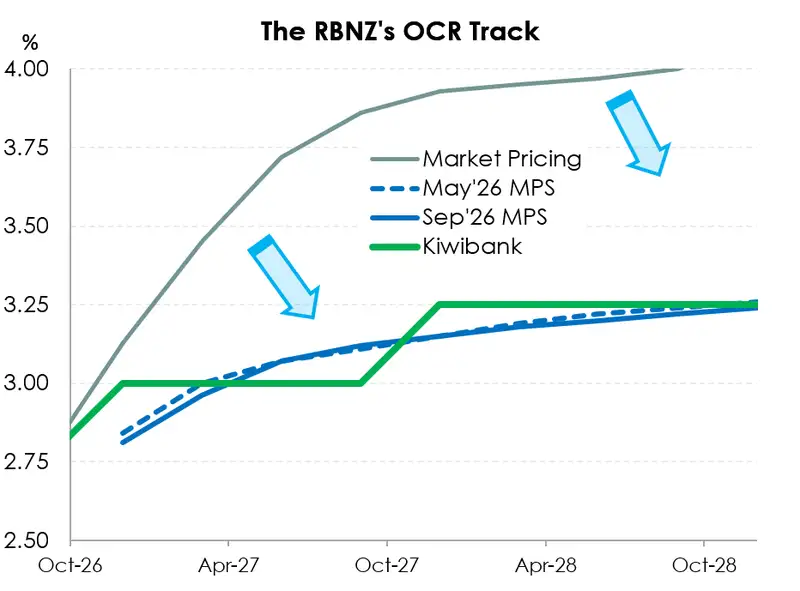
- The RBNZ voted to keep the official cash rate at 2.75%. The split vote went the way we hoped, although not the way we predicted, but we will take the win anyway. They are delivering on their September track and are willing to wait and see what the 50bps of hikes so far have done. We expect they will hike again in the future. A move to 3% and then 3.25% in 2027 is still on the cards.
- The statement and accompanying media conference delivered a balanced take on inflation risks. Some to the upside from offshore and some to the downside from low domestic demand and a weak labour force.
The RBNZ decided to hold the cash rate at 2.75% today. Great, we certainly applaud the pause. They have delivered two hikes, and want to look around. They are on a fact finding mission (data dependent). And their decision clearly lowers the highly inflated expected path for interest rates from here. We, along with most commentators and market traders, had expected a hike today. Although we remain firmly in the most dovish camp, expecting far fewer hikes compared to the consensus of economists looking for moves towards 4% and above. A move to 3-to-3.25% is still likely. But market pricing of 4% needs to be unwound. That will lower wholesale rates, and lower the pressure on all retail rates, particularly mortgage rates. This is good news for Kiwi households and businesses. It’s precisely the ‘time to assess’ we have been fiercely arguing for.
The commentary in the statement and press conference was nicely balanced. Every upside risk was counterbalanced with a downside risk. And that’s important. There is simply a lot of uncertainty, both here and abroad, and the economy is struggling to recover. The RBNZ Monetary Policy committee was split 4-3 in favour of a pause. So there are upside and downside risks, interpreted differently by the members.
We continue to expect a move to 3%, as outlined in the RBNZ’s September statement, followed by another pause. A move to 3.25% is still on the cards next year. But a move to 4% is not, in our opinion.
The Bill Phillips Curve
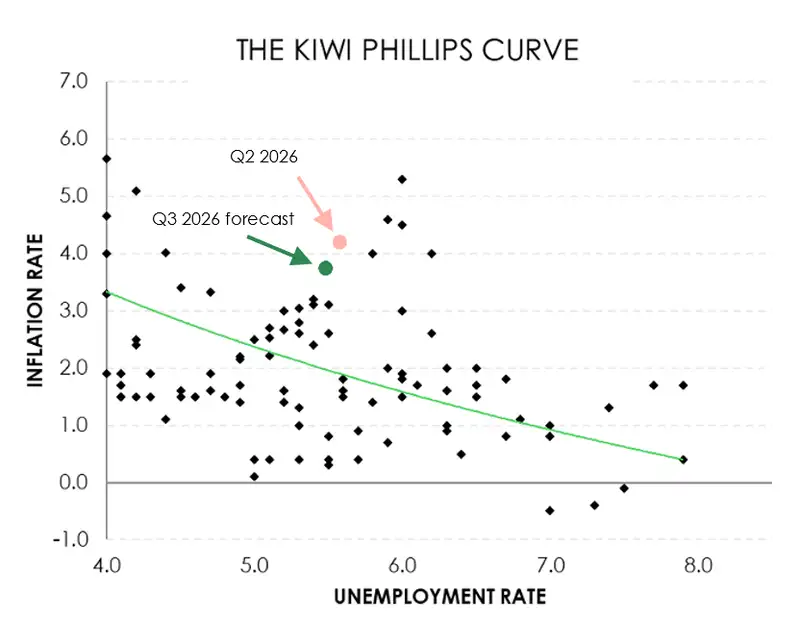
We have a high inflation rate in New Zealand, but it’s not being driven by domestic demand. Most importantly, we can see it’s not being reflected in the employment data. Wage growth is at 2%, with most wage increases sitting in the 1-2% range.
“To date, wage growth has been subdued, and medium-term inflation expectations have remained stable. However, core inflation measures have increased to around the top of the Committee’s 1 to 3 percent target band, and price increases have become more broad-based across the economy.” – RBNZ MPC.
When unemployment is high, we have “slack” in the labour market, that tends to be coupled with low inflation, that’s the Bill Phillips curve relationship. Why? Because wage costs are a large portion of business costs. When we have a lot of unemployment, business owners don’t need to put through huge pay rises to convince employees to stay, nor do they need to dangle as many carrots in front of new prospective employees to convince them to take a job. So, business costs don’t rise off the back of wage growth, and Kiwi employees have less money to take into the economy and spend, limiting demand for goods and services. In the current economic environment, that’s helping limit the pass through of the oil shock into the economy. Inflation is high… but not because we have increased wage growth in the economy. With this constraint, consumers have limited ability to increase their spending any time soon.
“Subdued growth in household spending is limiting the ability of some firms to pass on higher costs to restore profit margins. But the longer inflation remains high, the greater the risk of higher costs feeding into inflation expectations and price- and wage-setting behaviour, making inflation more persistent.” – RBNZ MPC.
Two Camps: Doves & Hawks
“All Committee members agreed on the overall outlook for inflation. However, members differed in how much weight they placed on various risks and the timing of the monetary policy response. The Committee agreed that tighter monetary policy is likely to be required but remains conditional on the economic outlook.” – RBNZ MPC.
The Reserve Bank's Monetary Policy Committee (comprised of the seven individuals who vote on interest rate decisions) are split into two camps. These two camps are broadly dovish and hawkish, respectively.
Four members, The Doves, favoured holding interest rates. These four members include Hansen, Williams, Gai, and Governor Breman. The other three members, The Hawks, favoured hiking interest rates. These members include Gourley, Conway and Silk.
The Doves are of the view that inflation in the September quarter was lower than expected. 3.7% versus the Reserve Bank's forecast from the September Monetary Policy Statement (MPS) of 3.9%. Pass-through of high fuel costs has been minimal to date. They don't see evidence of businesses expanding their profit margins in response to higher input costs, nor do they see materially stronger wage growth as a result of inflation this year. They place a lot of emphasis on weak domestic demand with household consumption flat, savings at unusually high rates, and the housing market subdued. This warrants pausing and assessing.
The Hawks focused on the stickiness of core inflation measures. The average of the core inflation measures is uncomfortably close to the upper limit of the Reserve Bank's 1-3% inflation target. Headline inflation remains well above target. This poses a risk that inflation expectations become entrenched at a higher level, which could lead to wage and price setting behaviour creeping up. So even though that hasn't happened yet, The Hawks want to be proactive in avoiding this occurring.
Critically, The Monetary Policy Review states that The Hawks believe that "This warrants an increase in the OCR to around the mid-point of the neutral range."
But that mid-point, as per the Reserve Bank's September MPS, is around 3.2%. Not 3.5%. Not 4%.
So even the most hawkish members of the Monetary Policy Committee believe that the OCR should be at 3 to 3.25%. That is aligned with the September MPS's, and our own, interest rate track.
Market Reaction
It must be said: the RBNZ effectively delivered what was outlined in September. They signalled a pause, and a very flat and gradual lift in the OCR track to 3% this year, 3.25% next year. The track remains 75bps below market pricing, and closing. Wholesale interest rates were poleaxed following the decision. The pivotal 2-year swap rate dropped from 4.12% to 3.98% at time of writing. And further falls are likely. The Kiwi currency lost a full cent against the Greenback, hitting 0.5585, before stabilizing around 56c. Against the Aussie, the Kiwi hit a low of 0.7955 and remains below 80c. We see downside risk to the Kiwi currency from here… wait until London gets “hold” of this news. The easing in financial conditions following the on hold statement will further support the Kiwi economy, at the same time adding a little to imported inflation. On the one hand… exporters love it. On the other hand… importers hate it.
All content is general commentary, research and information only and isn’t financial or investment advice. This information doesn’t take into account your objectives, financial situation or needs, and its contents shouldn’t be relied on or used as a basis for entering into any products described in it. The views expressed are those of the authors and are based on information reasonably believed but not warranted to be or remain correct. Any views or information, while given in good faith, aren’t necessarily the views of Kiwibank Limited and are given with an express disclaimer of responsibility. Except where contrary to law, Kiwibank and its related entities aren’t liable for the information and no right of action shall arise or can be taken against any of the authors, Kiwibank Limited or its employees either directly or indirectly as a result of any views expressed from this information.