The New Zealand economy is slowly recovering, but many businesses are still struggling to make it through the downturn.
Our chart this week compares new company incorporations against formal business failures, measured by company liquidations and receiverships. On one hand, entrepreneurial activity remains reasonably healthy, with company incorporations still sitting above their long-term average. On the other, insolvency activity continues to run well above normal levels, reflecting the lingering impact of weak demand, increased costs and squeezed cashflows.
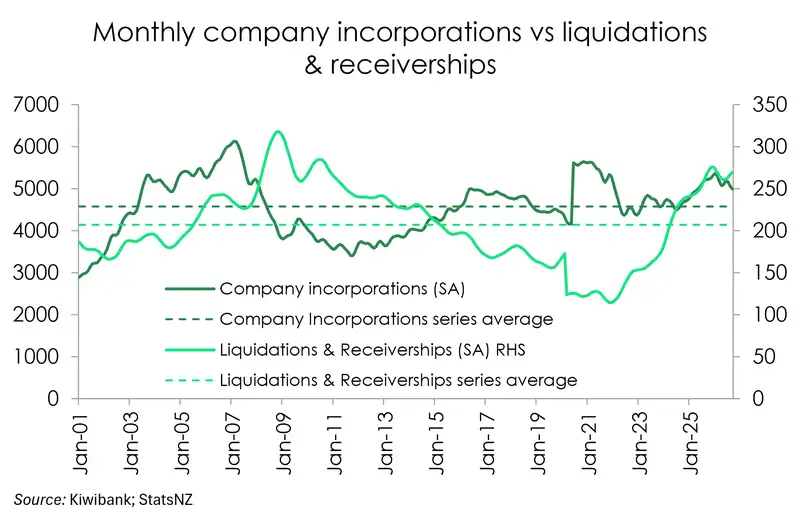
Companies Office data shows liquidations and receiverships have been trending higher over the past two years and remain elevated relative to historical norms. Meanwhile, incorporations have begun to drift lower after the surge seen through the pandemic and immediate reopening period.
The divergence highlights a key feature of the current cycle. Businesses are still being created at a healthy rate, suggesting confidence in New Zealand's long-run prospects remains intact. But existing firms continue to experience a hangover from several years of tough economic conditions that have plagued us since 2023, alongside rising operating costs and subdued household spending. Formal insolvency processes typically lag the economic cycle, often occurring well after trading conditions have deteriorated. That lag is still playing out today.
Importantly, elevated liquidations should not be interpreted as an economy-wide collapse. New Zealand continues to record far more company incorporations than formal insolvencies each month, and the overall stock of registered companies remains near record highs. The latest Companies Office statistics show more than 750,000 companies on the register, with new incorporations comfortably exceeding liquidations and receiverships combined.
Still, the rise in failures is a reminder that economic recoveries are rarely smooth. Many firms are only now confronting accumulated tax arrears, tighter credit conditions, and weaker revenue growth. Cashflow pressures, Inland Revenue enforcement activity, and persistent weakness in certain sectors such as construction and hospitality have kept business failures elevated even as broader economic indicators stabilise.
A sectoral divide is emerging. The Labour cost index has been persistently elevated for retail trade and accommodation despite persistently weak domestic demand. Construction firms have also faced high labour costs locked in from the boom years, weak residential building activity, and pressure on margins for fixed-price contracts.
Meanwhile, exporters are servicing a completely different market and finding demand strong. Increased costs are more evenly balanced against increased commodity prices and a weak Kiwi dollar. So, it all depends on which way a business is facing and the two-speed economy is not going anywhere fast.
All content is general commentary, research and information only and isn’t financial or investment advice. This information doesn’t take into account your objectives, financial situation or needs, and its contents shouldn’t be relied on or used as a basis for entering into any products described in it. The views expressed are those of the authors and are based on information reasonably believed but not warranted to be or remain correct. Any views or information, while given in good faith, aren’t necessarily the views of Kiwibank Limited and are given with an express disclaimer of responsibility. Except where contrary to law, Kiwibank and its related entities aren’t liable for the information and no right of action shall arise or can be taken against any of the authors, Kiwibank Limited or its employees either directly or indirectly as a result of any views expressed from this information.