

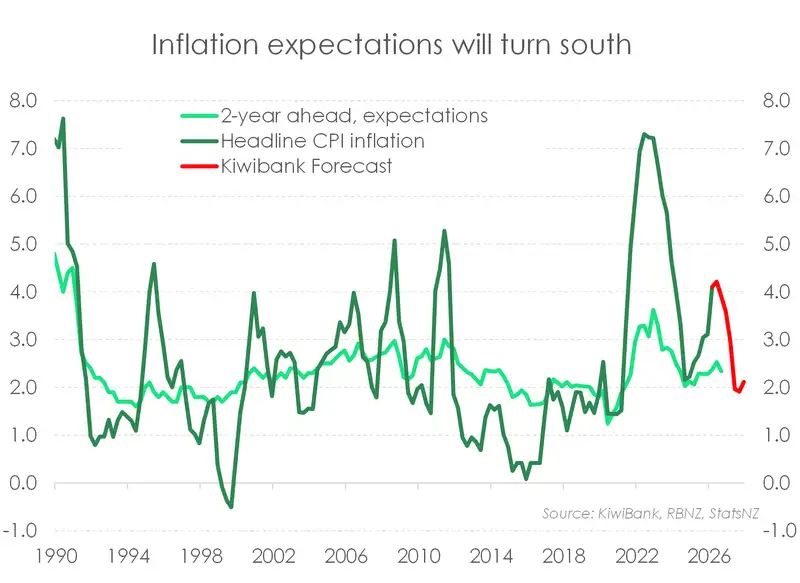
- Inflation expectations ease off and we celebrate the good news. The Reserve Bank has been laser focused on returning expectations to 2%, and things are heading that way fast. Rates are still likely to head to 3% by the end of the year, but the threat of more hikes is easing.
- Our manufacturing sector had a strong result for July. We are happy to see manufacturing continuing to perform above average.
- Net migration is positive, supporting the working age population. We have positive numbers for tourism too. The June 2026 year had the highest tourism numbers since 2019. It’s great news for closing that covid gap.

We are full of positivity this week. Trying to buck the pessimistic economist stereotype. We have some good news! Inflation expectations continue to ease. Last week we saw results from the Reserve Bank’s Survey of Expectations, which canvases forecasters, economists and industry leaders. These experts expect prices to return to a more moderate growth rate. The one-year ahead inflation expectations fell to 2.6% from 3.41%. The two-year ahead expectations fell to 2.34% from 2.53%. The Reserve Bank will be pleased with this movement, as expectations are well within its target band. The survey as it relates to households also showed some promise, with movement in the right direction there too.
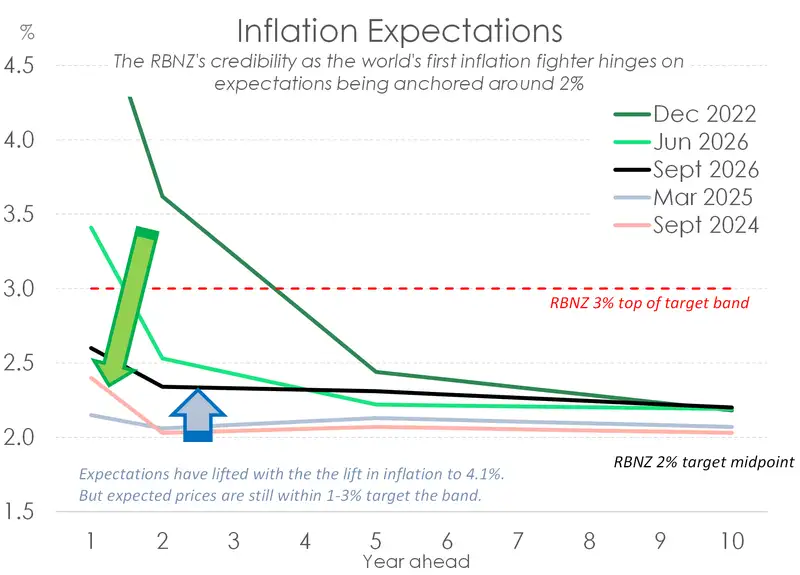
The Reserve Bank continues to emphasise that Middle East-related energy shocks are keeping near-term inflation elevated. Recent fuel price declines have provided some relief. The easing of inflation expectations is exactly what the Reserve Bank was hoping to see when they embarked on their hiking expedition. We still expect them to continue their path of hiking rates to 3%, but we now see more hope that they will hold there for the next year. Will 2027 finally be the year of recovery? We definitely hope so.
Some other positive news from over the weekend comes from our manufacturing sector, which is still showing strength. The BusinessNZ Performance of Manufacturing Index (PMI) fell to 54.3 in July, down from an upwardly revised 60.1 in June. This is still well above the survey’s long-term average of 52.5. This indicates a continuing expansion in manufacturing activity, albeit at a more moderate pace. The result suggests the domestic recovery remains intact despite interest rates going up and global uncertainty continuing to weigh on consumption.
But the positivity doesn’t end there. Stats NZ reported another month of positive net migration for the year to June. Migrant arrivals were up 1%, while departures were down 0.5%. Adults between 18 and 45 years old make up most of the migration flows, adding to our working age population. But it is a double-edged sword. An increase in our working age population can put upward pressure on the unemployment rate if jobs aren’t found (which is what we saw for the June quarter already). However, a larger population can also drive demand up and thus give Kiwi businesses a boost in challenging times.
Net migration for Kiwi passport holders is still negative. Kiwi are still flocking overseas (or over the ditch) in higher numbers than those heading back home.
Tourists are another story. Annual overseas visitor arrivals increased 9% to 3.67 million. That equates to 300 thousand more visitors this June than last June. With Australia and China making up over two-thirds of the increase. This makes it the highest year for traveller arrivals since 2019. We are inching closer and closer to our pre-Covid record.
These data point to continued population-driven support for consumption, labour supply and housing demand.
Looking ahead this week, we are expecting to see more positive news on consumption and selected business price indexes. We are also keeping our eyes peeled for the Global Dairy Auction overnight on Tuesday and Overseas Merchandise Trade on Friday.
Financial Markets
The comments below were provided by Kiwibank traders. Trader comments may not reflect the view of the research team.
Rates – Potential shifts in policy paths
Last week was interesting, despite some tight ranges early on, with the RBA decision Tuesday was the first highlight. Following the US CPI and PPI, and local data in the form of the RBNZ survey of expectations, and manufacturing PMI, all releases that could perhaps apply a little more of a bearing on monetary policy going forward. This against the background of what appeared to be a hardening of positions by both sides in the Gulf conflict. For the week, our curve looked to close lower, 2-year IRS at 3.62% (-5bp week on week), 5-year at 3.97% (-6bp w/w), and 10-year at 4.38% (-3bp w/w). The implied cash curve saw the year-end indicated slip under 3% at around 2.99% (-3bp w/w) or just less than two 25-point hikes, while H1 2027 was seen around 5bp lower than the prior week.
On the international front, the RBA left rates unchanged as expected though highlighted risks to inflation. They noted that cost pressures and price increases in the economy and that short-term measures of inflation expectations had eased but remained elevated. However, the market initially noted a slightly higher forecast unemployment track in the projections and the comment that policy was seen as somewhat restrictive, taking the view that this may be an indication that the RBA may be more inclined to hold steady going forward, reducing tightening probabilities as consequence. Following this on Thursday, Assistant Governor Kent spoke where he reinforced the board’s themes as set out in the statement, noting considerations regarding upside risks to inflation, however comments on how house price adjustments may affect consumer willingness to spend seemed to gain greater traction particularly given tax changes around property continue to make headlines. The RBA also announced on Friday a new member of the Monetary Policy Board with the new member seen as potentially softening the current composition a touch.
US July CPI data printed in-line with expectations at +0.1% headline and +0.2% core for July, followed later in the week by PPI that printed below expectation. These took on a bit more of a focus last week given the weaker general data prints of late and following reporting in the prior week that the Fed Chair was more amenable to raising rates if CPI printed strongly. The lower-than-expected reads saw the front of the curve move to further reduced priced tightening, with December Fed Funds futures gaining around 10-points over the week. Fed-speak continued to generally side on the hawkish, though importantly, the rotation of members needs consideration, particularly where 2027 voters remarks may be more neutral as was the case last week, which potentially may see the market push out priced tightenings.
Locally, before the week’s dataflow, PM Luxon confirmed that he had the support of caucus after a meeting on Wednesday. Thursday saw the release of the RBNZ’s quarterly survey of expectations (M14) which had taken on a higher degree of significance by the local market given the MPC focus around risks and signs that inflation expectations may start to embed, and obvious proximity to the next MPS. The survey showed a decline in the key 2-year ahead expectations with this falling to 2.34% from 2.53% seen in Q2. Market reaction saw the NZD immediately break lower while the rates market pared back tightening expectation, with year-end implied nudging just below 3% and H1 2027 below 3.40%. Friday saw the manufacturing PMI and another RBNZ dataset in the form of the household inflation expectations survey, known as the H1. The PMI survey printed a 54.3, lower than previous upwardly revised 60.1 though still solidly in expansionary territory. The afternoon saw the household inflation expectations release and while the market tends to apply more weight to the M14, a mean current perception of inflation at the household level of 7.6% still managed to generate a reaction, even though since the re-work of this survey in March 2022 persistently high current median prints is a theme. 1-year expectations did however print unchanged at 5.6% in Q3, while 2-year ahead was seen at 3.6% against 4.9% previously. Here while the outright levels may still pose concern for the RBNZ, the general direction of travel may at least provide some mild relief.
Noting the above for implications for policy, the recent run of softer US data, the RBA comments including those around potential impacts of housing on consumers and changing board composition, local data in the form inflationary expectations showing containment in the M14 and the H1 at least headed the right direction, may see markets generally test trading a more cautious or deferred policy path, at least in the near-term. For our market, as noted previously, our view was that data flow of late was supportive of a measured RBNZ tightening approach scenario, as such we viewed that the market was potentially at risk of being over-priced at more than two hikes by year-end. This week’s data continues to support that view and potentially may trade a little further lower through the 3.00% year-end central case. This may add some more interest to the front of the curve, particularly where timing of moves and the time between meetings can have a large impact on front-end carry. Again, within the context of the current tightening cycle, some shorter-term accrual-type received positions, or those with a forward-start element, either outright or on a spread basis that benefits from some roll-down the curve while providing some insulation from outright moves, may continue to see interest. As we would note, trading sentiment remains vulnerable to rapid changes in the geopolitical environment and/or shifts in the data, so views will need to be reassessed as these unfold. Graham Hughes, Trader – Financial Markets.
In FX – the NZD finished little changed last week
The NZD spent last week being pulled between softer New Zealand inflation expectations and mixed local data on one side, and a weaker USD driven by softer US inflation and lower yields on the other, leaving the Kiwi largely range-bound between 0.5850 and 0.5900. Earlier in the week, USD strength pressured the Kiwi as investors sought safe-haven assets and maintained a cautious outlook. Domestic data was light but generally softer, with the New Zealand manufacturing PMI falling sharply in July to 54.3 from 60.1, raising questions about the strength of the economic recovery. Labour market data released the previous week also pointed to emerging spare capacity, reinforcing the view that growth remains uneven.
Later in the week, New Zealand inflation expectations eased, with the RBNZ's two-year measure falling to 2.34% from 2.53%, reducing some of the urgency for further policy tightening. This saw the Kiwi briefly dip to 0.5830. However, the move proved short-lived, as markets continued to price a relatively firm RBNZ stance and the possibility of another OCR hike, which helped limit further NZD downside. Softer US inflation signals later in the week led investors to scale back expectations of additional Fed tightening, weighing on US Treasury yields and the US dollar. This allowed NZD/USD to recover from its lows and finish the week at 0.5891.
For the NZD/AUD cross, the RBA was a key driver. The cross moved higher as the market interpreted the RBA's messaging as less supportive for the AUD than the RBNZ outlook was for the NZD. Ongoing uncertainty around Chinese growth and mixed commodity price performance also limited demand for the AUD, amplifying the move higher in NZD/AUD. The cross closed the week at 0.8317 after a brief dip to 0.8268 following the release of the RBNZ inflation expectations survey.
Looking ahead, the key drivers for the NZD this week will be China's activity data, the FOMC minutes, and Australia's employment report, with the latter likely to be the most important event for NZD/AUD direction. On Monday locally we have the Selected Price indexes for July. Mieneke Perniskie – Senior Dealer, Financial Markets.
The week's key events
- Domestically, we have a big week with Electronic Card Transactions (July) and Selected Price Indexes (July) out today (Monday). Population estimates for June are out on Tuesday. We get Business Price Indexes on Wednesday, and Overseas Merchandise Trade Friday. We are also looking out for the Global Dairy Auction overnight on Tuesday.
- Across the ditch, The Reserve Bank of Australia has their labour market data out this week. The Market and RBA will have their eyes peeled for any slack that can help take pressure of inflation.
- The US housing data will be interesting, but all eyes will be on the FOMC Meeting Minutes, which will be released later in the week.
All content is general commentary, research and information only and isn’t financial or investment advice. This information doesn’t take into account your objectives, financial situation or needs, and its contents shouldn’t be relied on or used as a basis for entering into any products described in it. The views expressed are those of the authors and are based on information reasonably believed but not warranted to be or remain correct. Any views or information, while given in good faith, aren’t necessarily the views of Kiwibank Limited and are given with an express disclaimer of responsibility. Except where contrary to law, Kiwibank and its related entities aren’t liable for the information and no right of action shall arise or can be taken against any of the authors, Kiwibank Limited or its employees either directly or indirectly as a result of any views expressed from this information.