

Our COTW looks beyond the headline softness in August card spending and into a quieter trend developing underneath. New Zealanders are increasingly reaching for the credit card instead of the debit card, with the credit share of total card spending climbing to a fresh high.
August's electronic card spending data was a little disappointing on the surface. Total seasonally adjusted spending fell 0.9% over the month, unwinding some of July's gains as spending weakened across hospitality, durables, apparel and consumables. Annual growth slowed to just 0.2%, the weakest result since late 2025.
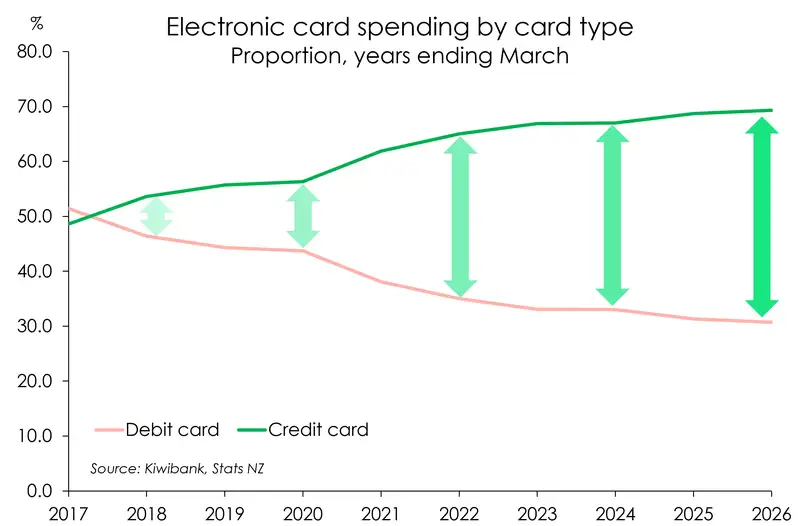
Beneath the monthly volatility sits a more interesting story. Credit cards accounted for 71.1% of the value of card transactions in August, while debit cards made up just 28.9%. That's the highest credit card share in the history of the series which began in 2002 and a sharp shift from a decade ago when spending was split much more evenly between credit and debit. In the year ended March 2017, credit cards made up less than half of all card spending. Today, they're responsible for more than seven out of every ten dollars spent on cards.
The move tells us something about how households are navigating the recovery. Consumer confidence has improved, but the labour market remains soft, and climbing interest rates are not supporting spending. Households are still emerging from a period of intense cost-of-living pressure. The growing reliance on credit suggests that many consumers remain cash-strapped.
A 2024 report by Worldpay notes that credit cards have become more popular in New Zealand in recent years. They link this to cost-of-living pressures which were particularly acute in the immediate aftermath of COVID. The acceleration of the divergence between the two lines on the chart after 2020 reinforces this story.
When real incomes were squeezed by high inflation in 2022-24, households ran down their savings. This led many Kiwi to turn to credit cards to help smooth out their spending.
But the shift need not be all doom and gloom. The narrative that Kiwi households are increasingly living beyond their means requires some push-back. Some of the lift in credit card spend may reflect the attraction of rewards programmes, travel points and cashback offers. But the persistence of the trend, particularly over the past two years, points to a broader behavioural shift. Credit cards are no longer just another plastic card among countless others in your wallet. They're increasingly becoming the preferred way to fund day-to-day spending.
For now, the rise in credit card usage doesn't signal stress on its own. But it is a trend worth watching. The recovery in spending is not yet underway. And a growing dependence on credit rather than debit, suggests that consumer confidence may be returning faster than cash buffers are rebuilding.
All content is general commentary, research and information only and isn’t financial or investment advice. This information doesn’t take into account your objectives, financial situation or needs, and its contents shouldn’t be relied on or used as a basis for entering into any products described in it. The views expressed are those of the authors and are based on information reasonably believed but not warranted to be or remain correct. Any views or information, while given in good faith, aren’t necessarily the views of Kiwibank Limited and are given with an express disclaimer of responsibility. Except where contrary to law, Kiwibank and its related entities aren’t liable for the information and no right of action shall arise or can be taken against any of the authors, Kiwibank Limited or its employees either directly or indirectly as a result of any views expressed from this information.