
- The Reserve Bank hiked the official cash rate from 2.5% to 2.75%. We disagree with the move. We would have preferred them to hold. But we are happy that they are looking at the future through a more dovish lens.
- New Zealand’s exports continue to perform well due to strong global demand for meat and dairy. This strength was offset by the sky-high fuel import prices which sent New Zealand’s terms of trade plummeting by 9%.
- The construction industry is finally showing signs of life. The June 2026 quarter had the strongest growth in building work put in place since September 2022 and follows nine quarters of year-on-year decline.
Last week’s Reserve Bank decision left us feeling positive, despite the hike. The increase to the official cash rate (OCR) from 2.5% to 2.75% was expected. We were itching to see what the future track would look like.
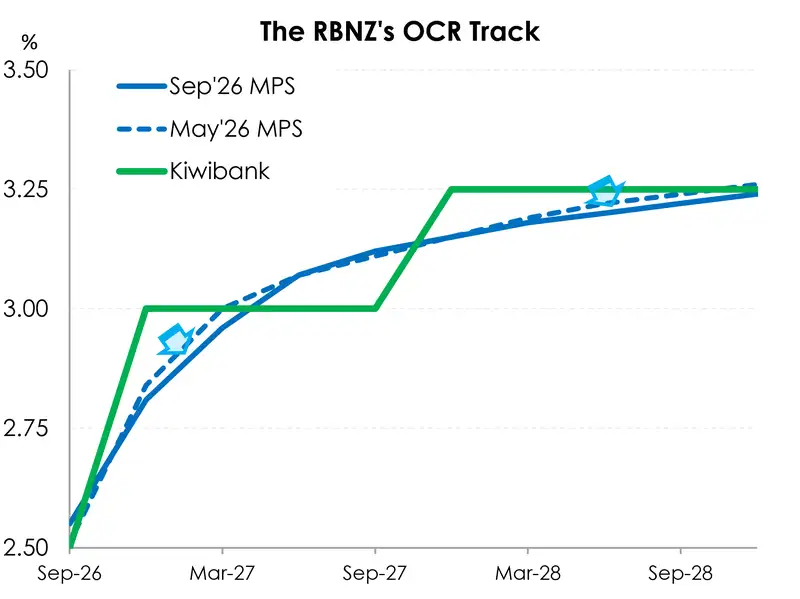
The OCR track is little changed from May. However, the likelihood of an October hike is lower than it was in May. This was affirmed in the Governor’s commentary conveying a preference for waiting and seeing. We like that.
Yes, the end point is the same at 3.28%. And no, the possibility of an October hike is not completely off the table. But the preference for waiting to assess the impact of the 50 basis points of hikes in July and September, is wise. The RBNZ’s hope is that a gradual removal of monetary stimulus will return inflation to the target band, without plunging the economy into an even deeper downturn. In particular, the Committee noted that the economic recovery has been concentrated in certain regions. Especially those that export a lot of dairy, meat, and tourism. See our recently released regional note for Kiwibank’s analysis on this topic.
A full economic recovery can’t be driven by exports alone. Consumer spending makes up almost half of GDP. The Reserve Bank is optimistic that Kiwi shoppers will loosen their wallets, and both strengthen and broaden the economic recovery.
June quarter trade data revealed that the price of our exports relative to our imports, fell by 9%. This reflects a significant jump in import prices driven by a 79% increase in the cost of fuel imports. Strong export prices (especially meat and dairy) softened some of the blow. The data shows that Kiwi have responded by buying less fuel. While the value of fuel imports increased by 63%, fuel import volumes were down 9% over the quarter.
The construction industry turned a new leaf. Building work put in place rose by 4.8% over the June quarter (seasonally adjusted) and 5.2% over the year to June (actual). Residential construction was particularly strong, which is the best indicator of construction industry performance. The quarterly print is the strongest since September 2022. The annual print is the strongest since June 2023. However, this does follow nine consecutive quarters that had negative annual growth. We’d like to see this trend continue for a few quarters yet before we put on our party (hard) hats.
Bond yields internationally are on the up-trend. US 10-year Treasury yields have moved close to 4.8%, while 30-year yields have risen over 5.2%, the highest levels since the early 2000s. Japan's 10-year government bond yield has moved above 3%, a level not seen in the last three decades. And the story repeats for the German Bund and UK gilt yields, which have also risen to multi-year highs. Investors are demanding higher compensation to lend money to governments for long periods. The larger "term premium" is because investors are seeking compensation for inflation uncertainty, fiscal risks, and long-duration exposure. There is also a seismic shift in the demand for longer-term yields, as employer guaranteed pension funds go out of fashion around the world. This has led to a recent shift in pension investing away from fixed-income securities and towards riskier and less liquid assets.
Financial Markets
The comments below were provided by Kiwibank traders. Trader comments may not reflect the view of the research team.
In Markets - RBNZ MPS the highlight
It was finally the turn for local news to set the tune for our markets, switching places with international developments, with the RBNZ MPS scheduled for mid-week. International developments still played a role, for instance there continued to be reaction to the Fed Chair’s Jackson Hole opening and some subsequent Fed-speak later in the week Australian Q2 GDP also on the same day as the MPS, a firming of BoJ expectations and some USDJPY moves, alongside the continuing events in the Gulf. Overall, the backdrop internationally was for firmer tightening paths while locally the RBNZ appeared to take a cautious approach. For the week, our rates curve was seen mildly higher, with 2-year IRS at 3.73% (+3bp week-on-week), 5-year at 4.10% (+4bp w/w), and 10-year at 4.49% (+4bp w/w), while the implied OCR path was seen lower at the front with year-end expectations at 3.01% (-5bp) and one-year out at about 3.49% (-1bp).
As noted, the follow-on from the firm tone adopted by the Fed Chair continued to weigh a little on our market at the start of the week as did local business confidence data that beyond the headline dip noted a lift in pricing and inflationary expectations. RBNZ day did see continued pressure on yields, which started to have a one-way feel to them in the lead up to the announcement that was further topped up by a stronger Australian GDP print just a half-hour ahead of the policy decision. OCR sensitive 1-year IRS having tracked to the mid-3.50%’s immediately prior having closed the prior day at 3.48%, while year-end implied cash had lifted to around 3.11%. The RBNZ lifted the OCR to 2.75 as was priced and expected by the market, however the largely unchanged projected OCR track since the May MPS did underscore a statement that was more tentative than market had expected. Within the projections there was also an element of nuancing of timing evident, with a small dip versus May in the Q4 average OCR for the current MPS indicating a more likely December move – something that was reinforced by Governor Breman the following day at the Finance and Expenditure Committee, and further in an interview on Friday with comments by Assistant Governor and MPC member Karen Silk. We had previously indicated that the October-December timing may be of interest, especially against a firming global backdrop where perhaps there was the risk to near-term pricing being a pull-forward – something the market had been cognisant of with recent moves to lift October probability, however the statement and subsequent comments have seen the implied curve move to push the larger probability shifts into Q2 and beyond. The 1-year ahead OCR sitting near unchanged on the week at or around 3.50%. Against the MPS projections, Q3 and Q4 2026 would appear in-line, with market implied at 2.55% and 2.85% against projections of 2.55% and 2.81%, while the gap starts to widen out into Q2 and Q3 2027 with market at 3.34% and 3.47% against 3.07% and 3.12%.
As noted, international developments still played a role last week, with the Australian GDP released just prior to the MPS printing firmer than expectation at +0.4% Q2 and +2.1% y/y. Response in their market was to further increase priced probability of additional RBA moves, with their curve looking at one stage for 4.80% cash – some 45-points above current. As would be expected the divergent moves in the projected pathways did apply further pressure to the NZDAUD. The US curve having traded higher post Warsh the prior week did see a reprieve on some reported comments from Fed Governor Waller. Here he noted that recent data would suggest that they are finally seeing some disinflation feed through, and if that were to continue, he would be inclined to be supportive of a hold. The comments saw Fed Funds futures rally on the day by around 5-6-points in the 2027 dates indicating a reduction in the priced Fed Funds rate. However, a firmer US payrolls print with prior period upward revisions on Friday did see this unwound to a degree, with Fed funds pricing one-year ahead finishing the week at 4.23% or 60-points above the current effective rate.
Looking forward, certainly with our MPC erring on the side of caution, and noting that a majority of members did see that there may still be risks around the inflation outlook, this may see data with a pricing element, such as the survey-type data, have a little more significance placed on it. With that said, this may reflect more so in the 2027 path with the market likely taking the near-term projections as the base case for the remainder of the year. This will also potentially see the latter parts of the short-curve a little more susceptible to global policy directions, where the firming global backdrop may start to pull or apply a little more influence. Here also the debate on projection materials by central banks may also be of interest, with the thought that current approach of detailed forward projections may actually inhibit the transmission of important market signalling on the state of the economic environment, with markets constraining their trade to align with guidance. In this environment, potentially those sorts of run down the curve type trades may continue to see interest, including the short forward start spreads like 1and 2-year one year forward start, or even shorter dated accrual type trades that within reason provide a degree of insulation to global swings in longer dates, particularly as the current global trend is to that of likely higher rate paths that will most likely draw out the pay-side. Graham Huges – Trader, Financial Markets
In FX – the slightly dovish rate hike saw the Kiwi lower
The NZD was already under pressure heading into the MPS, having lost ground over the previous week as renewed Fed tightening expectations drove a +0.9% rise in the DXY and pushed NZD/USD from around 0.5976 to 0.5913. Against that backdrop, the RBNZ's relatively unchanged OCR track failed to provide the hawkish surprise needed to offset broader USD strength, leaving the Kiwi vulnerable to a further extension lower.
NZD/USD took the MPS as a modest disappointment. After trading near 0.5915, the Kiwi fell to a low of 0.5830 before extending the drop to 0.5806. As the US dollar softened ahead of the US non-farm payrolls release, the Kiwi recovered to a high of 0.5897 before closing the week in New York at 0.5881.
While the RBNZ delivered the expected 25bp hike, the OCR track failed to validate the more aggressive tightening profile priced into markets, prompting an unwind of rate support for the currency. This came against an already challenging backdrop for the NZD, with stronger US economic data and hawkish Fed rhetoric driving a broad USD rally over the preceding week. The focus now shifts to whether 0.5850 can hold, with a break opening the door towards the 0.5807 50% retracement level.
Friday's US non-farm payrolls report was materially stronger than expected, with payrolls rising +162k versus market expectations of around 55k, helping to reinforce recent USD strength. The DXY recovered from the weeks low of 98.87 to finish at 99.16. Looking ahead, the key theme for markets this week is whether incoming inflation data validates the increasingly hawkish Fed pricing that was reinforced by Friday's strong payrolls report. The major event will be the US CPI release, while the ECB policy decision will also be closely watched by markets. Mieneke Perniskie – Senior Dealer, Financial Markets.
The Week's Key Events
- This week we don’t have a lot of data to scrutinise. We get local authority statistics on Monday and business financial and business employment data for the June quarter on Tuesday. We will also get some data on manufacturing activity and manufacturing PMI.
- Internationally, the US will publish PPI, CPI and housing data.
- The UK and Japan will publish GDP data and the EU will publish GDP and employment. While the ECB has a rates decision. China has trade, PPI and CPI data in the week ahead.
All content is general commentary, research and information only and isn’t financial or investment advice. This information doesn’t take into account your objectives, financial situation or needs, and its contents shouldn’t be relied on or used as a basis for entering into any products described in it. The views expressed are those of the authors and are based on information reasonably believed but not warranted to be or remain correct. Any views or information, while given in good faith, aren’t necessarily the views of Kiwibank Limited and are given with an express disclaimer of responsibility. Except where contrary to law, Kiwibank and its related entities aren’t liable for the information and no right of action shall arise or can be taken against any of the authors, Kiwibank Limited or its employees either directly or indirectly as a result of any views expressed from this information.