

- This week, we expect to see the Reserve Bank hike the official cash rate at their September meeting, from 2.5% to 2.75%. We disagree with the move, the economy is still too soft for a hike.
- Some areas of the economy are faring better than others. Exporters have seen good support from strong commodity prices and demand from our biggest trading partners. That hasn’t translated into domestic demand, or wage growth for regular Kiwi.
- The drag on the economy is being felt most strongly in the construction sector. A sign of recovery is showing up in the data, with ready-mixed concrete volumes increasing by 3.7 percent in the year to June.
We don’t have a lot of new Kiwi data to speculate on from last week. And our focus this week is on the Reserve Bank’s monetary policy statement out Wednesday.
We expect the RBNZ to continue hiking the cash rate from 2.50% to 2.75%. But don’t get it twisted, we don’t think it’s the right move, just the most likely one. We have an uneven recovery and cost pressures are hurting regular Kiwi.

The price hikes in food, electricity, rates, insurance and many others, continue to frustrate businesses and restrain households. Business and household incomes are not keeping up with the cost of these essentials. Businesses are struggling to pass on their higher costs to the already cash-strapped consumer. Margins are being squeezed.
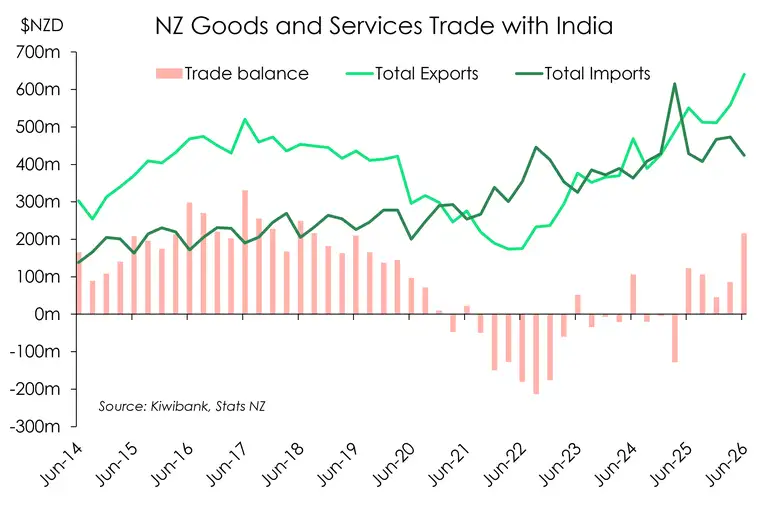
The story is a lot rosier for our exporters. Our main trading partners have strong demand, and the relatively weak Kiwi dollar has supported the export industry.
One new piece of data came from the NZ Retail Trade Survey. The total volume of sales was down 0.5% compared to the March quarter, but the value of spending was up 0.9%. Consumers are spending more and receiving less. The silver lining? Most of that was driven by fuel. Fuel retailing showed a nearly $300 million increase in sales value, and a more than 185 million decrease in volume.
Stats NZ's July employment indicators were released on Friday and provide the latest signal on labour market conditions. Employment remains soft by historical standards, consistent with earlier readings showing an economy operating below potential. However, the proportion of filled jobs are up 0.3% in July relative to June and 0.8% relative to July 2025. The growth is driven mostly by primary industries, goods-producing industries and services. Income data also printed on the stronger end. All wages and salaries were up 2.7% in the year to June 2026. It’s important to note that median weekly income from all sources has been tracking sideways for three years in a row now.
We have a recovery that’s building beneath the surface of the economic ocean. A few sectors have commandeered submarines and are chugging along just fine. The agri sector, especially meat and dairy exporters, are having the time of their lives. Strong commodity prices and a weak Kiwi dollar have been supportive, as well as demand from China and the US.
We’ve had an increased number of council consents (driven by the Incentives for Growth Fund). But those consents are yet to translate into building work actually being put in place. The March quarter data showed a decline. There’s hope for the June quarter, with seasonally adjusted ready-mixed concrete volumes increasing by 3.7 percent in the year to June.
Overall, the economy is soft, there is substantial slack in the labour market and wage growth is contained. We disagree that this is the right time for the Reserve bank to hike, but we must prepare for the inevitable.
Financial Markets
The comments below were provided by Kiwibank traders. Trader comments may not reflect the view of the research team.
In Markets - International drivers again...
Last week, in the lead-up to the RBNZ MPS, our market again took its cue from global markets, with Australian CPI and the central bank symposium at Jackson Hole key focal points. Oil markets continued to edge lower over the week as there appeared to be some small optimism around progress and as volumes shipped through the Strait continued to lift. For the week, our curve was seen higher and flatter, with the 2-year IRS marked at 3.70% (+3bp week-on-week), 5-year at 4.06% (+2bp), and 10-year at 4.45% (unchanged). The front of the curve moved to increase the priced tightening, with the year-end implied rate nudging 3.06%, while our one year was seen near 3.50%.
With the RBNZ due on 2 September and a distinct lack of solid local data, the start of the week saw our rates curve cycling between lower and higher, waiting for Australian CPI after the RBA minutes failed to really deliver any new insight over and above the last policy statement. The mid-week release was seen as particularly significant given the continued firm stance on inflation taken by the RBA, both in its last statement and by the various board members' speeches since the decision to hold rates earlier in the month. The July data printed firmer than expected, with the month-on-month figure lifting by 1.0% against 0.9% expected, while the annual measure was seen at +3.5% against +3.3% expected, with the annual core trimmed-mean figure also exceeding expectations at 3.6%.
The reaction was not limited to rates markets, with the AUD jumping from around 0.7160 to the mid-0.7180s after the release, while the NZD, in an unusual move, dropped from the mid-0.5970s to around 0.5960 rather than following the AUD higher as would usually be expected. The trigger for the move derived from AUD/NZD, which pushed higher through key levels around 1.20, with this diverging performance also being, in part, the result of the Australian curve moving to more rapidly reprice tightening probabilities by the RBA than our curve. Their market lifted the implied pricing of another hike to above 90% from around two-thirds prior to the release on the day, and continued to ratchet higher over the remainder of the week, finishing with an implied cash rate peak of around 4.68%, or one and one-third hikes. As would be expected, this weighed on our curve, pressuring the near-term path higher, which wasn't helped by consumer confidence data on Friday showing a tick higher in inflation expectations.
As noted, markets were also paying additional attention to the upcoming central bankers' conference at Jackson Hole, where Fed Chair Kevin Warsh was set to deliver the opening remarks in what was viewed as his first major address outside of delivering policy decisions since taking the helm at the Fed. The address attracted some additional scrutiny for indications on Fed direction or signalling, given the pullback from forward guidance, mixed data flow of late, continuing firm commentary from various FOMC members, and the attention on the shape of the curve by the US Treasury the week earlier. As delivered, the Fed Chair toed a firm line on inflation, reiterating that inflation was the priority and that more work may have to be done if it was not meaningfully moving back towards the 2% target. He added that the economy appeared to have strengthened and further indicated that rates may not be restrictive enough. On the matter of forward guidance, he noted that it was introduced during the GFC and was essential at the time but has now outstayed its welcome. He added that the role of forward guidance should be limited, as oversharing policy deliberations and overcommitting to future decisions can lead markets, businesses, and households astray. Market reaction saw a swift reassessment of the likely Fed path, with futures implying around 60 points of tightening over 12 months, while the bond curve was higher and flatter: 2-year notes at 4.35% (+11bp), 5-year at 4.48% (+8bp), and 10-year at 4.72% (+1bp).
This week, the focus for our market will be the RBNZ MPS on Wednesday. As we noted last week, while the September meeting is priced with a near certainty of a 25-point hike, this will not detract from the meeting, as the timing of potential future moves is still in play. Will the recent international developments, notably curve moves across the Tasman post-CPI and in the US following Jackson Hole, result in a little more pressure on the RBNZ to deliver the as-priced 3.00% by year-end sooner? Currently, October pricing is seen at roughly a half-chance, at around 2.88%. The current implied path for Q3 and Q4 does reasonably align with the May MPS projections, while Q1, Q2, and Q3 2027 are seen around 14bp, 28bp, and 35bp above the last projection, so there will also be interest as to whether the new projections adjust to meet the market or if a sooner-priced October move sees a lower projected peak, as has been discussed previously. As we noted last week, local data flow and currency developments would likely support a measured approach to tightening, with a 3.00% cash rate at year-end likely a reasonable fit with this scenario, though this may now have to contend with a global rates view that may be swinging harder towards a tighter rate path scenario. Graham Huges – Trader, Financial Markets
In FX – the RBNZ decision and US payrolls data are the next key drivers for NZD direction
After breaking higher the previous week, the NZD lost around 1.1% against the USD as hawkish Fed commentary and higher US yields fuelled a broad-based US dollar rebound. NZD/USD started the week near 0.5980 and briefly pushed towards 0.5990 before renewed USD demand emerged, leaving the Kiwi to finish Friday at 0.5913.
The key driver was a recovery in the US dollar following Jackson Hole, with markets reassessing the outlook for US interest rates and the USD Index gaining nearly 0.9% over the week. While the Kiwi had been one of the strongest-performing G10 currencies in recent weeks, breaking above key technical resistance and a multi-year downtrend, the shift in sentiment towards the USD ultimately overshadowed the NZD-positive narrative.
Expectations for a further 25bp OCR increase from the RBNZ this week provided some support and likely limited the extent of NZD weakness. Nevertheless, the Kiwi underperformed the AUD, with NZD/AUD falling from around 0.8330 to 0.8280 as the Australian dollar proved more resilient, supported by relatively firm domestic data, particularly the slightly higher than anticipated Aussie July CPI print.
Attention now turns to the RBNZ Monetary Policy Statement and OCR decision on Wednesday at 2:00pm NZT. Alongside the rate decision, markets will closely scrutinise the updated forecasts, OCR track and Governor's commentary for clues on the pace and destination of future policy moves. As the expected OCR increase is largely priced in, the market reaction is likely to be driven by the RBNZ's forward guidance. A higher OCR track and firmer inflation outlook would be supportive for the NZD, while a more rapid move towards neutral settings could weigh on the currency.
In the US, attention will focus on the ADP employment report, ISM Services PMI and, most importantly, Friday's non-farm payrolls and unemployment data. With RBNZ preceding a key US labour market report, the week is packed with event risk and will likely determine whether the NZD can regain momentum following last week's USD-driven sell-off. Mieneke Perniskie – Senior Dealer, Financial Markets.
The Week's Key Events
- It’s a big week in New Zealand with the September Monetary Policy Statement from the Reserve Bank due on Wednesday. We expect the RBNZ to lift the official cash rate from 2.5% to 2.75%. Other data out this week includes value of building work put in place & international trade in the June quarter, as well as building consents and livestock slaughtering for the month of July.
- Across the ditch, we’ll be watching for GDP-related indicators ahead of upcoming national accounts.
- In the US we are keeping an eye on Nonfarm Payrolls (Friday). A soft labour market outcome would ease pressure on the Fed; another upside surprise would increase tightening expectations.
- The Bank of Canada is set to hold rates steady at their Wednesday meeting for the fourth meeting in a row (2.25%).
All content is general commentary, research and information only and isn’t financial or investment advice. This information doesn’t take into account your objectives, financial situation or needs, and its contents shouldn’t be relied on or used as a basis for entering into any products described in it. The views expressed are those of the authors and are based on information reasonably believed but not warranted to be or remain correct. Any views or information, while given in good faith, aren’t necessarily the views of Kiwibank Limited and are given with an express disclaimer of responsibility. Except where contrary to law, Kiwibank and its related entities aren’t liable for the information and no right of action shall arise or can be taken against any of the authors, Kiwibank Limited or its employees either directly or indirectly as a result of any views expressed from this information.