
- NZIER’s Quarterly Survey of Business Opinion (QSBO) tells a tale of divergence. Businesses did it tough over the September quarter. Yet optimism about the future is at its healthiest level since 2014.
- The September quarter was plagued by weak demand. While that helped keep a lid on inflation, businesses suffered as a result. Businesses reported low levels of trading activity over the quarter.
- Easing cost and pricing indicators suggest that the risk of inflation is also easing. The net percent of firms that increased prices fell from elevated levels in June. And pricing intentions are back to the long-run average. It sounds surprising given pricing pressures, but reflects weak demand in the economy at large.
Despite a tough September quarter (we’re getting déjà vu), businesses are the most optimistic about the future since 2014. A net 40% of businesses are expecting better economic conditions over the coming months, up from the net 14% in the June quarter.
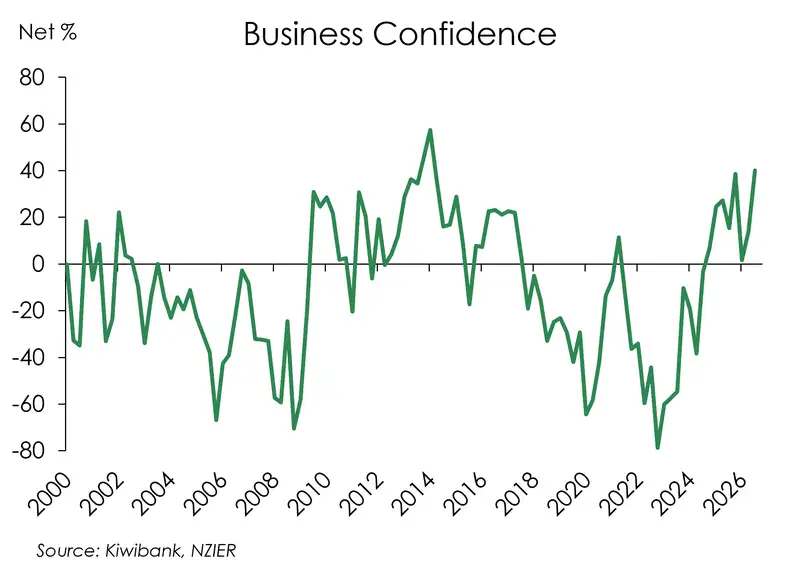
“A net 10% of businesses expect an increase in activity over the coming months, down from 13% in March. This suggests underlying domestic demand is weak.” Is what we wrote after last quarter’s QSBO. While the numbers this time round have started tracking in the right direction, we find ourselves needing to recycle that line about weakness in domestic demand.
That softness in demand is something we’ve written about extensively. A subdued housing market, slack job market, and strained household budgets have weakened demand. This is reflected in the QSBO’s domestic trading activity measure, which captures self-reported business activity. Domestic trading activity fell over the September quarter, with a net 1% of businesses reporting a decline in activity versus a net 1% reporting an increase in the June quarter.
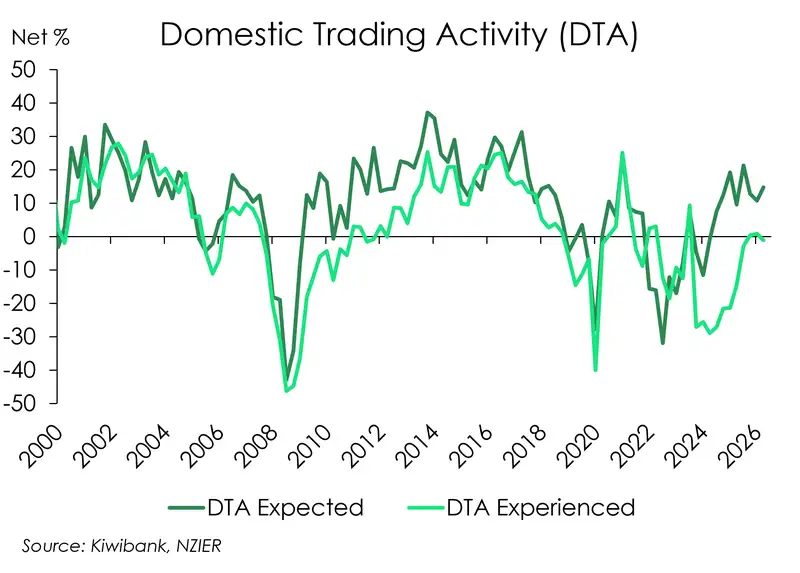
Although trading activity was weaker in the September quarter, businesses are expecting better months. We expect this poses a downside risk for September quarter GDP, but signals a more material improvement in the December quarter and into next year. We like it.
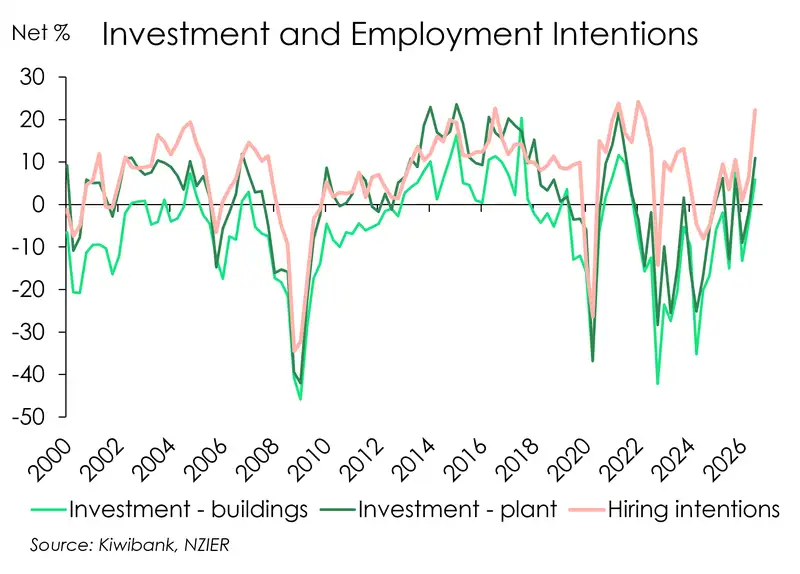
The weak activity but buoyant optimism suggests Kiwi businesses are gritting their teeth and getting on with it. Future investment and hiring intentions have lifted, further signalling optimism about better times ahead. Businesses are looking to invest in new buildings, plants and machinery in the months ahead. They’re also looking to hire more workers. Welcome news given the most recent labour market statistics.
Cost and pricing pressures across the economy are easing. With relatively weak domestic demand, businesses have struggled to pass on costs. While this has eaten away at profits, it has insulated households from even higher inflation.
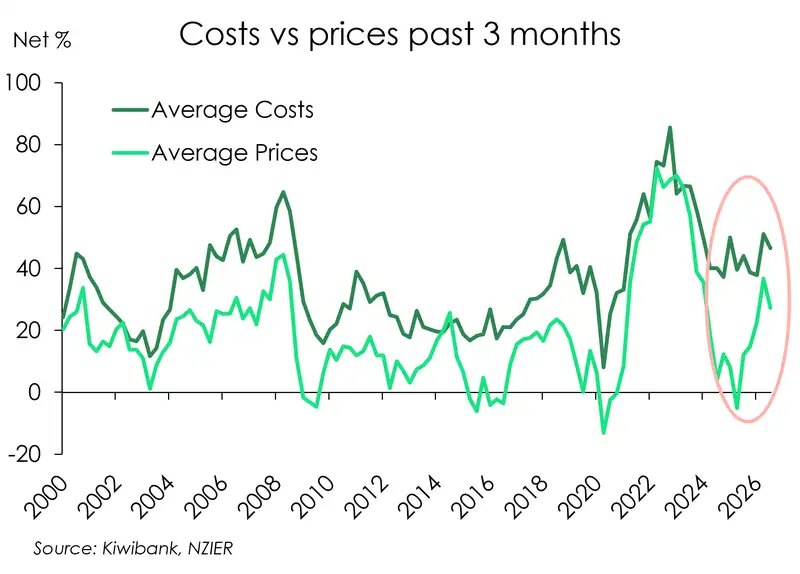
Average prices eased off from elevated levels, likely driven by a fall in oil prices across the September quarter. This offered relief to both businesses and consumers. Expected future costs also eased. This means businesses are expecting cost pressures to ease, and to hike prices more slowly as a result. Both are encouraging and suggest inflation risk is relatively contained. That’s key to the outlook for interest rates.
The retail sector is now the most optimistic of all sectors surveyed. Huh? Strange considering that retailers generally reported weak sales and new orders in the September quarter. Optimism also lifted in the building sector off the back of stronger demand and a moderation of cost pressures. But the sector still had to absorb significant cost increases over the past few months, negatively impacting profitability. The pipeline of future construction work is also moderate, at best.
Capacity utilisation edged slightly higher, up from 90.8% in the June quarter to 91.0% in the September quarter. Still above the long-run average of 89.6% but below the March rate of 91.2% (capacity utilisation data not s.a). The lift in September was driven primarily by the manufacturing sector.
A net 8% of firms reported capacity being a constraint, down from a net 16% in the June quarter and sitting essentially in line with the long run average of 9% (capacity constraint data not s.a). The main issue facing businesses was weak demand. Lack of sales was identified as the key constraint businesses faced.
There are growing signs that spare capacity in the labour market is being chipped away at. Businesses reported more difficulty finding both skilled and unskilled workers than in the June quarter. While some labour was shed over the September quarter, businesses are much more optimistic about future hiring. That suggests labour market statistics for the September quarter will look similar to June, before improving in the December quarter and into next year.
The optimism of Kiwi businesses makes us happy. And it broadly aligns with what we’ve been hearing from businesses across the motu.
However, we do think there is a risk that the optimism is too heavily conditional on an assumed rapid improvement in domestic demand. That improvement will be influenced by factors including a stronger housing market, post-election certainty, and an improved geopolitical situation. All of which are outside of businesses’ control.
While this data was certainly a welcome sign of optimism after a challenging year to date, this is not a licence to increase interest rates. Doing so risks squashing a recovery in demand that is so needed for businesses to thrive going forward.
All figures are seasonally adjusted (s.a) unless otherwise stated.
All content is general commentary, research and information only and isn’t financial or investment advice. This information doesn’t take into account your objectives, financial situation or needs, and its contents shouldn’t be relied on or used as a basis for entering into any products described in it. The views expressed are those of the authors and are based on information reasonably believed but not warranted to be or remain correct. Any views or information, while given in good faith, aren’t necessarily the views of Kiwibank Limited and are given with an express disclaimer of responsibility. Except where contrary to law, Kiwibank and its related entities aren’t liable for the information and no right of action shall arise or can be taken against any of the authors, Kiwibank Limited or its employees either directly or indirectly as a result of any views expressed from this information.