
- The price of petrol is up again. This will cause headaches for motorists and the Reserve Bank. Refined fuel prices out of Singapore remain high, which doesn’t bode well for the outlook in New Zealand over the coming months.
- The AI data centre build-out is propping up some spending overseas, and tech companies show no signs of slowing down.
- Our own economy is at the mercy of interest rate differentials to the bigger players, like the US and Australia. When they hike interest rates aggressively and we don’t, our dollar loses value. A double whammy when the petrol price spikes.
There are two big conflicting things happening globally: The big oil shock & The AI investment boom.
The oil shock sends oil prices up and drives investor preference for “safe” assets. The price of things like gold have increased, as well as the value of the reserve currency, which is the USD.
Because this is an energy supply shock, it also drives inflation fears up. Bond yields, give us a sense for how the market views the risk of future inflation. They have been steadily rising. To the point where now, in the US, their 5, 10 and 30 year bond yield rates are all at levels last seen in 2007… right before the GFC (not ideal).
On the other hand, we have the AI investment boom. This drives huge amounts of money into AI build out. Lots of tech companies are investing in increasing their compute power by building data centres. That also stimulates the global economy a bit because they need to buy a lot of stuff, hire a lot of people. Money is moving hands. That money has to come from somewhere. Investors are pouring billions of dollars into these companies, crowding out other investments. This has driven massive valuations for the top tech companies doing the building. But, unlike the tech bubble we saw in the early 90s, these are not new start-ups, these are established behemoth companies that were already worth a tonne of money, already had very established revenue streams. And these companies are posting some incredible results, they’re definitely not showing signs of falling over.
So, inflation fears are up, but so is the stock market. With bond yields increasing, and economies that are being propped up in many ways by AI investment. Central Banks around the world are raising interest rates to keep a lid on inflation. The US Federal Reserve raised interest rates for the first time in three years last week, and we expect this won’t be a one and done hike. Across the ditch we were hoping the Reserve Bank of Australia would be able to take a break from hiking their rates, but alas they’ve signalled they are going to keep going (they have a rate decision coming up this week).
That leaves the Kiwi dollar in a bit of a weak spot. Because even if our Reserve Bank were to hike rates to match the likes of the US, the preference for US assets is strong. As it stands, our Reserve Bank has signalled a much softer, slow and steady approach to increasing our interest rates. We think this is necessary given how patchy and soft our economy is. We don’t think they can afford to be as aggressive as some of the other central banks are around the world. Our economy is not strong enough right now to warrant it. Nonetheless, it means the gap between interest rates here and interest rates around the world is widening, and our Kiwi dollar is looking less and less attractive therefore losing value.
That’s driven some good and some bad for us. Our export-driven industries are doing well. Very well. Dairy, meat, kiwifruit exporters… all benefiting from high commodity prices and a weak kiwi dollar. Our tourism sectors are also benefiting (making up for some of that weaker domestic demand).
But the cost of imports is rising as our dollar weakens, making it more expensive for importers to break even, making it more likely that they will try to pass on higher costs onto consumers. Making inflation fears rise.
This dichotomy creates a two-speed economy. Some sectors are booming, while others struggle.
So, what’s going to happen next? Our call for what the NZ Reserve Bank will do remains the same for now. Most of the fundamental factors which played into the Reserve Bank’s September decision still hold. The labour market is weak, the economy has spare capacity, the housing market is weak, consumption is low, and the recovery to date has been uneven. We will continue to monitor new data and events and revise the path accordingly, but for now maintain our call of a hold in October, a 25 basis point in December taking the rate to 3%, followed by a hold until mid to late 2027 at this broadly neutral level.
On the 14th of September we published a chart showing that the price of Singaporean refined oil had lifted sharply. But the retail price of petrol in New Zealand hadn’t budged. We predicted that the price of petrol would soon follow, given the historical relationship between the two. The data (unfortunately) proves that petrol prices did indeed jump.
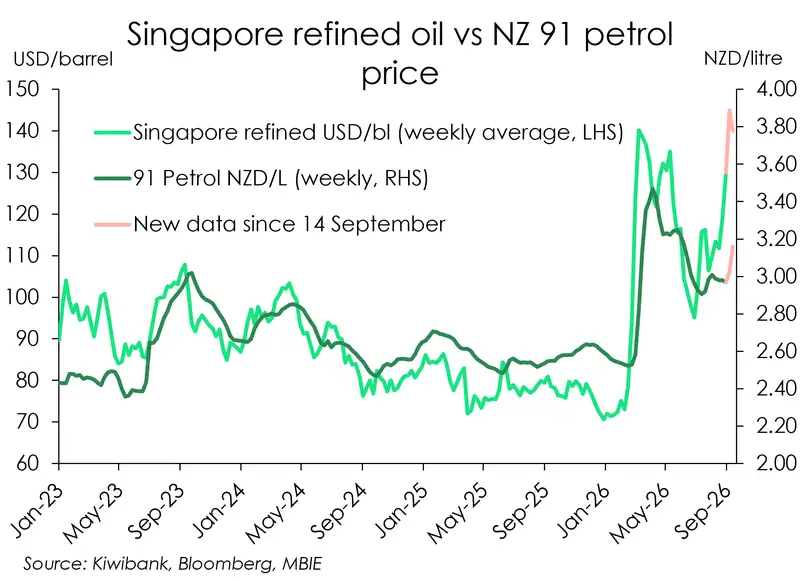
The pink bits at the end of each series shows how each of the prices have tracked since we published our original chart. The price of petrol in Aotearoa has indeed risen, although you probably don’t need our chart to tell you that. A visit to or even a drive past any petrol station gives you all the evidence you need. Petrol price pain will persist for a bit longer.
If you want more on the relationship between Singaporean refined oil and New Zealand petrol prices, read our original article here.
Financial Markets
The comments below were provided by Kiwibank traders. Trader comments may not reflect the view of the research team.
In Markets – Offshore still dominating
Last week attention largely shifted back to volatility in international markets though there were some local releases to spur some interest. For the week, our implied cash rate curve looked to finish higher, with year-end priced at around 3.14% against 3.10% the prior week, and year-ahead at around 3.93% against 3.80% previously. Further out, our rates finished higher though marginally steeper, with the 2-year IRS seen at 4.12% (+14bp week on week), 5-year IRS 4.47% (+14bp), and 10-year IRS 4.79% (+15bp).
The start of the week saw attention shift back to US bond markets which initially stabilised after the prior Friday selling, before coming under heavy selling pressure again midweek. Some tentative hope of progress in the Middle East conflict early in the week saw Brent slip below USD100 per barrel, though inflation concerns were back with this lifting back to around USD107 per barrel. Fed-speak was again to the fore after the FOMC with commentary landing on the hawkish side as would be expected. Generally, speakers noted inflation running above target with some remarking that oil was not the only driver of this and the need for policy to provide a meaningful restraint on this with further hikes likely. Labour markets were typically viewed as solid with some noting that the risks to jobs have receded. Data flow reinforced the natural bias of the market to sell, with stronger PMI’s cited as a factor in the midweek selloff despite these measures usually seen as perhaps secondary to the ISM surveys on the manufacturing and services sector. The result was US Treasuries and Fed tightening expectations sharply higher. US 10-year notes were seen around 25bp higher on the week at around 5.19%, while the front of the curve saw 2-year notes at around 4.91% as rate path expectations continued to push up. Year ahead Fed Funds futures implying around 91bp of tightening against around 72bp the week prior. NZ and Australian markets followed the selling, though a notable dip in the flash estimates of Australian PMIs and a lift in the unemployment rate reported on Thursday applied the brakes, with that sentiment making its way felt on this side of the Tasman.
For our markets, data remained a little thin on the ground. There were some interesting releases including the independent review of the monetary policy response to the Covid-19 pandemic, scheduled talks by MPC members including comments from Governor Breman in Dunedin, and a new RBNZ internal MPC member. The independent report did make some recommendations, including a more systematic approach, a greater emphasis on real interest rates, and more focus on near-term inflation signals than forecasts. Overall, this was probably leaning a little more towards hawkish, though the market appeared to take this in its stride at release. What did cause a bit of a stir was a headline attributed to the Governor on her Dunedin visit that should higher oil prices persist it would be expected to result in higher near-term inflation which saw a rates market response as you would expect. The RBNZ press release also noted the uneven nature of the recovery so far and the focus on inflation over the medium term, affording some balance to the statement, though the single headline report dominated trade. The scheduled talk by RBNZ Chief economist Paul Conway was postponed, though Friday did see the announcement of a new RBNZ internal member to the MPC, which may have implications on the balance of thinking for the rest of the year.
Looking ahead, offshore continues to dominate with events like the RBA decision and US payrolls, though there may be some interest on local reads of business and consumer confidence, and potentially the Pre-election Economic and Fiscal Update (PREFU). With our short curve continuing to price high probabilities for October and December, there does potentially remain some risk of overpricing of the near-term path, particularly given the seemingly preferred RBNZ stance of assessing the impacts of the tightening to date. This is evidenced by the rate path in the projections and the more direct remarks from the Finance and Expenditure Committee. On-balance the October or December tussle is more likely, as it is hard to consider the RBNZ having indicated a pause to assess after two tightenings, suddenly rolling out four in a row. Currently our short-end is pricing an October tightening at around 70%, while year-end OCR is marked at about 3.14% - i.e. 25 plus just over a half chance of more. Running the current implied path against the last MPS projections for 2027 has the average implied cash rate running over RBNZ projections by 32bp, 58bp, and 75bp respectively for Q1, Q2, and Q3 2027. This pricing did appear to start to apply a small handbrake to the upward trajectory of shorter swaps over the week, with a minor steepening of the curve in the latter stages of the week observed. The path of rates is likely higher as we have noted previously, though now the current brisk pace of tightening priced in the curve potentially may see the risk of a rate path move to adjust to somewhere between RBNZ and market pricing. As in the past few weeks, all can change in a moment or on a headline, particularly with significant focus on the US, the Fed, Treasuries, and the Mid-East at the moment. Graham Hughes – Trader, Financial Markets
In FX – the US dollar's renewed strength continues to weigh on the Kiwi
The US dollar remains firmly in control, with the DXY climbing back above 101 as Federal Reserve officials doubled down on the higher-for-longer rates narrative following the last FED meeting. Markets are now pricing a strong chance of another Fed move, while US Treasury yields have continued their march higher, with the 10-year yield pushing above 5.15%. Strong US PMI data has reinforced the view that the US economy remains remarkably resilient despite restrictive monetary policy, leaving NZD/USD pinned near 0.5660 and continuing to trade as a relative rates story. While New Zealand's economy is benefiting from strong commodity prices, improving tourism and a recovering manufacturing sector, widening NZ-US rate differentials and ongoing safe-haven demand for the greenback remain significant headwinds for the Kiwi.
Across the Tasman, NZD/AUD narrowly managed to hang onto 0.80 cents last week after recently trading at fresh 16-year lows, but the fundamental backdrop remains challenging. Australian employment data was mixed last week, however markets expect further RBA tightening when they meet this week as policymakers remain focused on inflation risks. In contrast, the RBNZ has signalled a more measured path, leaving interest rate differentials firmly in Australia's favour. The key question for markets is whether current RBNZ tightening expectations are too aggressive relative to the Bank's own projections. Any repricing lower in New Zealand rate expectations could see policy spreads widen further against the Kiwi. As highlighted in our latest FX Tactical, the relative rates story remains the dominant driver, with the balance of risks still pointing toward further NZD/AUD weakness and the 0.8000 level remaining a key area to watch. Adrian Lodge – Senior Dealer, Financial Markets.
The Week's Key Events
- We have a bit data-wise domestically, first we have the balance of payments and international investment position: Year ended 31 March 2026. Some monthly data to keep an eye on includes employment and building consent data for the month of August. And ANZ consumer and business confidence data. We also have the 2026 Pre-election NZ Economic and Fiscal Update (PREFU) out on Tuesday.
- Weather data will be out as well, but someone more intelligent than us will have to tell us what it means.
- Australia has their central bank decision on rates on Tuesday, followed by inflation data on Wednesday (isn’t that the wrong way around??). The market is pricing in a 25bp hike, which we agree is pretty much a given from the RBA.
All content is general commentary, research and information only and isn’t financial or investment advice. This information doesn’t take into account your objectives, financial situation or needs, and its contents shouldn’t be relied on or used as a basis for entering into any products described in it. The views expressed are those of the authors and are based on information reasonably believed but not warranted to be or remain correct. Any views or information, while given in good faith, aren’t necessarily the views of Kiwibank Limited and are given with an express disclaimer of responsibility. Except where contrary to law, Kiwibank and its related entities aren’t liable for the information and no right of action shall arise or can be taken against any of the authors, Kiwibank Limited or its employees either directly or indirectly as a result of any views expressed from this information.