
Retail fuel prices in New Zealand closely track the spot price of Singapore refined fuel. The price of the latter has skyrocketed yet again in the past week.
The latest price increase reflects elevated crude oil prices driven by an escalation of hostilities in the Middle East. A resurgence of Chinese demand for oil has also added to price pressures.
New Zealand fuel prices are yet to follow suit, which suggests more pain is in store for Kiwi motorists at the pump. City Rail Link couldn’t have opened at a more opportune moment!
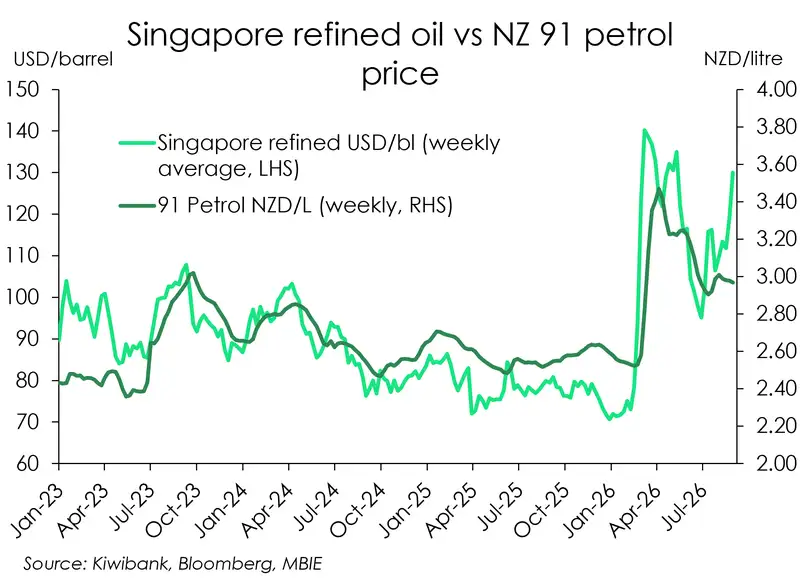
The Singapore refined fuel spot price reflects the prevailing market price for fuel in the Asia-Pacific region. Unlike the prices of crude oil such as Brent, WTI or Dubai, Singapore represents a refined fuel product. This is one step closer to the price we see at the pump in New Zealand.
Singapore dominates oil refinement in the Asia-Pacific region and is the distribution hub for the region. They are very good at turning oil that’s been pulled out of the ground into a product that cars can actually run on. And Singapore’s strategic geographic location makes them a key regional distributor of refined fuel.
New Zealand no longer has oil refining capability. That means we import almost all our fuel as a refined product. Refined fuel either comes directly from Singapore, or other origins that use Singapore as the benchmark for their pricing.
Retail petrol prices in New Zealand are essentially the Singapore spot price plus other costs associated with selling fuel domestically. That includes things like shipping it halfway around the world to get here, insurance, GST, fuel excise tax, and retailer margins.
The chart demonstrates just how closely New Zealand retail fuel prices track the Singapore refined spot price. When the Singapore price goes down, we follow suit. When the Singapore price went through the roof in March of this year, the same thing happened at petrol stations across Aotearoa.
For those who are eagle-eyed, the spot price has risen sharply once again. But the retail price of fuel in New Zealand hasn’t moved, yet. Anyone who filled up their car over the weekend can probably attest to that. And there may be a number of people looking to get in quick.
The last recorded spot price was a whopping $147 USD per barrel, compared with an already steep $120 USD per barrel two weeks ago. The current price is within striking distance of the peak observed in March this year, and is higher than it has been at any time since March. (Note that the chart doesn’t capture this latest high as it takes weekly averages rather than daily spot prices).
The implication? We are likely to see further price rises at the pump to reflect higher refined fuel costs. Fuel retailing has notoriously low margins. Petrol stations will be looking to pass on the increased cost of imported fuel as soon as those higher refined fuel costs hit their books. And judging from recent history, that probably isn’t too far off.
All content is general commentary, research and information only and isn’t financial or investment advice. This information doesn’t take into account your objectives, financial situation or needs, and its contents shouldn’t be relied on or used as a basis for entering into any products described in it. The views expressed are those of the authors and are based on information reasonably believed but not warranted to be or remain correct. Any views or information, while given in good faith, aren’t necessarily the views of Kiwibank Limited and are given with an express disclaimer of responsibility. Except where contrary to law, Kiwibank and its related entities aren’t liable for the information and no right of action shall arise or can be taken against any of the authors, Kiwibank Limited or its employees either directly or indirectly as a result of any views expressed from this information.