

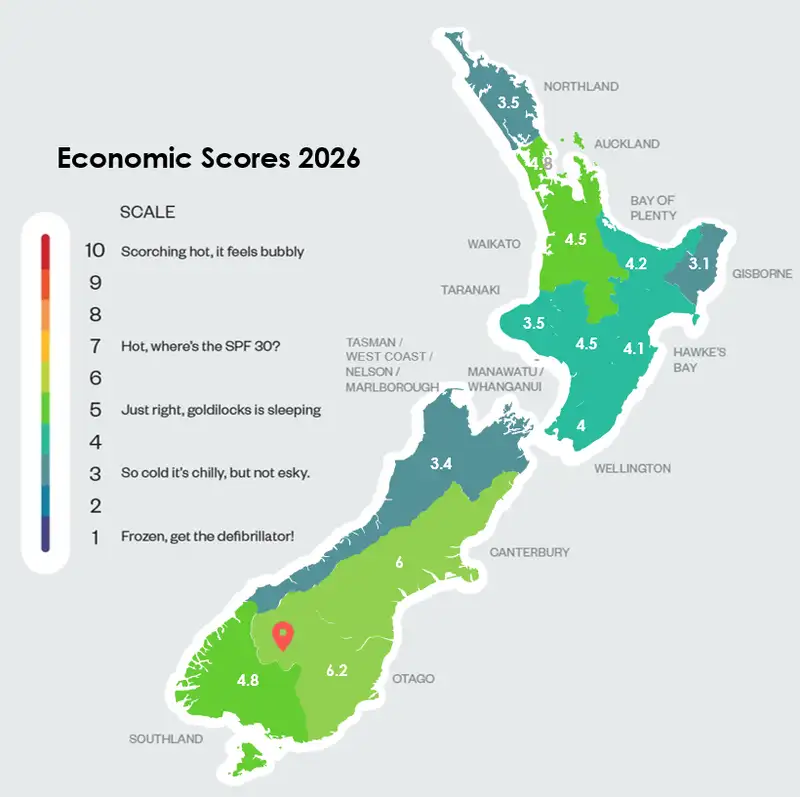
- Economic activity has improved in parts of the country and stagnated in others. It’s disappointing to say the least. The average score lifted from a mid-3 out of 10 to a low-4. But at the regional level, things heat up the further you go South. Gisborne falls below Wellington at the bottom of the heap.
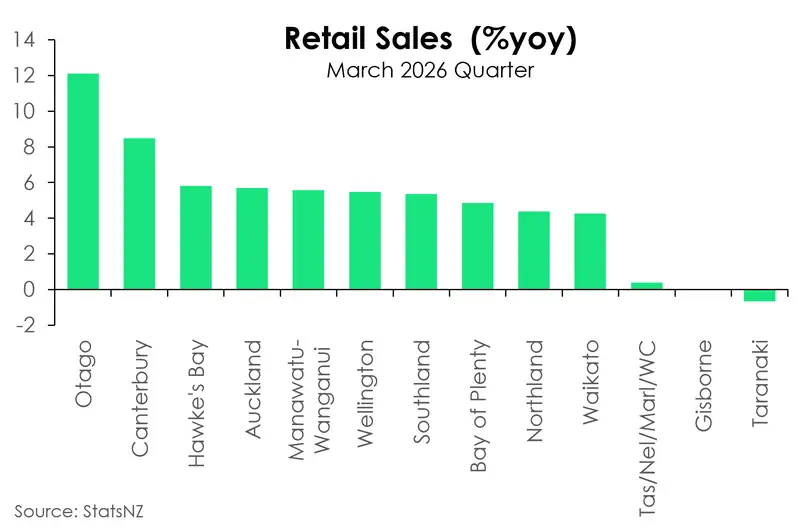
- The key theme over the last few years remains unchanged: the South Island continues to outperform the North. Otago and Canterbury outshine Southland as the top two performing regions, with activity boosted by farming and a bounce back in tourism.
- Everything washes out in the un(der)employment rate. The North Island has a high unemployment rate of 6%... the South, has a low 3.7%. And that divergence worsens when you look at the underemployed levels. Kiwi households are finding it hard to get the hours, and the income, they need.
- The economic environment remains highly uncertain, and the disruptive global backdrop is an added challenge. Spring is coming, and the tourism heavy regions should outperform.
We’re just going to come out and say it: it’s disappointing. It’s disappointing that we’ve notched up another year without a meaningful recovery. It’s disappointing for firms facing higher costs and a despondent consumer. And it’s disappointing for households stuck in a cost-of-living crisis.
Last year we noted: “Without a doubt, it’s still tough for many to navigate the tumultuous economic environment. And there’s now an added challenge of a tariff-induced slowdown in global growth.” All we have to do is replace “tariff-induced slowdown” with “oil price shock”, and the hits to confidence just keep coming… with a general election on the horizon to boot. And yes, businesses and households are hyper-sensitive leading into this election. Because the economy is not much better, and people are not feeling much better off. Will they vote with their feet, or just stamp their feet?
Buried within the aggregates there are some industries, like agriculture, tourism and manufacturing, doing well. And there are some industries struggling, like construction, retailing and other discretionary services. We’re getting a lot of mixed signals throughout. On a Goldilocks scale of 1-to-10, most score below 5, cold or too-cool and definitely not “just right”. The only warmth in the porridge is in the Deep South. But that’s not where our population lives. Over 4 million people (about two-thirds) live in the North Island (cold and in places miserable), compared to around 1.3 million in the South Island (warm and inviting).
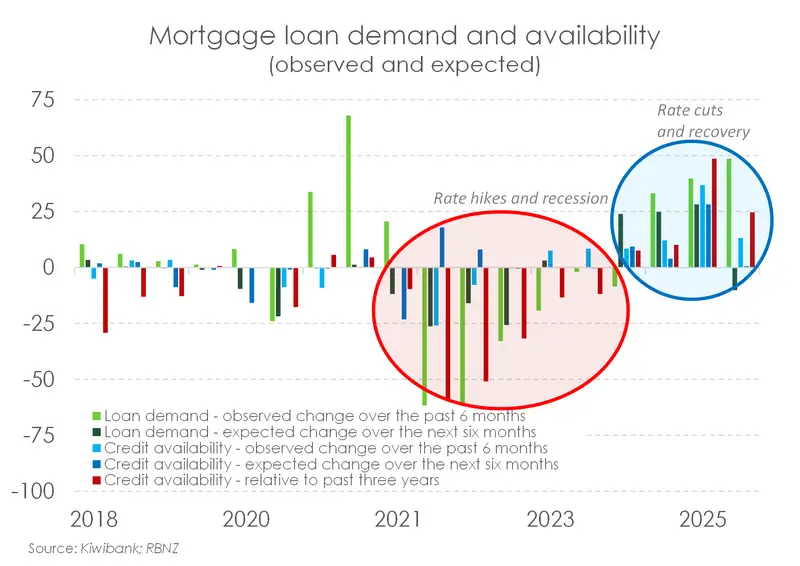
And we’re just going to have to say it again: a recovery is underway and should strengthen into 2027. Summer is our peak tourist season, and there’s a lot more activity across agriculture and hopefully real estate. Interest rates are still low, although we’d argue not low enough. And it’s not financing that’s holding back decision making. Banks are now very keen to lend, not like recent history, so the oil in the economic engine is full, ready to support growth.
So yeah, we keep our glass half full. The recovery is coming. We’d hate to wake up in a year’s time only to deliver the same message again (hopefully the AI investment boom doesn’t bust… surely not).
Across the board business is tough with customers reliant on winning the next contract to be able to keep going… otherwise tough decisions, particularly around staff, will need to be made. On the other hand, some customers are picking up large contracts on big infrastructure projects which will run for the next 2-3 years."
It feels like, it’s mixed.
The cool thing about this report is it gives us an excuse to reach out to the vast network of Kiwibank business bankers and mobile mortgage managers… those who do the real work, on the ground. It means that beyond our Economic Scores on the heatmap, we also get a “feels like” score from the people on the ground in each region.
Agriculture is a big differentiator. The farms in the North are doing well, but they are generally smaller and more indebted compared to the larger behemoths in the South. Tourism is good, really good, in parts. There’s a reason our business bankers and mobile mortgage managers say Queenstown feels closer to a 9 out of 10. Queenstown’s score is pulling up Otago’s total, but there’s no doubt that the tourist dollar (Aussie, US and Yuan) makes its way around surrounding regions.
When we look at the North Island, it’s mixed. Let’s start at the bottom of the table and Island. Our “feels like score” for Wellington is just 3.4, the lowest of the low. The election is playing a larger part in the capital. “Many businesses are taking a cautious approach, with investment and expansion plans largely on hold rather than actively pursuing growth."
The feels like scores for Northland, Bay of Plenty, and the mighty Hawkes Bay came in at 3.7. Not a big improvement on last year or Wellington’s score. “Cashflows remain tight... This is seeing clients persevere with existing capital equipment and hold off on expansion plans."
Whereas the Waikato and Gisborne came in at just 4.1 and 4, respectively… that still “feels” soft. “Overall business confidence has remained low throughout the year, with many businesses experiencing significant cash flow pressures. The transport industry has faced challenging conditions, largely due to the diesel crisis and broader economic headwinds… Civil construction businesses have experienced stronger performance... Residential development activity has also begun to recover, with new housing projects and subdivision developments gradually gaining momentum.” Rakesh Kumar, Commercial Manager
Up in Auckland, it’s not good. The “feels like score” of 3.9 says it all. “The business climate is cautiously neutral, with increasing downside risk. The recent OCR increase and ongoing Middle East conflict have heightened economic uncertainty, while the upcoming election appears to be causing some businesses to delay investment and expansion decisions. Despite this, most businesses remain resilient, although confidence and growth expectations have become more measured.” Kevin Haviland, Commercial Growth Manager
Our strongest “feels-like score” came out of Queenstown… no surprises there. They speak another language in the Deep South. It’s hard to understand what they’re saying. They talk of strong growth, low unemployment and expansion… and they say it with a southern smile, rather than a northern grimace.
If you live in the South Island, you’re feeling like a solid 6. Our “feels like” scores 6 across Canterbury, Otago and Southland, and only slightly less in other parts of the South Island. “Businesses are performing well in hospitality, tourism, accommodation and construction. Businesses are acquiring or expanding, growth is limited to getting staff in the district (due to costs of living, high rents).” Natasha Rowe, Commercial Manager.
Temperature reading: Tepid
On average, economic scores have thawed. The feeling that spring is on the doorstep is a relief. Our regional heatmap is showing more 4s than 3s out of 10. With 5 out of 13 regions hitting the “just right” score of 5. We’re moving in the right direction. Two regions posted 6 out 10.
Most regions are still far from their best. When lukewarm is the top of the leader board, you know we have a long way to go. It’s still a turbulent economic environment. Uncertainty is the word of the year, and it’s also a known killer of growth. Last year, there was the tariff-induced slowdown, and this year we have the oil crisis. Luckily, we haven’t been completely derailed, just hit. For their part, households have been refixing their mortgage rates for longer periods. That was the theme coming into 2026 and should help those who got in early. Locked in lower rates will insulate many from the interest rate hikes.
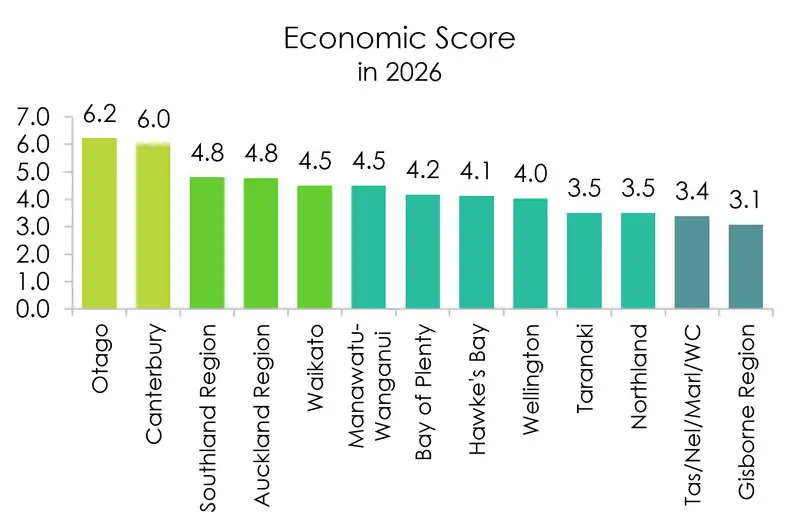
The average economic score in the South was a 5.1, compared to a colder 4.0 in the North. Otago took the top spot, with a score of 6.2 out of 10. And with Canterbury not far behind, scoring 6.0. Demand for housing in the Otago region continues to support construction and house prices.
Another year of strong tourism doesn’t hurt either. Thanks to a weak Kiwi dollar, we’ve seen Aussies turn up in droves. Chinese visitor arrivals are also going from strength to strength. With the introduction of new visa rules, Chinese passport holders can now hop over to New Zealand from Australia, without the need for an additional tourist visa. So, they’re playing hopscotch and who could blame them? Australia is a great stepping-stone on the way over to the main event. Before Covid, tourism was our biggest contributor to GDP. With the way things are headed now, it seems we will see the sector overtake manufacturing again in 2027.
The resurgence in tourist activity is supporting regional employment. The only regions to see a meaningful (and positive) shift in their unemployment rates are in the South. Canterbury is continuing to rebuild. The story of strong commodity prices has continued for another year. Boosted even further by global volatility, together with a weak Kiwi dollar, rural regions are at an advantage.
The rising star out of the Tron
The rising star of the North is Waikato. The Tron (Hamilton) has been crowned the fastest growing city for three years running. With the country’s aging population to consider, Hamilton is making big investments to boost the capacity to train the next generation of healthcare workers.
The region’s biggest barrier to growth is a skills mismatch in their workforce. In terms of attracting new talent, businesses are struggling to get Kiwi workers to migrate to the region. Hamilton is still trying to shake off the bad reputation from 10 to 15 years ago. It doesn't SOUND like it would be a good place to live, but people living there repeatedly report loving it. So, a lot of work is needed in the marketing side of things. All in all, the Waikato region has an economy that is ticking over. It's still soft and patchy based on the industry or sector, but manufacturing and logistics are a big underpinning there. They are "better than bad", better than the national average, and better than they once were. But they’re not running hot.
Queenstown burning bright
As we migrate from North to South, we go from rising stars to blazing ones. The Otago region is going from strength to strength. The drivers are well understood, especially when it comes to the housing market. Queenstown and Wānaka continue to command premium prices North of $2m and $1.7m respectively, powered by lifestyle appeal and a steady inflow of high-income buyers. Hybrid working has only amplified that trend. Location is no longer tethered to employment in the way it once was. Even as national prices track sideways, the region is quietly outperforming. Importantly, this isn’t just about prices. Listings are rising sharply in parts of the South, signalling confidence among sellers and sustained turnover in the market.
It all comes out in the un(der)employment rate.
Mixed, sector specific - some input costs in our projects are increasing on the back of the middle east impacts while other elements are screaming out for work."
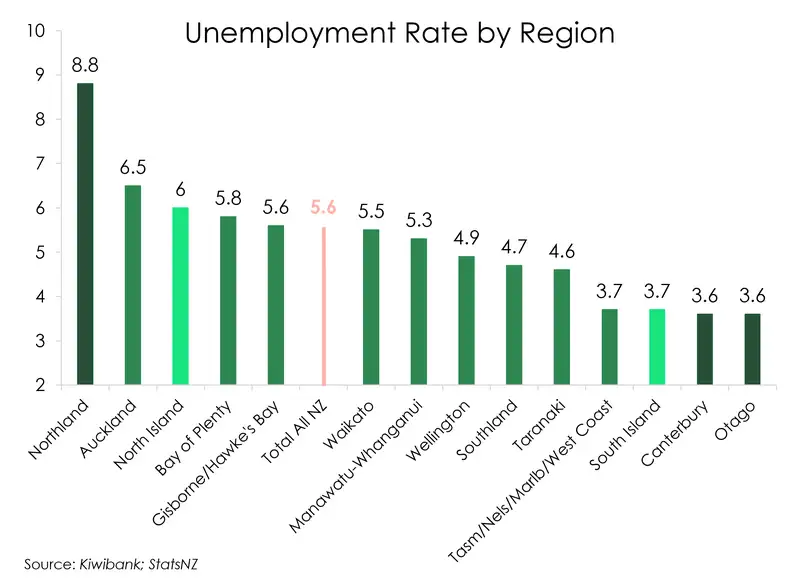
The great regional divide shows up in the un(der)employment rates. Right at the top is Northland, with a whopping 8.8% unemployment rate, followed by Auckland at 6.5%, and a 4.9% in Wellington. Although Wellington’s unemployment rate seems low, given the state of the capital’s economy… maybe there’s been a bit more migration (out of town). South of the strait (Cook not Hormuz), most rates come in below 4%. It’s a stark contrast.
And what’s worse? The underutilisation rates. Underutilisation adds the underemployed to the unemployed… it’s a broader measure of untapped capacity. And it looks terrible in the North, and forgiving in the South. Across the country, the underutilisation rate averages out at an elevated 13.8%, with 13.9% in the North Island, and 11.9% in the South. The regional divide has been growing larger since 2021, and there are some standouts.
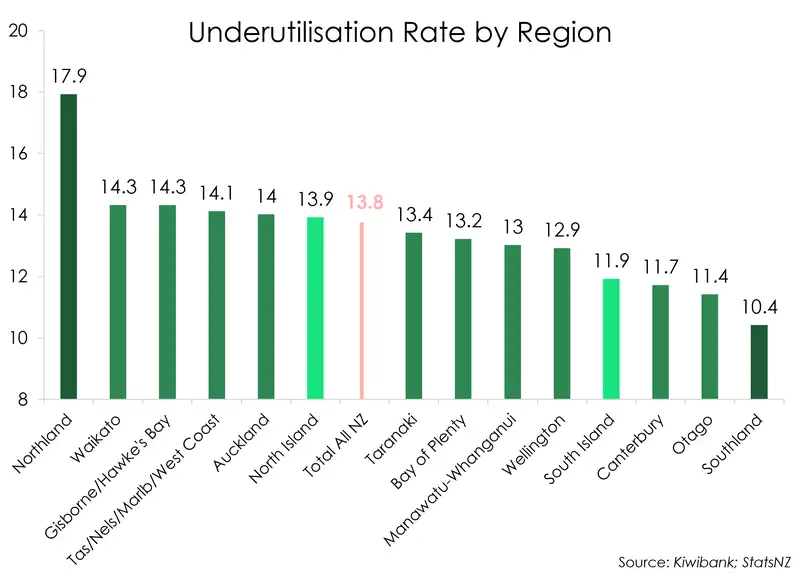
Canterbury, Otago and Southland are, again, the strongest performers. But the near 18% underutilisation rate in Northland is far worse than the 8.8% unemployment rate suggests. The economic shocks just keep hitting the Far North, with weather events, timber mill closures, tough industrial headwinds, a soft housing market, and a tourism industry in need of a good summer.
Poor progress in property.
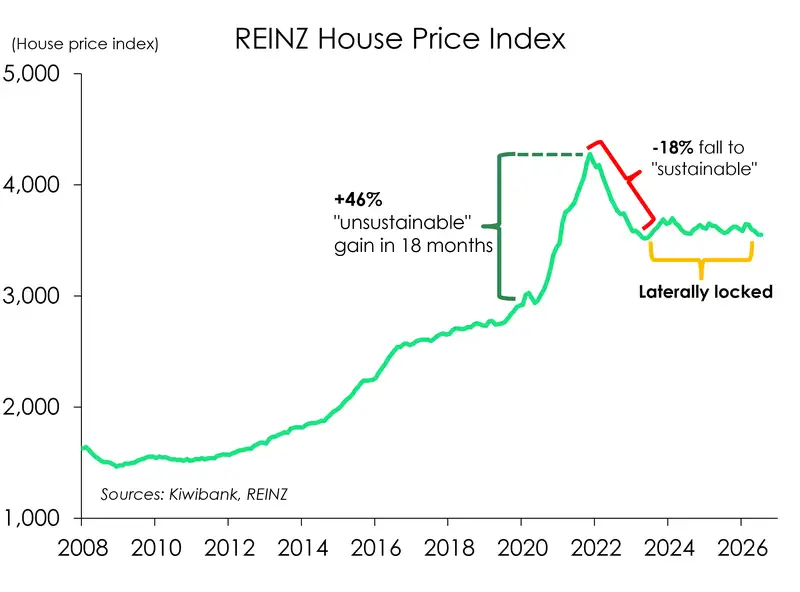
Across the country, the housing market has struggled to recover, with prices limping sideways.
Investors remain cautious about whether future capital growth will justify a new purchase. There is also a level of policy uncertainty influencing decision making. Some investors are taking a wait-and-see approach due to the upcoming election and the potential for changes to capital gains tax to investment properties."
Following the excesses out of Covid, property prices fell by 18% over 2022-23… and remained there. The RBNZ’s rate cuts may have stopped prices falling, but the level of mortgage rates is not stimulating. House prices have risen just 1% in 3 years. And that’s a national average… it is a very different story when split by regions.
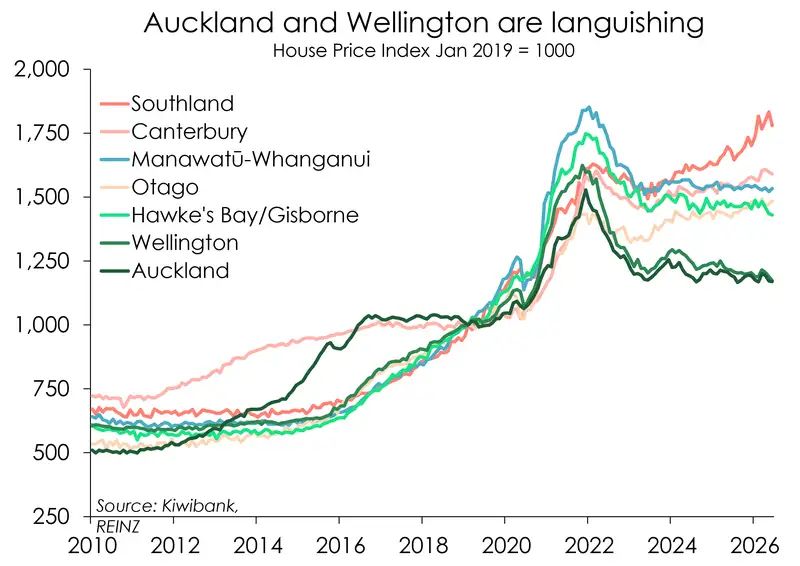
Two of our weakest regions are two of our largest. House prices in Auckland and Wellington remain down by 22% and 25%, respectively, from the post Covid peak. In fact, most of the North Island has failed to recover.
The interesting thing is that there's a big difference between capacity to buy and confidence to buy right now. Within Wellington, there are plenty of people who have the capacity to buy, but very little confidence to do so, which is evident in the number of pre-approvals many of us have floating around."
House prices in Canterbury have broken even, after falling 10%. There has been a respectable recovery of 10%, with house prices back at the 2021 peak. Otago is on another level, with house prices 5% above the 2021 peak. And it’s Queenstown doing its own thing. House prices are up 20% in the last year alone, as more and more Kiwi and foreigners are attracted to the lakes. Southland is the strongest performer, with house prices up 6% over the last year, to be 8% above the 2021 peak. Confidence is higher, activity is stronger, and the “wealth effect” more potent the further you move away from the equator.
When it comes to activity across the country, sales are lifting, but it’s taking a long time to sell. The days to sell is sitting at an uncomfortably high 50 days, well above the long term average of 39. There’s simply a large amount of stock for sale, and it needs to clear.
“The window for buyers is still relatively favourable. They have choice, negotiating power, and less competition than we've seen historically. Waiting for a major drop may not pay off, but neither should buyers feel compelled to rush. Townhouses and new-builds remain challenging. There is substantial competition among similar properties, especially where multiple developments have been completed in the same catchment.” Stacey George, Mobile Mortgage Manager Auckland.
“Confidence remains low and many Mum and Dad investors are choosing to hold off until there is greater certainty. Looking ahead, investor demand is likely to take longer to recover than owner-occupier demand. Many investors will want to see evidence that the property market is regaining momentum before committing capital back into residential property. If interest rates continue to rise, this could further suppress investor activity and delay any recovery.” Shayne Hawtin- Mobile Mortgage Manager, Southern.
“Anecdotally, I'm hearing more discussion around alternative investments than I have previously. Strong share market performance and the ease of investing through managed funds and online platforms appear to be making some investors more willing to consider options outside residential property. First-home buyers appear to be driving more activity than investors in the current market.” Liz Tee, Mobile Mortgage Manager, Auckland.
What’s the cash rate by region?
If we were setting monetary policy, we would have held the cash rate at 2.25% for the rest of this year. Because we want to let the recovery gain traction, and get nervous businesses and households through the election. We would have looked to hike early in 2027. But alas, the RBNZ is hiking to 3% this year, with a continued threat to 3.25% next year.
If you look south towards Canterbury, Otago and Southland, we would set the cash rate around 3-to-3.25%, a firmly neutral setting. So we’d hike for about one-third of the Kiwi population.
But when you look north, at the other two-thirds of our population, we would have monetary policy around 2.25-2.75%... still on the lighter side of neutral. Auckland and the Mooloo Tron still require a slightly stimulatory setting of 2.5-2.75%. Whereas Wellington, Northland, Gisborne, BoP, and the Mighty Bay deserve the cash rate back where it was at 2.25%. The rest of the population, not yet named, also deserve rates around 2.25-2.5%.
So all-in-all, we continue to highlight the softness of the recovery, and the need for interest rates that are on the lighter side of neutral, enticing activity. The cash rate should have been left at 2.25% a little longer to help the North.
But the RBNZ have chosen to tackle the threat, not the evidence, of inflation. Maybe the RBNZers are looking out the south side of their building on The Terrace.
The feel good (or bad) factor
We asked Kiwibank business bankers and mortgage managers for the word on the street. Here’s what they said:
4.7 Across the Motu
“Many clients are investing in equipment, technology, and operational improvements to increase efficiency. Some are expanding premises or seeking finance to support growth opportunities, while others are refinancing existing facilities to improve cash flow and position themselves for future expansion.” Ash Wilson, Business Banking Join Consultant.
“Many businesses are shedding non-core assets to simplify operations and maintain margins.” Troy Sutherland, General Manager Commercial South.
“Since late May we have seen a positive improvement in activity levels, especially in the M&A and leveraged space. This activity spans both domestic and global investment into NZ. Putting most recent Geopolitical issues to one side it feels like confidence is returning at the Corporate end of town.” Tracey Walker, GM Corporate & Property Finance
(3.7) It’s cold in the Winterless North.
“We are seeing good levels of enquiry, with some businesses in a sound position & seeking funding. Others are being cautious, and some are seeking assistance via Interest Only terms.” Geoff Yendell, Commercial Manager.
(3.9) Just not quite strong enough. Auckland.
“Patchy, export related sectors - timber, meat, tech, tourism - are doing better. Industries susceptible to domestic demand continues to be difficult with outliers in each industry. Many clients have accepted that the structural economic transition in New Zealand coupled with geopolitical instability will last and business needs to be able to operate as normal in these times.” Rudi Bansal, Regional Manager.
“Good in pockets. Amazing innovation and success in technology sector, but we don't shout about it enough. For traditional trading businesses - good operators are doing OK. Bad operators exposed.” Emma Stoneman, Commercial Growth Manager.
“A mix of both. We have customers buying additional machinery to service large infrastructure contracts with Watercare and Vector. On the other end we are receiving more cashflow/overdraft increase requests as customers are needing additional working capital to be able to start some of the larger contracts which are currently being awarded.” Ben Gillies, Commercial Growth Manager.
“Still a lot of uncertainty in general, but I feel like business owners are better equipped to deal with adversity.” Mike Mangino, Commercial Manager.
“Construction and services to construction sector remains sluggish and tough. There is a real lack of projects, significant competition for projects and significant margin pressure.” Phil Whittle, Commercial Manager.
(4.1) Same old same old four in the Tron. Waikato.
“Overall business confidence has remained low throughout the year, with many businesses experiencing significant cash flow pressures. The transport industry has faced challenging conditions, largely due to the diesel crisis and broader economic headwinds. However, financial results have shown improvement in FY25 compared to the previous year. Civil construction businesses have experienced stronger performance, primarily driven by increased council-funded projects across the Waikato region. Residential development activity has also begun to recover, with new housing projects and subdivision developments gradually gaining momentum.” Rakesh Kumar, Commercial Manager.
“Oil prices are having less of an impact than expected. Certain sectors still going well, particularly Dairy Service companies…Commercial doing well, particularly the Inland Port (Ruakura). Resi Construction, still down. Hospo still struggling.” Eddie Stocks, Commercial Growth Manager.
“Dairy farmers have done well due to Fonterra’s share payout with the sale of Kapiti. The job market is tight” Nicki Smith, Business Manager.
(3.7) The winter of wait and see in the Bay of Plenty.
“Enquiry levels in recent months up on previous months but still tentative at best. Some individual businesses doing well but overall malaise with many treading water and hoping for an improvement in trading conditions post war & election.” Roger Shaw, Commercial Manager.
“Cashflows remain tight and the market for work/tenders remain very competitive thus trimming gross margins. This is seeing clients persevere with existing capital equipment and hold off on expansion plans.” Cam McKinnon, Commercial Partner.
“Overall, confidence has improved and businesses generally feel like we've moved through the worst of the downturn, but many remain cautious and are focused on strengthening their position before pursuing significant growth opportunities.” Jason Reddish, Commercial Associate.
(4.0) A gain in momentum but loss of rhythm. Gizzy.
“Forestry activity is continuing to improve, helping support business confidence and broader economic activity across the region. Transport operators are also reporting improved margin management, with less price-based competition. While there is some concern about the impact of Rhythm & Vines leaving the region and the loss of visitor spending it brings, Gisborne remains a relatively self-sufficient economy, with overall sentiment improving.” Lara Woolley, Commercial Manager.
“Weather events have continued to impact a number of industries across the region over the past 12 months, creating ongoing challenges for local businesses. The loss of Rhythm & Vines is also expected to have a significant effect on tourism activity and regional spending. At the same time, investment in infrastructure remains a key priority to support economic growth and improve the region's long-term resilience” Karl Trafford, Commercial Growth Manager.
(3.7) The mighty cautious Hawke’s Bay.
“There is more activity than there was a few months ago, but demand is by no means going crazy. It is those who have spotted a good deal and want to make the most of it (and are in a position to do so).” Lara Woolley, Commercial Manager.
“Majority of customers remain in a cautious mode. A lot want to do things, like invest in business, plant/machinery etc… but put on back burner due to the way the economy has been and in general low business confidence. A lot of the businesses financial performance has taken a hit in the last 12m so with a downturn in trading performance, tax issues/arrears, slow/impacted debtor collection etc this has all had a negative effect on borrowing power.” Karl Trafford, Commercial Growth Manager.
(3.0) Tough in Taranaki.
“Things remain tough in the Taranaki region, with many businesses and households still struggling to see light at the end of the tunnel. Strong commodity prices have supported the farming sector, however the ongoing decline of the gas industry continues to weigh on the local economy. It's not all doom and gloom, but confidence has yet to materially improve.” Louis Challies, Commercial Manager - Business.
(5.0) It feels like a 5 in Manawatū/ Whanganui.
“Manawatū remains subdued, although lower operating costs and strong exposure to the agribusiness sector are providing some support.” Troy Sutherland, General Manager Commercial South.
“Since June, I've seen enquiry across a broad range of sectors and purposes, including plant and equipment purchases, owner-occupied commercial property, residential development and business acquisitions. While businesses remain cautious, many are still prepared to invest where they can see strategic value and long-term growth opportunities.” Will Warren, Commercial Manager.
(3.4) Uncertainties in the Beehive hurt Wellywood.
“Businesses are still spending and borrowing where they need to, but it feels very disciplined. Most investment is directed towards things that genuinely move the needle, such as new equipment, site improvements or productivity gains, rather than a "build it and they will come" growth mindset.” Victoria Spring, Regional Manager.
“Wellington continues to operate in a low-growth environment, which has weighed on business confidence and investment activity.” Troy Sutherland, General Manager Commercial South.
(6.1) Canterbury’s feel-good factor is a firm six.
“There are signs that customers are looking to grow and invest. Particularly SMEs, wanting to open new businesses (mostly hospitality), leasing opportunities, lots of interest in [Kiwibank] for BB loans and StartUp+ enquiries.” Kisha Merenciano, Business Associate.
“Existing property finance clients are expanding via buying new commercial property to reposition, with demand for 'upgraded' space continuing to be strong. This seems equally true for subdivisions (land) and housing developments in general. Pockets of oversupply perhaps, but in general land and housing stock continues to move, albeit prices may have to be altered slightly downwards to move those units or sections that are the ugly ducklings of the development (there's always the less attractive ones).” Brammers, Greg Bramley, Senior Property Finance Manager
(5) Better than the North, Tas/Nel//Marl/WC print strong.
“Most Nelson-Tasman investors aren't bearish. They're just struggling to find deals that make sense.” Simon Parle, Mobile Mortgage Manager.
“It's a weak economy with low enquiry levels, careful investment due to uncertainties and probably a small improving trend. The closer to Agri you are the better you feel.” David Wilkinson, Regional Manager.
(7.0) In Otago… boosted by the lakes.
“Investor interest feels like it is improving as lower interest rates and the return of interest deductibility have helped the numbers stack up better. However, many investors are still taking a cautious approach, making sure rental returns and affordability work, while also keeping an eye on the economy and the upcoming election.” Leanne Hannah, Mobile Mortgage Manager.
(9.0) The hottest town is Queenstown.
“Businesses are performing well in hospitality, tourism, accommodation and construction. Businesses are acquiring or expanding, growth is limited to getting staff in the district (due to costs of living, high rents).” Natasha Rowe, Commercial Manager.
“The Central Lakes region appears to be operating in its own confidence bubble, with business activity and sentiment remaining considerably stronger than elsewhere in the country.” Troy Sutherland General Manager Commercial South.
(7.0) And likewise in Southland.
“Otago and Southland are performing better than average, supported by continued agricultural spending, which is helping to offset the impact of higher fuel costs and broader economic headwinds.” Troy Sutherland General Manager Commercial South.
Kiwibank’s Regional Score
Kiwibank’s Regional Score summarises seven economic indicators in 13 regions (see map on the front page). Included in the scores are: population growth, retail sales, employment & unemployment rates, house price index, house sales and residential consents. To combine these different measures (e.g., number of people versus values of retail sales) we take annual growth rates for population and retail sales and per capita rates for regional consents and house sales. Absolute values are used for house prices and employment and inverted unemployment rates. These measures are then standardised relative to 2019 for the entire country. We then combine the indicators for each region by taking the average of the various measures. Finally, we convert each average into a score from 1-10 by fitting the data to a normal distribution with a mean of 0.
All content is general commentary, research and information only and isn’t financial or investment advice. This information doesn’t take into account your objectives, financial situation or needs, and its contents shouldn’t be relied on or used as a basis for entering into any products described in it. The views expressed are those of the authors and are based on information reasonably believed but not warranted to be or remain correct. Any views or information, while given in good faith, aren’t necessarily the views of Kiwibank Limited and are given with an express disclaimer of responsibility. Except where contrary to law, Kiwibank and its related entities aren’t liable for the information and no right of action shall arise or can be taken against any of the authors, Kiwibank Limited or its employees either directly or indirectly as a result of any views expressed from this information.