

“The committee judges that gradually removing monetary stimulus is appropriate to return inflation to the 2 percent target mid-point while supporting growth and employment.” - RBNZ
- The Reserve Bank reached a consensus decision to increase interest rates to 2.75%. In line with market expectations, and our own. But the hike came with a surprisingly dovish chirp as opposed to a hawkish screech.
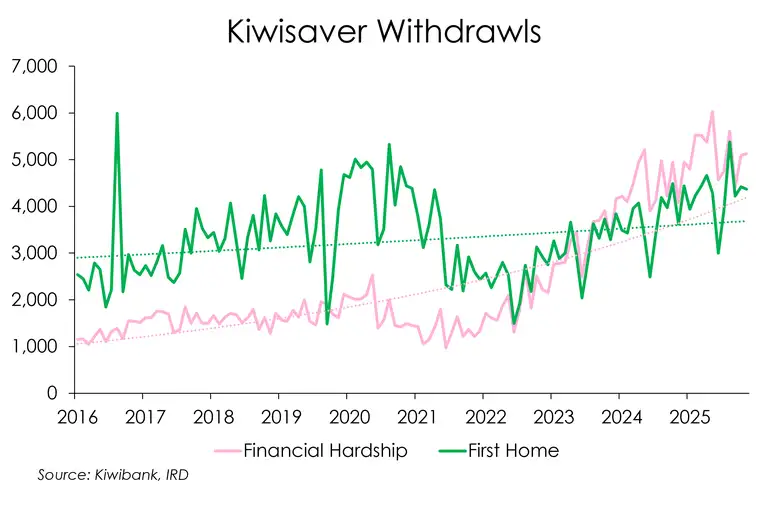
- A strong export sector has not been enough to prop up the entire economy which has been afflicted with falling real house prices and weak consumer spending. New Zealand's economy has significant spare capacity. This spare capacity limits the risk of further inflation, as workers have little power to ask for higher wages in the current job market.
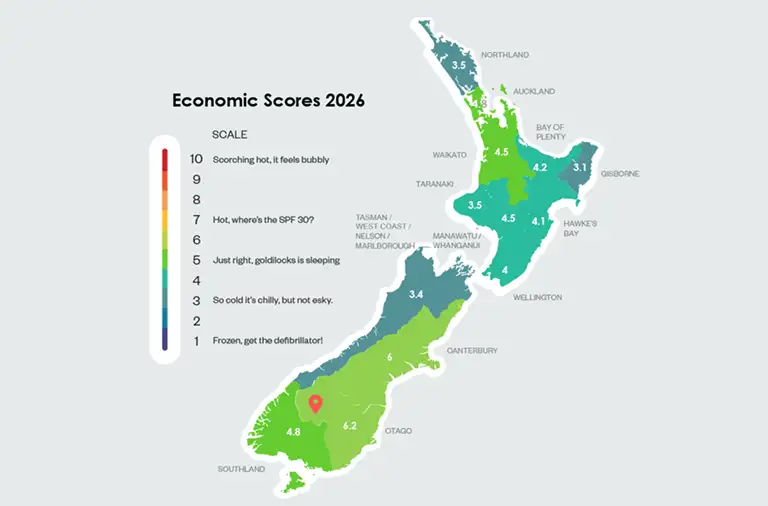
- We are flattered on suspicion that the Reserve Bank has been reading our outputs! Their assessment of current and future economic conditions is aligned with what we have been pointing out. Inflation should return to the target band by the middle of next year, and the regional divide remains stark.
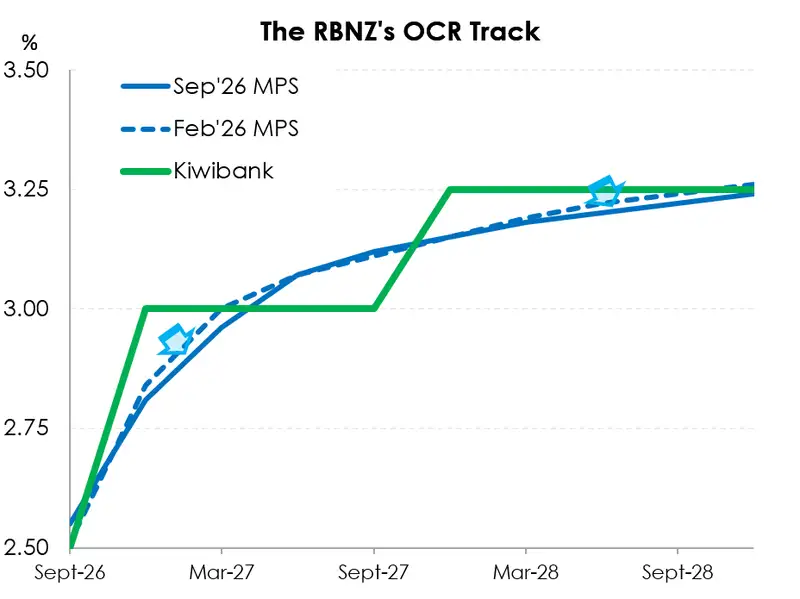
We expected a rate hike and we got a rate hike. The official cash rate is one step closer to the neutral rate, lifting from 2.5% to 2.75% today. The interesting part of today’s monetary policy statement is the Reserve Bank’s updated trajectory for the OCR.
At first glance, it almost looked as if they forgot to put the old OCR track in. As it turns out, the track is almost the same in September as it was in May. The chance of a hike in October is actually lower now, as the monetary policy committee conveyed a tone of ‘wait and see’ following their two consecutive hikes.
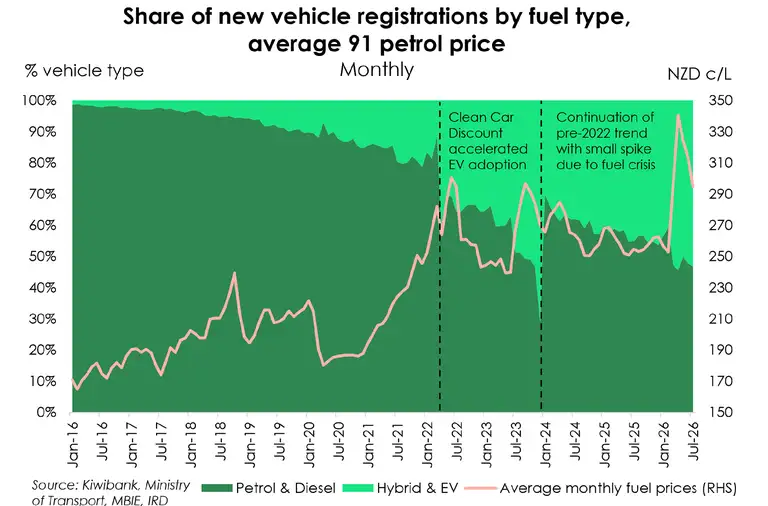
Despite volatility, the worst of the direct inflation spike due to fuel prices looks to be behind us. The focus of the Reserve Bank is on secondary domestic inflation effects. Think transport, construction, and domestic airfares. The Reserve Bank can’t wave a magic wand and control oil prices. But they can use interest rates to limit the extent to which inflation spreads throughout the economy.
Thankfully for them, the weak Kiwi economy is doing a lot of the heavy lifting for them. There is significant spare capacity in the New Zealand economy. Their words, and ours. This spare capacity will moderate second-round price effects. Additionally, the weak jobs market will continue to limit workers’ ability negotiate higher pay. That also serves to keep inflation in check.
The Reserve Bank noted the unevenness of the recovery. A strengthening of the recovery is of course important, but perhaps more importantly is a broadening of the recovery. Export oriented regions and sectors have performed well. Really well. We need to start seeing recovery across the wider economy and the country as a whole.
Oil price volatility still top of mind
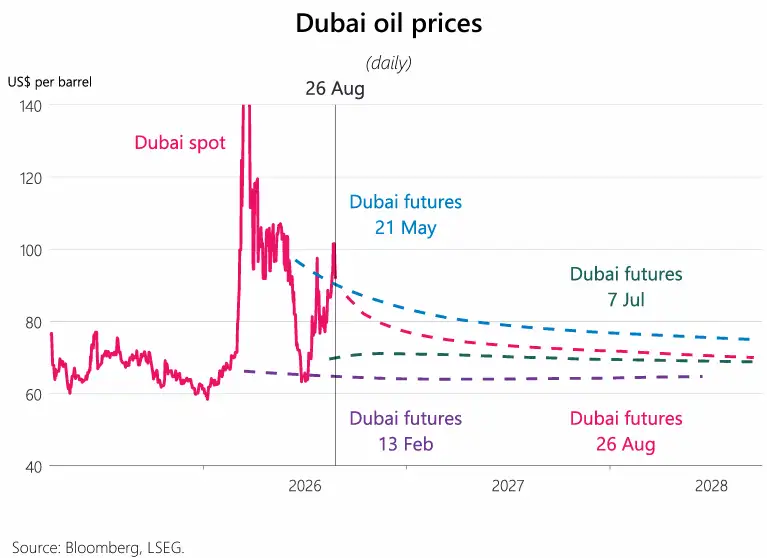
The rollercoaster of oil prices is a headache from a monetary policy perspective. Although it's a migraine for everyday Kiwi who rely on fuel to go about their lives and work. In February, oil futures looked stable and trading in a normal range. That changed drastically in March, when oil prices peaked amidst the Middle East conflict. Things were looking considerably better by July. But the rollercoaster continues, with prices up again in September… and so on.
El Niño adding risk on top of risk
The MPC highlighted weather-related events as a key risk to the Kiwi economy, stating that “The current El Niño weather pattern is likely to develop into one of the strongest in recent history over coming months”.
There is a tenuous link between the current El Niño weather pattern and drought in the regions, especially the South Island which is highly dependent on agricultural exports for economic growth. Much like predicting the economy, predicting the weather is hard. The risk of drought, albeit difficult to quantify, is set to temper economic growth projections. A decrease in agricultural output would mean price increases, which feed into inflation, combined with weaker economic growth – the worst of both worlds.
We are crossing all fingers and toes that the 2026/27 summer won't be an unusually dry one.
Labour market
“It’s not a strong labour market yet” – Anna Breman, Reserve Bank Governor
It feels like the RBNZ has been reading our outputs. A soft labour market appears key to the RBNZ’s decision today. Unemployment by age group and region is diverging. The labour market data looks grim. A 5.6% unemployment rate, the highest since September of 2015. And over one in six young people in the labour force were unemployed.
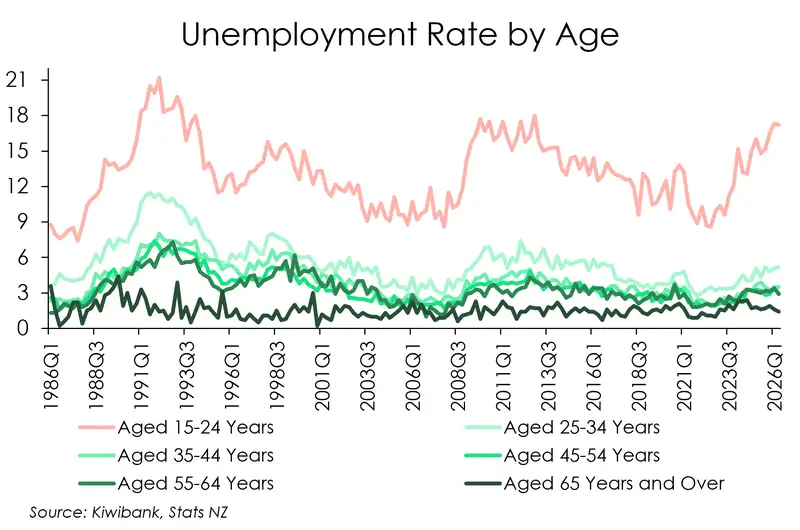
The unemployment rate for young Kiwi aged 15 to 24 was 17.2% in June. Not really backing down from the March quarter 17.3% (a 14- year high). The next closest age group, those aged 25 to 34, have an unemployment rate of 5.2% (a 9-year high).
Historically, youth unemployment has always been elevated relative to older groups, but the current level is among the highest seen since the post-COVID recovery period.
“We care deeply about the labour market” – Anna Breman, Reserve Bank Governor
The South Island unemployment rate is much lower than the North. At 3.7% for the June quarter compared to 6.0% in the North. The regional divide has been growing larger since 2021. The South Island has strong demand for manufacturing from overseas markets.
We note that the unemployment rate is highest in Northland at 8.8%. With the Auckland unemployment rate at 6.5% compared to capital’s 4.9%. The lowest unemployment rate can be found in the Canterbury and Otago regions, both at 3.6%. The North and South have very different economic outlooks.
Exporters vs Services
Household consumption
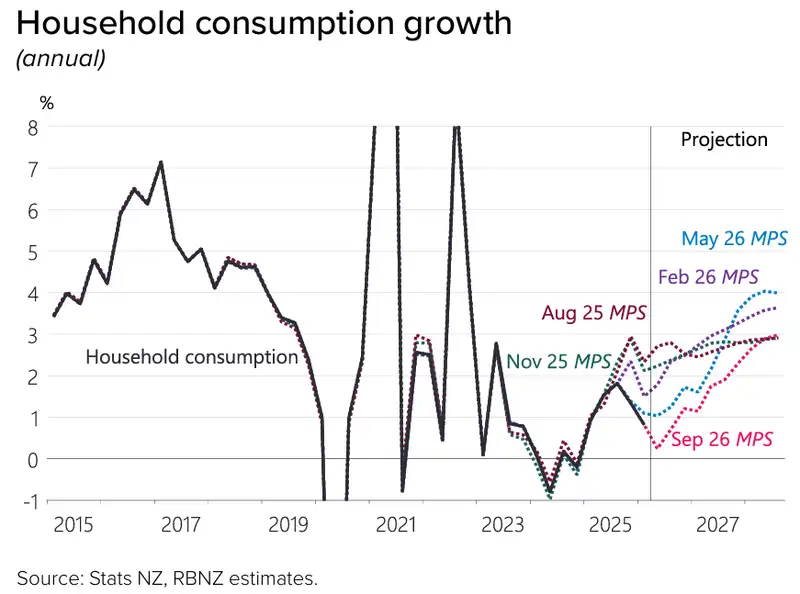
Our export sector is booming. The Reserve Bank is cautiously optimistic, they (and we agree) are still waiting to see the positive spillover into domestic demand outside of the regions where exporters live and work.
The area requiring the most support is the services sector. The Reserve Bank Governor noted that the services sector employs around 70% of New Zealanders. The weak domestic consumer is keeping growth constrained in the sector that affects the Kiwi economy most directly.
“How household consumption evolves over the medium term is a key uncertainty underlying our economic projections.” - RBNZ
Wholesale rates
Wholesale rates have taken today’s decision as a given.
Before the RBNZ’s announcement, the market had 24.5bps (99% chance) for today’s meeting, and they split the difference for another 25bps hike this year between October and December.
Following the RBNZ’s decision, a 25bp hike in October is just over 1/3 priced in. We like these odds. We had thought that they would deliver a 3-step move to 3%. But we may get a pause at 2.75% to assess… sounds sensible to us. Market pricing and some market commentators had positioned for a 4% cash rate by the end of next year. The RBNZ’s updated OCR track hoses those expectations down.
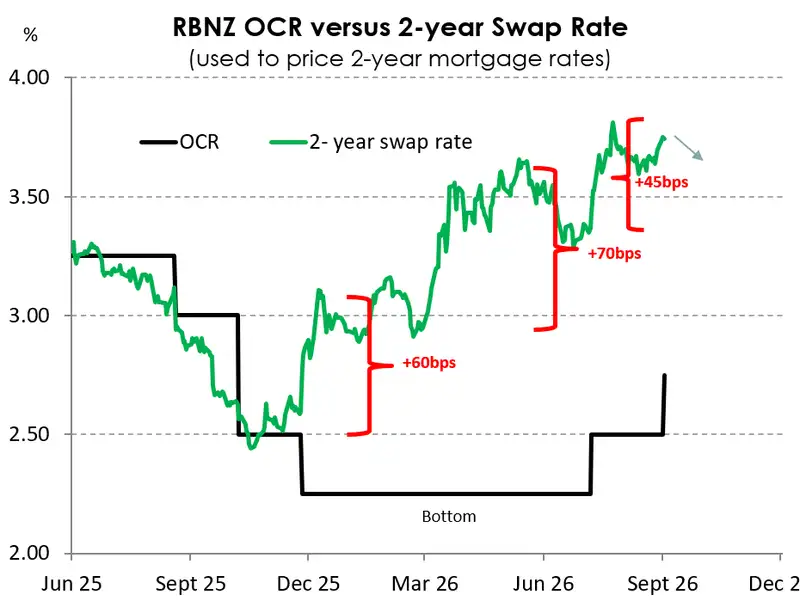
The wind has been taken out from under the wings of the hawks (Sorry Graham).
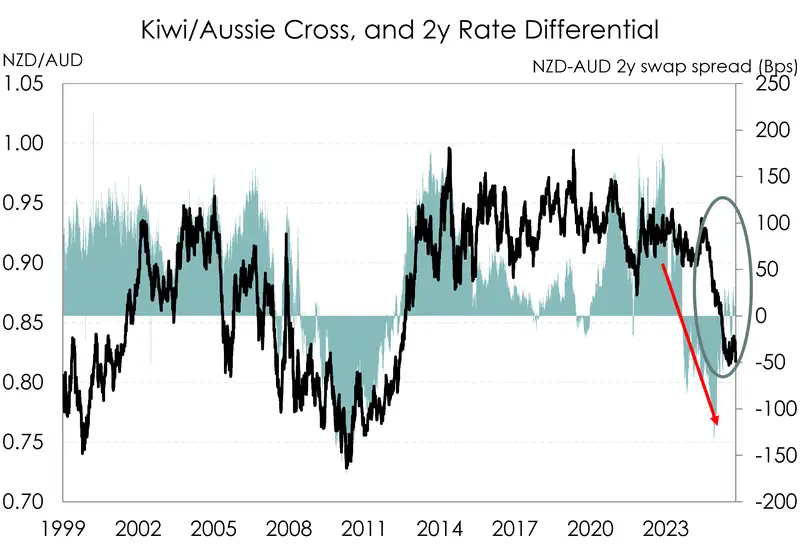
The pivotal 2-year swap rate has fallen around 10 basis points to 3.69%. We expect this move to continue south as overly-zealous expectations are removed.
The Kiwi dollar fell off its perch, falling 50 points to 0.584 against the USD. Against the Aussie, there was an even greater move, down from 0.825 to 0.818 AUD.
All content is general commentary, research and information only and isn’t financial or investment advice. This information doesn’t take into account your objectives, financial situation or needs, and its contents shouldn’t be relied on or used as a basis for entering into any products described in it. The views expressed are those of the authors and are based on information reasonably believed but not warranted to be or remain correct. Any views or information, while given in good faith, aren’t necessarily the views of Kiwibank Limited and are given with an express disclaimer of responsibility. Except where contrary to law, Kiwibank and its related entities aren’t liable for the information and no right of action shall arise or can be taken against any of the authors, Kiwibank Limited or its employees either directly or indirectly as a result of any views expressed from this information.