

The number of KiwiSaver withdrawals for reason of financial hardship was relatively stable between 2016 and 2022. Since 2022, there has been an eyebrow raising increase in the number of hardship withdrawals. Especially when compared to first home withdrawals.
The number of withdrawals for hardship has exceeded that for a first home deposit every month since July 2024. The average withdrawal amount has increased 69% over the decade between August 2016 and June 2026. Compared with a ~38% increase in prices over the same period. It’s a clear story of hardship for a growing number of Kiwi households.
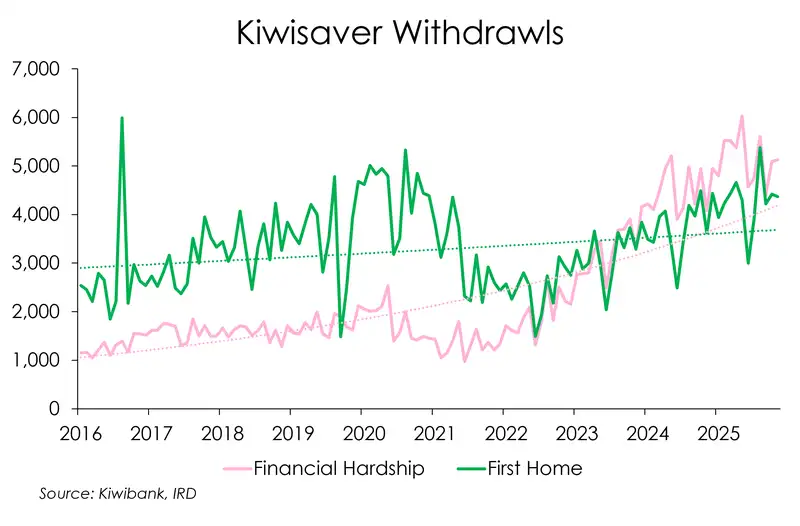
Withdrawals for reason of financial hardship are up. Both in terms of volumes, as per the chart, and values.
The scheme was fundamentally designed for retirement savings or a first home deposit. The rate of withdrawals for covering short-term financial hardship is putting an increasing number of Kiwi behind in terms of retirement and house savings.
The number of financial hardship withdrawals reflects economic pain for many Kiwi households. The likely culprits? A sky-high cost of living paired with a weak labour market that has left many Kiwi unemployed or underemployed.
The number of withdrawals for buying a first home has increased by 72% between August 2016 and June 2026. More Kiwi getting onto the property ladder is good news. What’s not such good news is the 346% increase in the number of hardship withdrawals over the same period. Almost all of that increase occurred between 2022 and 2025.
The average dollar amount of each hardship withdrawal has increased by 69% from ~$5,000 to $8,450. Headline inflation has (only…) risen approximately 38% over the same period of mid-2016 and mid-2026. The increase in hardship withdrawals has grown in real, not just nominal terms.
There are a number of reasons a KiwiSaver member can apply for a financial hardship withdrawal. Many of these reflect direct economic hardship while others are health or family related. If someone cannot meet minimum living expenses or pay the mortgage on their home, they can make a case for a financial hardship withdrawal. The other reasons relate to medical circumstances. The inability to cover medical expenses is another sign of economic hardship.
No matter the reason for withdrawal, each increase in the number and dollar amount of hardship withdrawals represents a Kiwi household facing genuinely tough times.
We expect the recovery in economic conditions over 2027 to be accompanied by an easing in financial hardship withdrawals. Particularly as labour market conditions improve. However, rising interest rates are likely to add to household living cost pressures. Another reason we are hoping for a long rate hike holiday through 2027.
All content is general commentary, research and information only and isn’t financial or investment advice. This information doesn’t take into account your objectives, financial situation or needs, and its contents shouldn’t be relied on or used as a basis for entering into any products described in it. The views expressed are those of the authors and are based on information reasonably believed but not warranted to be or remain correct. Any views or information, while given in good faith, aren’t necessarily the views of Kiwibank Limited and are given with an express disclaimer of responsibility. Except where contrary to law, Kiwibank and its related entities aren’t liable for the information and no right of action shall arise or can be taken against any of the authors, Kiwibank Limited or its employees either directly or indirectly as a result of any views expressed from this information.