
After soaring to almost US$13,000 per tonne in late 2024, cocoa prices collapsed more than 75%. Now they’re creeping back up again.
At first glance, it looks like another commodity boom-and-bust cycle. But cocoa's wild ride highlights how vulnerable global supply chains remain to weather and disease. And, unsurprisingly, cocoa isn't alone…
Coffee markets are wrestling with many of the same forces. In both markets, current supply conditions have improved. But commodity markets don't just price today's supply. They price tomorrow's risks.
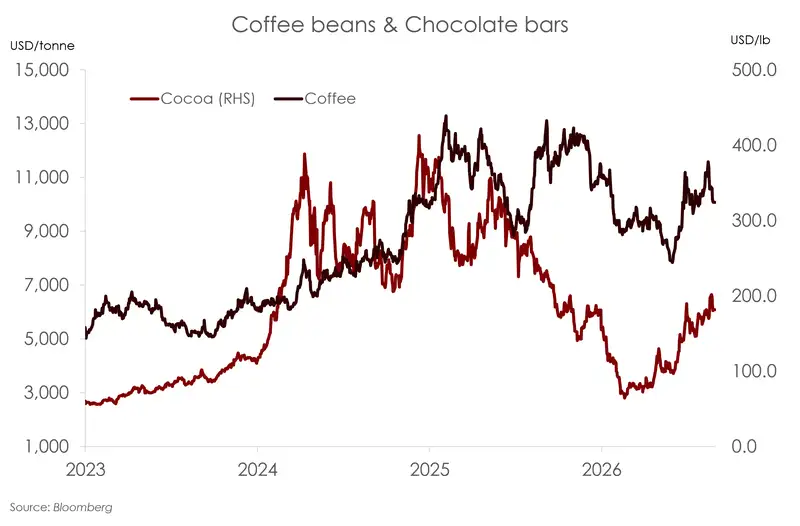
Around 60% of the world's cocoa beans come from just two countries: Côte d'Ivoire and Ghana. That concentration has left cocoa markets highly exposed to changing weather conditions across West Africa. Flooding, crop disease, and concerns about a powerful El Niño event have all contributed to sharp swings in production expectations over recent years.
The interesting development today is that the market is receiving two very different signals. Current supply conditions look relatively comfortable. Production from Côte d'Ivoire has rebounded strongly, inventories have recovered, and exports are running well above year-ago levels. Under normal circumstances, that would point to lower prices. But commodity markets trade the future, not the present…
Investors are increasingly focused on the next harvest. Early crop assessments in West Africa suggest yields could weaken again, while disease pressures remain elevated. Forecasts for a strong El Niño are adding another layer of uncertainty, raising concerns that today's supply surplus may not last.
Demand has also proven more resilient than expected. Although record-high cocoa prices encouraged consumers and manufacturers to cut back buying in 2024, lower prices have encouraged demand to return, particularly in North America and Asia.
The coffee story is eerily similar. Brazil and Vietnam, the world's largest coffee producers, have recently delivered stronger supplies and larger exports, helping ease immediate concerns around availability. Yet traders remain nervous about what comes next.
A strong El Niño could disrupt flowering, reduce yields, and create production challenges across key growing regions in South America and Asia.
Cocoa inventories have recovered from critically low levels, while coffee production is expected to increase this season. But prices remain elevated relative to historical norms. Markets are placing a premium on uncertainty.
It's a reminder of how concentrated many global food supply chains have become. When a handful of regions dominate production, local weather events can quickly become global price shocks. Whether it's cocoa trees in West Africa or coffee plantations in Brazil, climate conditions thousands of kilometres away ultimately influence the cost of a morning flat white or a block of Whittaker’s chocolate here in New Zealand.
The result is a market caught between improving current supply and growing concern about future production. That's helping keep cocoa and coffee bean prices well above pre-pandemic norms and far higher than the levels seen before 2024.
All content is general commentary, research and information only and isn’t financial or investment advice. This information doesn’t take into account your objectives, financial situation or needs, and its contents shouldn’t be relied on or used as a basis for entering into any products described in it. The views expressed are those of the authors and are based on information reasonably believed but not warranted to be or remain correct. Any views or information, while given in good faith, aren’t necessarily the views of Kiwibank Limited and are given with an express disclaimer of responsibility. Except where contrary to law, Kiwibank and its related entities aren’t liable for the information and no right of action shall arise or can be taken against any of the authors, Kiwibank Limited or its employees either directly or indirectly as a result of any views expressed from this information.