The labour market data looks grim. A 5.6% unemployment rate, the highest since September of 2015. And over one in six young people in the labour force were unemployed.
We’re still trying to recover from a recession. We only just recorded a second consecutive quarter of growth in December of last year. The impact of the downturn is still reverberating through the economy. We’re seeing the pain of that recession in the latest labour market data. This isn’t the impact from the geopolitical conflict in the Middle East. Not yet.
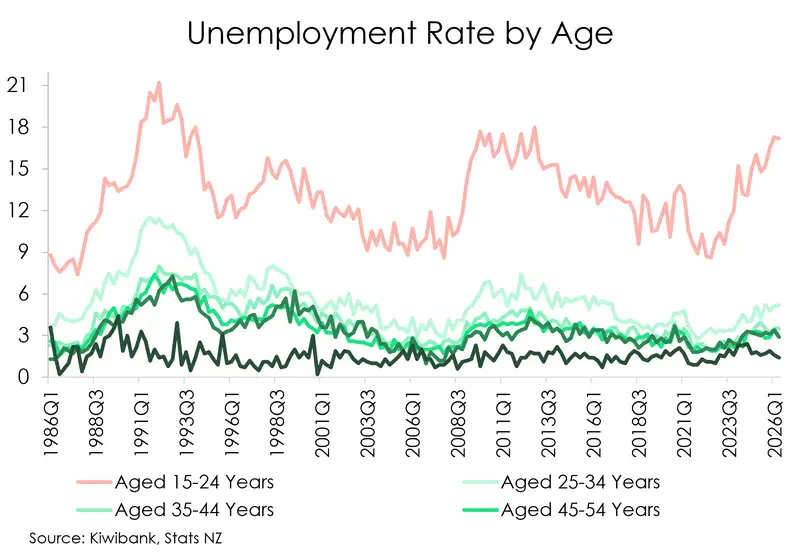
In this week’s chart, we highlight how economic downturns can have disproportionate effects on young people. A downturn hits young people harder and faster. The unemployment rate for young Kiwi aged 15 to 24 was 17.2% in June. Not really backing down from the March quarter 17.3% (a 14- year high). The next closest age group, those aged 25 to 34, have an unemployment rate of 5.2% (a 9-year high).
Historically, youth unemployment has always been elevated relative to older groups, but the current level is among the highest seen since the post-COVID recovery period. Young workers are typically concentrated in sectors such as retail, hospitality and other discretionary services, which tend to weaken early during economic downturns. Their lower levels of work experience also make them more vulnerable when hiring demand softens.
The rest of the workforce seems barely affected. Those aged 35 to 44 have an unemployment rate of 3.5%. We also had a rate of 2.9% for the two groups aged 45-54 and 55 to 64. Across the board, the older age groups had lower unemployment rates in the June quarter of 2026 than they did in in the June quarter of 2025. Things are improving for the older, more experienced, part of the population.
The painful reality is that the first jobs to get cut are at the entry-level. Businesses owners looking to cut costs will try to do more with less. They ask their more senior workers to take on some of the administrative work, or they outsource some tasks to AI. That means fewer hours available for young people hoping to build up their resumes.
The very low unemployment rate among older workers partly reflects the fact that individuals remaining in the labour force at these ages are often highly attached to work and possess specialised skills. Many employers continue to face skill shortages in experienced occupations, helping to support employment outcomes for older Kiwi.
As unemployment rises across the board, more experienced workers also become easier and cheaper to hire. Employers are more likely to get job applications from experienced, predominantly older, workers. That leaves young people at a disadvantage.
The most striking feature of the data is the persistent disadvantage faced by 15 to 24-year-olds. Since records began in 1986, youth unemployment has consistently been two to four times higher than unemployment among prime-age workers. The data also shows that this is not the first time youth unemployment has skyrocketed well beyond that of other age groups.
Youth unemployment peaked above 20% during the early-1990s recession, reaching 21.2% in the first quarter of 1992.
Unemployment for young people rose to around 18% during the aftermath of the Global Financial Crisis and early-2010s period.
This demonstrates that younger workers act as the labour market's shock absorber. They are typically the first group affected when conditions deteriorate.
All content is general commentary, research and information only and isn’t financial or investment advice. This information doesn’t take into account your objectives, financial situation or needs, and its contents shouldn’t be relied on or used as a basis for entering into any products described in it. The views expressed are those of the authors and are based on information reasonably believed but not warranted to be or remain correct. Any views or information, while given in good faith, aren’t necessarily the views of Kiwibank Limited and are given with an express disclaimer of responsibility. Except where contrary to law, Kiwibank and its related entities aren’t liable for the information and no right of action shall arise or can be taken against any of the authors, Kiwibank Limited or its employees either directly or indirectly as a result of any views expressed from this information.