

- Employment in New Zealand did not grow by enough to offset the increased number of workers entering the workforce. This drove the unemployment rate above expectations at 5.6%. High underutilisation and a decline in hours worked indicates a soft labour market.
- The job situation in the US was also soft. A falling unemployment rate was driven by an exodus from the workforce. And the US recorded a decrease in jobs.
- Financial markets were spurred on by tech sector earnings and hopes of a re-opening of the Strait of Hormuz. But hopes faded by the end of last week. Oil is trading at fair prices, but remains elevated and volatile.

Labour market data for the June quarter was both surprising and mixed. Unemployment was 5.6%, higher than market expectations, and a significant step above our optimistic forecast of 5.3%. We thought the worst of last year’s recession was behind us. The labour market usually lags the rest of the economy by 6-9 months. We had some growth momentum in the second half of last year. But clearly it was not enough. We continue to expect the unemployment rate to push higher by the end of the year, when the full impact of the Middle East conflict shows up.
As with any labour market data release, unemployment was the focus. But it’s more than that, it must include underemployed people. And our underutilisation rate spiked to the highest level in 12 years, at 13.8%. That rate implies Kiwi workers are struggling to get the amount of work they want. They may have a job, but they’re not earning enough, as seen through the small decline in total hours worked across the economy.
The cost of everyday goods and services continue to rise faster than wages. Wage growth was stuck at 2%. Paired with the 4.1% inflation rate over the same period, it shows Kiwi households continue to be worse off in real terms.
Although things were grim overall, there were some green shoots. Employment grew, meaning the economy was adding new jobs. It simply wasn’t enough to offset the growing labour force. The participation rate rose from 70.4 to 70.7%, meaning more Kiwi are looking for work.
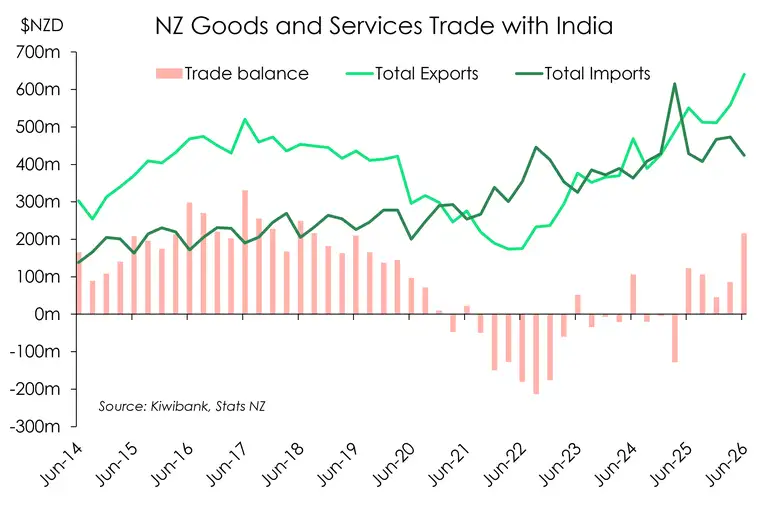
Be sure to read our take on the labour market data and our chart of the week.
Overall, this labour market release was another sign of softness in the Kiwi economy. And things will likely get worse before they get better. Even so, we do not expect this to change the Reserve Bank’s course of action. The RBNZ has set us up to deliver two more rate hikes this side of Christmas. They have communicated the view that a swift return to neutral rates is the preferred approach. Market pricing supports this view.
The US also had labour market data out last week. Similar to NZ, the data wasn’t pretty. The US economy shed 23,000 jobs in July. That is way below expectations of an increase of 80,000. June jobs data was also revised down. Hourly earnings were up 3% annually compared with 3.7% prior and below expectations of 3.4%. The unemployment rate actually fell from 4.2% to 4.1%. But the fall was largely driven by an exodus from the workforce, particularly retirements. This could be seen as good news. Because financial markets have performed well, enabling retirement.
Oil initially fell in the first half of last week off the back of optimism that a path to re-opening the Strait of Hormuz was being forged. However, negotiations between Oman and Iran appear to have stalled which took some wind out of the sails. Oil prices remain elevated and volatile, but thankfully below July peaks. It’s little comfort to Kiwi motorists and businesses who are still likely seeing the impact of those July peaks flow through to the pumps in NZ.
Financial Markets
The comments below were provided by Kiwibank traders. Trader comments may not reflect the view of the research team.
In Markets – A Softer Labour Print, But the Tightening Story Remains
Last week, the continued themes of local data and broader geopolitical developments continued to play out in rates markets. The added pre and post-BoJ coordinated USD/JPY currency intervention at the tail end of the prior week also within scope, particularly with initial reports of the ability to use the Fed's repo facility. The prospect of renewed efforts to broker a Gulf ceasefire, aimed at reviving the prior deal that had broken down, gained traction in markets during the early stages of the week. Lower oil prices, alongside reports of the ability to use the repo facility instead of outright US bond sales to cover the intervention, initially saw rates supported before waning optimism. A mix of Fed-speak that on balance landed on the hawkish side, issuance, and pre-payrolls worries all weighed.
However, the main event for our market was the Q2 labour market statistics on Wednesday, with additional interest also provided by reported comments from the RBNZ Governor. The story prior to the data release had the Governor reiterating the goal of achieving low and stable inflation and pushing back against those who would see the current rate of inflation as just the new normal. In the lead-up to the release, rates had traded a touch lower due to moves offshore. The headline unemployment print of 5.6% was higher than market consensus of 5.4%, though this higher headline was attributable to a jump in the participation rate to 70.7% from 70.4% previously, meaning an expansion in the pool of workers. The impact of this on the headline rate can be seen, for instance, if you hold the participation rate unchanged at the prior quarter’s level in the calculation; this would have rendered a headline print around 5.2%. Other metrics in the data did paint a slightly better picture than the headline suggested, with quarterly employment growth at +0.5% against +0.1% expected, and earnings growth also higher in the quarter, with private sector wage inflation at +0.7% against +0.6% expected.
Though, to be fair, many will point to a lift in the underutilisation rate to a multi-year high as indicative of the slack that remains in the labour market and something that may well keep wage inflation in check. Our economics team also covered those aspects, as well as an informative regional breakdown, in their release on the day. Market reaction saw the NZD immediately lower on the headline print, though perhaps not as far as you would have expected given the size of the headline figure, working its way to around 0.5870 from the mid-0.5890s, while rates markets continued to add to an earlier pre-data move lower, with the 2-year IRS finishing around 8 points lower on the day at around 3.62%. Near-term pricing saw tightening expectations pared back, with year-end implied OCR falling to around 3.03% from 3.08% prior, and one year out to around 3.42%. As I have previously noted, the core view remains around a 3.00% year-end target, with the implied pricing likely ranging between 1½ and 2½ 25-point moves. The weaker headline print, coupled with some of the firmer components coming on the heels of the elevated but relatively stable period-ahead inflation expectation measures in the business and consumer surveys, is likely to further support the measured RBNZ tightening approach scenario.
Thursday and Friday really saw the market return to watching geopolitical and offshore developments, where the market viewed the further detail emerging on the proposed Iran-Oman plan to open the Strait as potentially less acceptable than the initial headlines earlier in the week may have suggested. US rates markets saw yields trade higher in response, with Brent crude trading back through USD 80 per barrel towards USD 83, while additionally a press report that the Fed Chair was seemingly more amenable to raising rates if CPI printed strongly, further Fed-speak that landed predominantly on the firm side, and a weight of corporate bond issuance were all cited as factors. These dragged rates generally higher globally. Ahead of key US payrolls data, the short end of the curve had moved to reprice near one Fed tightening by year-end, and another by H2 2027. Ahead of the RBA meeting on Tuesday, Australian market pricing centred on no change, though it had not entirely ruled out the chance of another RBA move this cycle, with a 3.53% implied rate priced by the end of Q1 2027. The end of the week saw US payroll data print negative job creation for the month of July, coming in at -23k against +80k expected, though the headline unemployment rate printed lower at 4.1% against the expected and prior 4.2%. Again, the participation rate played a role, declining to 61.4% from 61.5%, which supported a lower headline unemployment print in a move opposite to that seen here. US rates rallied on the back of the monthly decline, with Treasuries on average about 4 points lower, while implied pricing saw Fed Funds futures chalk up gains, with year-end pricing shaving around 5 points off the implied rate to around 75% priced. H1 2027 pared expectations back to around 42 points of cumulative tightening.
Looking ahead, this week we see the quarterly release of the RBNZ Survey of Expectations, where the focus will be on two-year-ahead inflation expectations and the manufacturing PMI survey. With the MPS less than a month away, recent data has probably tended to support the view of a moderate approach to dialling back the current policy accommodation, and with that in mind, the familiar themes noted in prior commentaries likely remain in play. Within the context of likely higher overall rates, after all, this is a tightening cycle, there may be renewed interest in outright shorter-term accrual-type received positions following the unemployment data. The front of the curve in the one to two-year area, where the view might be that the market potentially remains over-priced at more than two hikes by year-end. Or those with a forward-start element, perhaps the one-year forward-start one-year and one-year forward-start two-year, both of which have recently seen the 4.20% level cap, may draw further interest. The forward starts may also lend themselves to spread trades that benefit from some roll-down the curve while providing some insulation from outright moves, with the view of maintaining a normal, not inverted, curve. Noting that this particular combination was flat only a few weeks ago and now sits at around 8 points. For the week, the 2-year IRS finished at 3.67% (-1bp week on week), the 5-year IRS at 4.03% (unchanged), and the 10-year IRS at 4.41% (+3bp), while the year-end implied OCR sat at around 3.03% (-5bp). As with all things markets, and particularly at the moment, sentiment remains vulnerable to rapid changes in the geopolitical environment and/or shifts in the data, so views will need to be reassessed as these unfold. Graham Hughes, Trader – Financial Markets.
In FX – the NZD consolidated its late-July gains last week
Risk sentiment softened into the end of the week as renewed uncertainty surrounding a potential Iran-US agreement lifted oil prices and weighed on equities. Brent crude rose back above USD 83/bbl, US stocks declined, and Treasury yields moved around 6bps higher, with markets focused on whether the US 10-year yield will retest its early-2025 highs.
NZD/USD remained range-bound below 0.5900 for the bulk of the week, closing the week near that level after briefly reaching a high of 0.5910 mid-week. The Kiwi's performance last week was largely one of consolidation following its strong rally in late July. New Zealand's Q2 labour market data did little to dent the currency, with expectations for further RBNZ tightening continuing to provide broad support.
The softer-than-expected US non-farm payrolls report kept the DXY on the back foot into the weekend. The US dollar also remains under some pressure following the previous week's yen intervention. Markets continue to question whether the Fed will act decisively enough to contain inflation, although these themes were already evident before the payrolls data disappointed. This week sees attention move to July’s US CPI print to understand if the softening employment picture leads to a deflationary outlook and potentially a reduced need for Fed tightening.
Closer to home, New Zealand's Q2 employment data reinforced the view of a gradual economic recovery. However, spare capacity and contained wage pressures suggest little change to RBNZ expectations. NZD/AUD remained range-bound between 0.8320 and 0.8390. Tomorrow's RBA policy decision could provide the catalyst for a break above 0.8400 should the Bank signal it is comfortable remaining on hold for the foreseeable future. Mieneke Perniskie – Senior Dealer, Financial Markets.
The Week's Key Events
- Domestically, we have REINZ housing data to look forward to, as well as BusinessNZ manufacturing PMI and Stats NZ travel & migration data. The Reserve Bank will also release the findings of its Survey of Expectations, which will reveal the latest 2-year ahead inflation expectations.
- Across the ditch, The Reserve Bank of Australia will make an interest rate decision. It is widely expected to hold rates at 4.35%.
- The US inflation data will be released this week, with both consumer and producer price indexes.
All content is general commentary, research and information only and isn’t financial or investment advice. This information doesn’t take into account your objectives, financial situation or needs, and its contents shouldn’t be relied on or used as a basis for entering into any products described in it. The views expressed are those of the authors and are based on information reasonably believed but not warranted to be or remain correct. Any views or information, while given in good faith, aren’t necessarily the views of Kiwibank Limited and are given with an express disclaimer of responsibility. Except where contrary to law, Kiwibank and its related entities aren’t liable for the information and no right of action shall arise or can be taken against any of the authors, Kiwibank Limited or its employees either directly or indirectly as a result of any views expressed from this information.