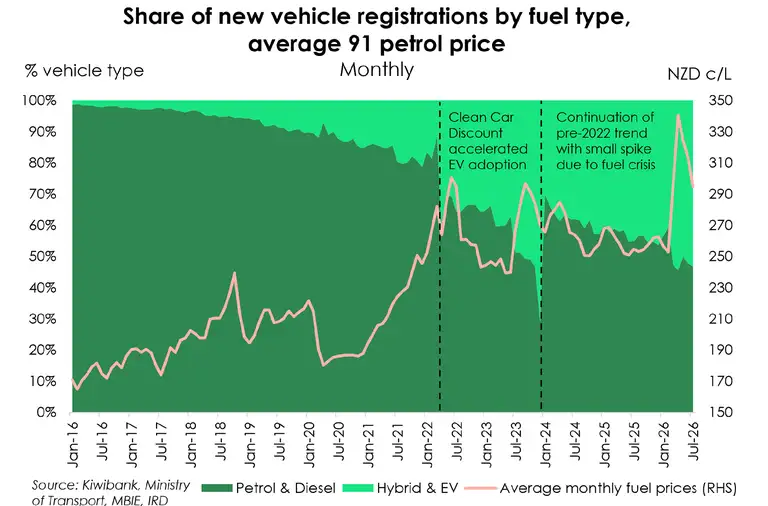

- Inflation data is out this week. The consensus view is that inflation for the June quarter will print at 1.4% quarter-on-quarter, and 4.0% year-on-year. Despite being above the Reserve Bank’s target band of 1-3%, we aren’t panicking. The spike in the June quarter will be driven by fuel prices which have since eased.
- A weak Kiwi dollar and new trial scheme for easier travel between Australia and New Zealand for eligible Chinese passport holders supported strong tourism data. Visitor arrivals in May 2026 printed at 93% of pre-pandemic May 2019 arrivals.
- Electronic card spending data surprised to the downside, with spending falling 1.2% in June. The reversal from the May data is surprising given the drop in fuel prices in June. Households are exercising caution amidst economic uncertainty.

We’re looking ahead to Tuesday’s inflation print with pessimism. We know it will print high. Consensus sees it landing at 4.0% year-on-year and 1.4% for the quarter. 4.0% is well above the Reserve Bank's target band of 1-3%. We aren’t panicking about this though, the inflation spike is expected. It will be driven by the increased oil prices we saw in April and May.
The important part, from the RBNZ’s perspective, is the domestic (non-tradable) component of inflation. Domestic generated inflation will show how much (if any) of the fuel price increases are passing into local prices. The Reserve Bank wants to minimise the pass-through. This is why it hiked the interest rate in July and has warned that more hikes are likely before year end.
A lower inflation print, specifically a lower non-tradable inflation print, will give the Reserve bank more room to breathe. And this might mean we only see one more rate hike this year instead of two. A higher inflation print will give them steam to hike to 3% by the end of the year, as previewed in their May monetary policy statement.
Last week we had some high frequency data pointing to a mixed-recovery taking shape across the motu. Stats NZ released May migration data. Migration is showing signs of strength including positive net migration, with seasonally adjusted net migration keeping above 0 since Jan 2025. But Kiwi Citizens are still leaving more than arriving.
Tourism data for May printed at 93% of pre-pandemic May 2019. On a yearly basis, there was an increase compared to May 2025 year. Tourism was supported by a weak Kiwi-Aussie exchange rate and new immigration rules making it easier for some Chinese passport holders to travel between NZ and Australia without a visitor visa.
We also saw June electronic card transactions released during the week. Spending trends suggest households remain cautious and sensitive to the geopolitical crisis. Electronic card spending fell 1.2% in June. This reversal to May data is surprising, given the drop in oil prices that saw petrol costs drop in June. This implies that households are saving rather than spending any perceived spare cash. If this persists, an increase in the savings rate will put downward pressure on inflation.
When households are cautious and have used up their savings buffers to overcome a difficult time (such as the spike in the price of petrol, diesel and more), they aren’t likely to spend up a storm when cost pressures ease. We are more likely to see household spending track sideways until people are comfortable that their buffers are re-built.
The NZIER Quarterly Survey of Business Opinion for the June quarter showed business confidence improving modestly, with domestic trading activity remaining weak. While conditions in the Middle East improved in the June quarter, volatility still reigns supreme. We discuss the survey responses more in our chart of the week.
Financial Markets
The comments below were provided by Kiwibank traders. Trader comments may not reflect the view of the research team.
Rates – CPI the main event
It has been a week of two-halves. Local releases dominated the first half before US data and Fed-speak came to the fore in the second. Developments in the Gulf and equities provided additional input.
Rates markets remained on the back foot early in the week with Monday and Tuesday trade seeing a continuation of the selling seen post-decision. The year-end implied cash rate lifting to around 3.10%, or near 2 ½ 25-point tightenings by close on Tuesday. Two-year swaps were marked around 17-points higher than the Thursday close at 3.70% and the 10-year 14-points higher at 4.36%.
Monday opening saw an initial attempt at a small rally after the post-decision selloff fade early on. After the release of a 50.6 expansionary-territory PSI print, comments from an MPC member indicating that policy remained stimulatory, and later in the afternoon a jump in the RBNZ’s GDP now Q2 and Q3 reads (released Monday due to the Friday holiday). Tuesday saw the pressure remain with a firmer QSBO and a speech by the RBNZ Chief Economist Paul Conway taken as hawkish by the market. As was noted in the MPR the prior week, general confidence and the extent to which recent cost increases were able to feed through into higher prices were seen as important considerations for medium-term inflation and policy going forward. The market viewed the speech as on the hawkish side, with particular notes around the behavioural response to cost shocks and whether these fade or become embedded, how policy may need to adapt depending on the inflation environment and how this may need policy to respond more firmly to re-anchor expectations, and how research on price setting behaviour sees a quicker pass-through on costs. Additionally, it was noted that there may be some upside risk to their Q3 inflation forecast. That was page 2 of 11, but markets had probably read enough by then. The QSBO reported a lift in business confidence in Q2, and of more interest for the RBNZ, a lift in inflation pressures reported by firms and a net 41% firms noting being able to pass those costs on.
The second half of the week was dominated by US CPI and various degrees of Fed-speak. US CPI printed lower with the core measure at 2.6% y/y against a 2.8% expected which sparked a reassessment of the priced tightening path with this sliding to well below one 25-point move priced. Fed-speak generally remained on the hawkish side though, noting concerns by various members about above-band inflation. Importantly Fed Chair Warsh, while referencing that the print was positive relative to expectations, though he was not for cherry-picking data. By the end of the week the front of the US curve had moved back to price in one 25-point move as highly likely, though this remained off the more than one that had been priced prior to CPI. The US moves did lend some strength to the NZ rates market that had to that point moved reasonably quicky post the RBNZ. The local rally appeared stilted and perhaps lacking a full degree of conviction ahead of the local CPI with year-end cash still pricing above 3%. The Q1 and Q2 2027 average cash pricing also remained significantly above the MPS forecasts, with Q1 marked around 18-points higher than the previously 3.00% assumed in the May projection. While Q2 was seen around 30-points higher at 3.37%. By the end of the week, December OCR was pricing at 3.06% (+6-points w/w) while 2-year was 3.62% (+10 w/w) and 10-year 4.35% (+13 w/w).
For the week, the key piece of information for us will be CPI. The QSBO perhaps provided new information last week, that is, that pricing power to a degree may be more apparent and potentially broad-based than thought. With the various releases from the RBNZ talking to this being a factor as to whether inflation will embed or not, will add even more weight to this dataset. Having noted this, the market remains vulnerable to a weaker than expected print not insofar as derailing a tightening cycle, but seeing a repricing jiggle of the timing up front i.e., perhaps 2+ tightenings by year-end trades to 1+ tightenings. Potentially the very front of the curve will be where the action is. Also adding some extra interest will be that we start to hit the main Central Bank decisions this week and next, including ECB, Fed, and BoJ. Graham Hughes, Trader – Financial Markets.
In FX – The focus is the CPI print for the Kiwi
While the NZD continues to benefit from relatively hawkish RBNZ expectations and improving domestic activity indicators, those positives were overshadowed last week by resilience in the USD, higher US yields, and softer global risk sentiment. The next major test for the currency will be tomorrow’s CPI print and its implications for the RBNZ policy outlook.
After being well supported the previous week by the RBNZ's hawkish Monetary Policy Review and stronger domestic data, the NZD struggled to extend gains last week as global factors took centre stage. The key domestic catalyst remained the RBNZ's 25bp hike and accompanying guidance, which reinforced expectations that further tightening may be required. This, combined with June's strong BusinessNZ Performance of Manufacturing Index and improving business sentiment in the QSBO, helped underpin New Zealand rate expectations, with markets continuing to price around 75bp of additional tightening by mid-2027. The resulting outperformance of New Zealand short-end rates relative to Australia drove NZD/AUD to a high of 0.8370 by the end of the week.
However, support from domestic factors was offset by a firmer USD environment. After an initially quiet week, stronger-than-expected US labour market data, including a decline in jobless claims, alongside continued hawkish Fed commentary, helped the USD recover. Markets modestly increased the probability of further Fed tightening, pushing US yields higher and lifting the USD index from around 100.50 to 100.75. As a result, NZD/USD traded with a largely defensive tone, slipping from around 0.5850 to the low 0.5840s by week's end. The AUD also weakened, falling back below 0.7000, highlighting the broad-based nature of USD strength.
Risk sentiment was mixed through the week. Equity markets softened, led by renewed weakness in technology and semiconductor stocks amid concerns over AI-related investment spending. Asian equities were also under pressure, with both the Nikkei and KOSPI posting sizeable declines. Despite ongoing tensions in the Gulf region, oil prices moved lower, reflecting concerns around global demand and providing little support for commodity-linked currencies. Mieneke Perniskie – Senior Dealer, Financial Markets.
This Week's Key Events
- The key release coming up this week in NZ is inflation data for the June quarter of 2026.
- Australian labour market data is out this week, as is a slew of data from the UK including inflation, labour market, retail sales and consumer confidence.
- S&P are releasing PMI data for several key economies including the US, Japan and Australia.
All content is general commentary, research and information only and isn’t financial or investment advice. This information doesn’t take into account your objectives, financial situation or needs, and its contents shouldn’t be relied on or used as a basis for entering into any products described in it. The views expressed are those of the authors and are based on information reasonably believed but not warranted to be or remain correct. Any views or information, while given in good faith, aren’t necessarily the views of Kiwibank Limited and are given with an express disclaimer of responsibility. Except where contrary to law, Kiwibank and its related entities aren’t liable for the information and no right of action shall arise or can be taken against any of the authors, Kiwibank Limited or its employees either directly or indirectly as a result of any views expressed from this information.