

- Labour market data is out this week. We expect it to track sideways, with the unemployment rate at 5.3%. The softness in the labour market will continue to hold back wage growth, without a wage-price spiral.
- With input costs going up, Kiwi businesses are struggling to operate on thin margins. Kiwi households are also operating on thin margins. Both are sensitive to prices going up any further.
- The hostilities in the Middle East eased over the weekend (but we said that last week too). The US stock market has been sensitive to Fed decisions, and tech sector earnings. On balance, sector earnings have put more wind in their sails than the Fed has taken out.
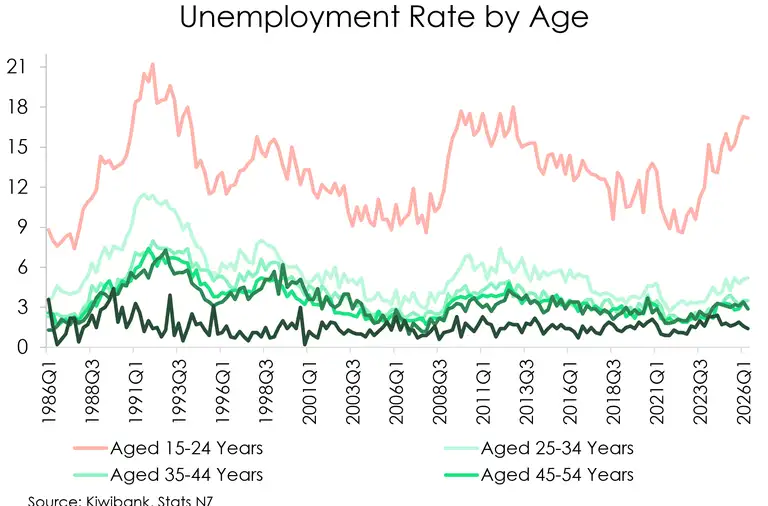
We’re looking forward to June quarter labour market data out this Wednesday. We expect the unemployment rate to remain unchanged, at 5.3%. That’s slightly below the RBNZ’s forecast. But we are not out of the woods yet.
The labour market is slow to respond to hard times. The first things Kiwi business owners cut are investment and hiring intentions, maybe hours. But not jobs. Most business owners will hold on to their staff for as long as possible. Three months of elevated costs from fuel are wearable. Therefore, we are not expecting a spike in unemployment in the June quarter. Not yet.

As Kiwi businesses face higher costs, the risk is that their margins will be eroded to the point of failure. Some are skating on thin ice. Many businesses are trying to pass on costs, with great resistance from customers. That leaves shrinking margins and the need to cut costs (elsewhere). The debate is hot on whether they will be successful. We are on the demand destruction side of the argument. Kiwi households have been wearing costs of their own, and won’t react well to prices going up. Households have very little (if anything) left over to spend at the end of each week. This makes them more sensitive to changes in prices, especially for non-essentials.
We expect inflation will have peaked in the June quarter, and that the softness in both demand and the labour market will keep a lid on wage growth. No wage growth means no wage-price-spiral, which means no need to panic about inflation getting out of hand.
Last week was dominated by the US Fed’s decision. The committee voted 9 to 3 for a hold, with dissenters in favour of a hike. The hawkish hold caused a spike in the 10-year US Treasury bond rates, up over 4.74%. But equity markets were not bothered. Despite immediate drops in the S&P 500, Nasdaq and Dow, all exchanges closed higher on Friday. Apple captured the headlines with strong earnings. And they are not alone. 84% of companies in the US tech sector were meeting or beating earnings estimates.
The Bank of England and Bank of Japan also voted to hold last week.
Over the weekend, negotiations between the US and Iran have progressed. Apparently. With a “deal” seeming more likely. Have we heard that before? Yeah… all too often. The price of both Brent Crude and West Texas Intermediate oil have tracked sideways since last Wednesday. The oil price has come down sharply from the spike two weeks earlier. The glass remains half full, for now…
Closer to home, we had Australia’s inflation rate print lower for the year in June, with the trimmed mean measure holding steady. We expect the RBA to hold their cash rate steady in their August meeting.
And finally, we had a quiet week for data in NZ. The housing market has been a particular focus, with house prices tracking sideways and down. Wellington and Auckland have held down the North Island. But the South Island is pulling up the national average with super strong performances in the deep south, especially Queenstown.
Financial Markets
The comments below were provided by Kiwibank traders. Trader comments may not reflect the view of the research team.
Rates – Confidence rebounds and Employment data to look forward to
Last week was a busy one for data, central bank commentary, and geopolitics. NZ rates finished the week lower, with the implied path seeing movement particularly in H1 2027. The 2-year IRS closed at 3.68% (-13bps w/w), the 5-year at 4.03% (-12bps), and the 10-year at 4.38% (-12bps). Meanwhile, the year-end implied cash rate was a couple of basis points lower at 3.08%, while the June 2027 meeting was around 11bps lower at 3.50%.
Monday saw rates open lower. A reported pause in Middle East hostilities lent support to US rates, while oil was marked sharply lower. A comment in the regular Treasury economic summary on the prior week's CPI, noting that spillovers to other prices appeared limited, was also seen as supporting the tone as the market sought to recoup some of the prior Friday's rate rout. Both the NZ and Australian implied cash rate curves shaved a few basis points from their priced paths. The Australian one-year-out rate fell by around 8bps, while ours was only a couple of points lower, although more movement was seen in Q1 2027 pricing. The key near-term local focus remained an upcoming speech by the RBA Governor on Tuesday and Australian CPI on Wednesday, with NZ business and consumer confidence measures not due until later in the week.
The RBA Governor maintained a hawkish line, noting that while core CPI had evolved broadly as expected, it remained too high. She added that it was still unclear whether rates had been hiked sufficiently to return inflation to target, although she also noted that the full effects of earlier hikes would take time to pass through. The Q&A touched on the fact that CPI had been outside the target band for some time and that this added pressure to restore it, while acknowledging that conditions were already somewhat restrictive. Interestingly, when discussing employment, she noted that sustainable employment requires low and stable inflation, as these are the conditions in which businesses can go about their business. Nevertheless, the rates market took the speech as a reason to buy, with participants noting that while the speech sounded hawkish, it did not provide a firm indication of further hikes.
Wednesday brought the Australian CPI release. Ahead of that, it was reported that a local politician was seeking to reinstate the RBNZ's dual inflation-employment mandate. This was notable given the RBA Governor's comments on employment and the current RBNZ remit, which charges the Committee to "have regard" to such matters. CPI printed lower than expected, with headline inflation at +0.6% q/q and +3.8% y/y. The trimmed mean also came in below expectations at +0.8% versus +0.9% expected. This provided another reason to buy rates, with the Australian curve moving around 10bps lower in the 2-3 year and around 6bps lower in the 10-year sector. The move spilled over into our market, with the front end rallying by around 5bps. The AUD also weakened in response, with the NZD/AUD cross moving higher. Implied cash rate paths shifted lower, with Australia's terminal rate now marked around 4.48%, down from 4.70% just a few days earlier indicating around a 50% chance of one further tightening, down from more than one full hike previously priced. Our curve also pulled around 11bps of implied tightening from the path, with the June 2027 meeting marked around 3.49%.
Thursday saw the FOMC leave rates unchanged in a 9-3 vote. The accompanying statement summarised the current environment, noting that price pressures remained elevated in some sectors, not just energy, and that supply shocks continued to play a role. There was little in the way of forward-guidance. While no change had been the consensus expectation, the decision prompted a rapid steepening of the curve, with front-end yields lower and back-end yields higher. Fed Chair Warsh noted that the reduction in forward guidance would require a period of adjustment and that the central bank need not be the centre of attention. His view appeared to be that markets should be allowed to respond more directly and promptly to incoming data, which he framed as a positive development. US rates pivoted around the five-year sector, with 2-year Treasury yields falling around 5.5bps while 10-year yields rose by a similar amount. Short-end pricing also trimmed the probability of year-end tightening to around 80%.
Locally, Thursday and Friday brought business and consumer confidence releases with improvements in both. The business activity indicator rose to 49.3 from 36.9, including a lift in construction sector confidence. Consumer confidence increased to 99.3 from 91.3. Of greater interest to the RBNZ were the relatively steady inflation expectation measures. The business survey showed one-year-ahead inflation expectations falling to 3.14% from 3.36%, while consumer inflation expectations remained elevated. These outcomes likely provided support for a measured RBNZ approach to further tightening.
Looking ahead, this week's employment data will be a key focus, particularly given recent discussion in some circles around reintroducing a dual-mandate-style framework. The prevailing view is likely that employment would need to come in materially stronger than expected to trigger a meaningful reassessment of the implied tightening path. Conversely, an in-line or slightly weaker result would probably support a move back toward a base-case scenario of two further tightenings by year-end. With the front end of the curve currently trading above that scenario, similar trade themes to those highlighted last week may remain relevant. For instance, trades that benefit from the passage of time and curve roll-down could continue to attract receiving interest in the 1-2 year sector, or in the 1y1y forward, which has previously found a reasonably solid cap around 4.20%. Likewise, spread structures that benefit from roll-down while providing some insulation from outright directional moves, whether spot or forward-starting, may continue to attract interest. As noted previously, however, these ideas rely on an orderly employment print and a degree of market normality, meaning the attractiveness of such trades will need to be reassessed as incoming data unfolds. Graham Hughes, Trader – Financial Markets.
In FX – Central banks and likely intervention were the focus:
The past week was dominated by central bank decisions, with currency intervention providing a dramatic finish. Market participants were focused on the Fed's FOMC decision, where rates were left on hold as expected. However, markets were disappointed by the forward guidance, questioning Fed Chair Kevin Warsh's resolve to contain inflation. With markets largely in a holding pattern at the start of the week, albeit with some DXY strength ahead of the Fed decision, most of the action in currency markets was compressed into the latter half of the week. The Kiwi opened near 0.5820 and initially drifted lower to 0.5765. New Zealand's GDP print provided a modest boost, but the real catalyst came following the Fed decision and subsequent Yen intervention.
The FOMC decision carried a hawkish tone on the surface, given the split vote and three dissenters favouring a rate hike. However, subsequent commentary cast doubt on Warsh's willingness to follow through. While he stated that the Committee would act quickly if inflation pressures accelerated, markets generally viewed his remarks as lacking conviction. This prompted an initial pullback in the USD. That move was then amplified by what appeared to be a coordinated intervention by US and Japanese authorities in USD/JPY, sending the USD lower and lifting the Kiwi to a weekly high of 0.5879.
The NZD/AUD cross broadly appreciated last week following the softer-than-expected Australian CPI print. After opening the week at 0.8275, widening rate differentials supported the cross, which moved sharply higher to close at 0.8373. Upside momentum remains intact for NZD/AUD heading into this week.
Looking ahead, the key domestic event is New Zealand's Q2 labour market data. Offshore, attention will focus on the US ISM manufacturing and services PMIs, followed by the latest non-farm payrolls report at week's end. Markets will also remain alert to the prospect of further Yen intervention. The Kiwi appears to be at something of a crossroads. Continued evidence of economic recovery should underpin NZD strength over the medium term. However, the week may begin with a modest correction, given the outsized moves seen in USD/JPY last week. Mieneke Perniskie – Senior Dealer, Financial Markets.
The Week's Key Events
- This week we have domestic labour market data for the June quarter of 2026 out on Wednesday. That is all to focus on domestically.
- Across the ditch, Australia has job adds and household spending data, as well as goods trade balances to look forward to.
- The US has a slew of data including Trade Balance, Manufacturing and Services PMI as well as non-farm payrolls. They close the week out with some inflation expectations and Fed speak on Friday.
All content is general commentary, research and information only and isn’t financial or investment advice. This information doesn’t take into account your objectives, financial situation or needs, and its contents shouldn’t be relied on or used as a basis for entering into any products described in it. The views expressed are those of the authors and are based on information reasonably believed but not warranted to be or remain correct. Any views or information, while given in good faith, aren’t necessarily the views of Kiwibank Limited and are given with an express disclaimer of responsibility. Except where contrary to law, Kiwibank and its related entities aren’t liable for the information and no right of action shall arise or can be taken against any of the authors, Kiwibank Limited or its employees either directly or indirectly as a result of any views expressed from this information.