- Budget 2026 delivered no real surprises. As expected, set on the backdrop of a global uncertainty, the Budget revealed a short-term downgrade to the economic outlook.
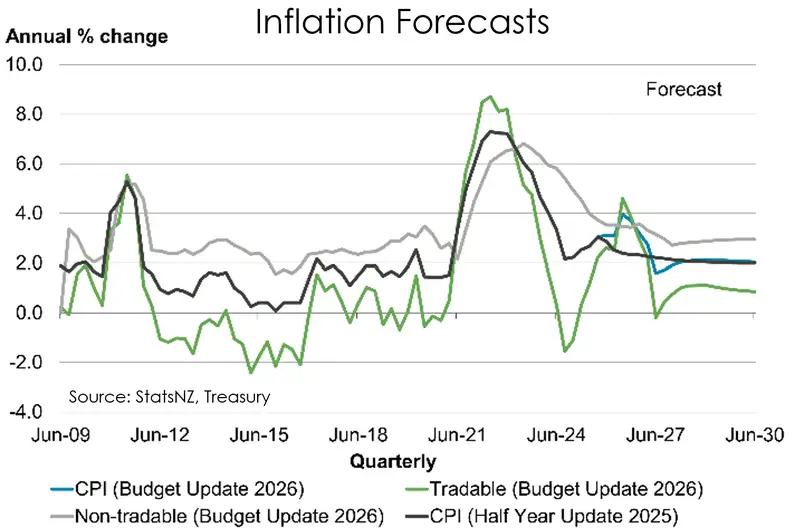
- A more uncertain global outlook didn’t seem to hinder longer term growth in Treasury’s forecasts. Indeed, a rebound is predicted that falls outside our own expectations. Inflation is forecast to peak at 4.0% in the June quarter of 2026, lower than our own estimate of 4.2%. Then it’s forecast to drop to 1.6% by June 2027.
- “Treasury forecasts show the operating balance returning to surplus in 2028/29 and the government debt curve stopping its rise and heading downwards.”
- Winners appear to be health investments, education, and one Road of National Significance. Although with a focus on cutting costs now, the re-allocation of funds are far into the future and far from a lolly-scramble.
The Budget is out and for those looking to satisfy a sweet tooth, it did not deliver. As expected, set on the backdrop of a global uncertainty, the Budget 2026 revealed a short-term downgrade to the economic outlook. However, the Budget relies heavily on an economic conditions improving and rebounding into 2027, 2028 and beyond. The focus of this budget is on consolidation and reducing government budget debt and debt financing costs into the future.
Surprises were few and far between, but we did get a bank levy and a hope of a surplus on the (optimistic-looking) horizon. The budget revealed $3.8 billion of new spending and $1.7 billion in savings. With most of the savings coming from cuts announced before budget day, we are left with no earth-shattering news to digest.
Inflation & GDP forecasts
The Budget’s GDP outlook for the near-term is rosier than our own – and what market consensus is warning. June 2026 Real production GDP is forecast at 1.2% (annual average % change). Inflation is also forecast to peak at 4.0% in the June quarter of 2026, lower than our own estimate of 4.2%. Then it’s forecast to drop down drastically to 1.6% by June 2027.
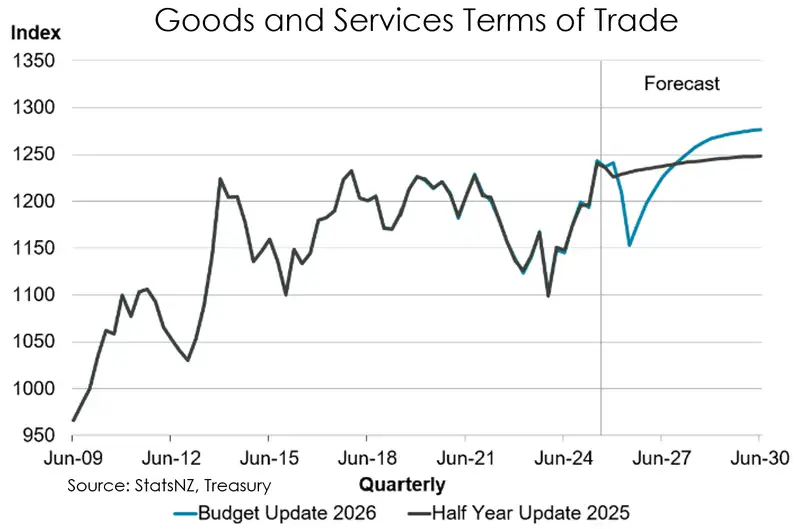
This is underpinned by the assumption that tradeable inflation drops into negative territory (-0.2% yoy) by June 2027. We won’t even touch on how hard terms of trade will have to rebound for this to come true. Okay, we will touch on it – the strong rebound predicted, is off the back of a predicted drop in fuel price.
The Budget assumes that oil prices drop in 2027 and that life goes back to normal. We’d love to be as optimistic, but it’s a big call to make. It’s all uncertain from our point of view, and the budget promises to deliver growth in 2028 and a Budget surplus by 2029… All of that is dependent on the when the war in the Middle East ends. And we can’t say with any certainty when that will be.
Employment & wage growth
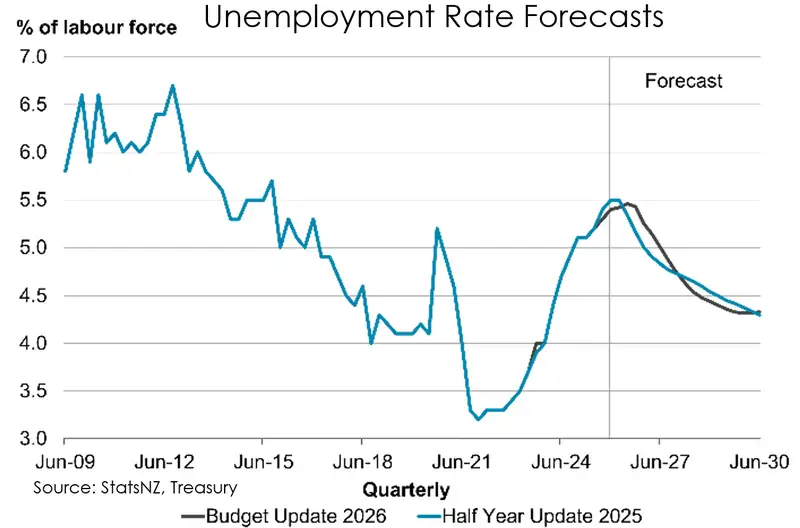
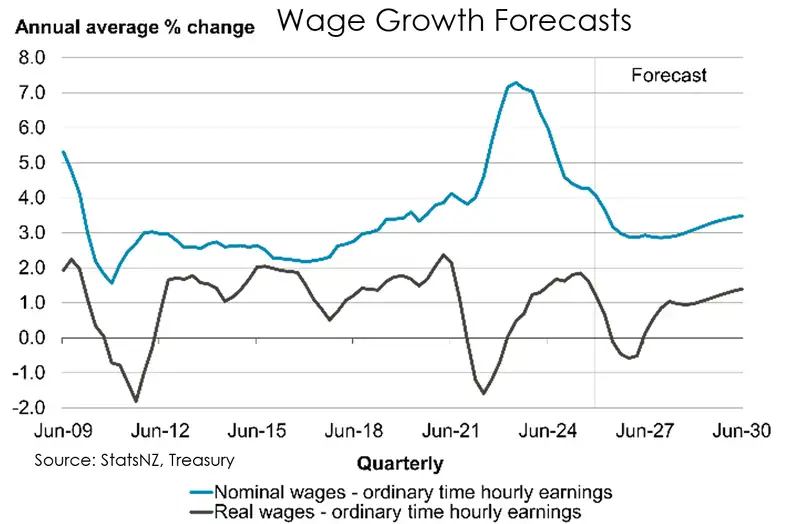
The Budget implies a boost in job growth. The government estimates the re-allocation of funds will create 220,000 new jobs. And Treasury go on to predict unemployment dropping from a predicted peak of 5.5% in the June quarter of 2026 to 4.3% by September 2029. All the while, real wage growth isn’t predicted to grow above 1% until June 2029. Lower unemployment, higher GDP, lower inflation and very little wage growth. What a world that would be, if only...
Government Debt
“Treasury forecasts show the operating balance returning to surplus in 2028/29 and the government debt curve stopping its rise and heading downwards.”
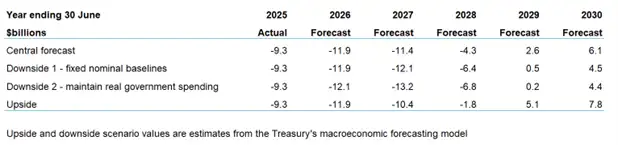
The OBEGALx (Operating Balance Before Gains and Losses, excluding ACC) is expected to remain in deficit until 2028, and is expected to reach a surplus regardless of the forecast scenario.
The central focus of the Budget is on reducing government debt growth. The plan is ambitious and won’t show fruit for many years to come. A lot can happen between now and the projected move into a government budget surplus (2029). A lot can go right. A lot can go wrong. We’ve had the economy derailed too many times in the last few years to really feel as optimistic about our odds. But maybe we’re just jaded.
(Some) budget focus points
Ageing Population & Health
Superannuation is expected to cost the Government $26.5 billion in the coming financial year. One of the biggest areas of Government spending. That is only expected to grow with the ageing population (to $31.3 billion by 2029/30). The burden on the health system is also expected to increase. As such, the Budget puts an emphasis on funding health infrastructure. A total of $5.8 billion is allocated to the health operating budget. Of that, capital investment of $682 million will go towards a new tower block for Whangarei Hospital. There is also $36 million to make the SuperGold Card an official form of ID. Making it easier for our aging population to access services.
Infrastructure: Will one road lead to many?
Some funding going to infrastructure will be spent on the Roads of National Significance. One road, to be exact. The Budget allocates $1.8 billion to the Cambridge to Piarere Expressway. Although often touting “targeted” responses and spending, detail is lacking in how the total $1.2 million (capital and operating funding) going to the Kiwi rail network will be allocated.
Energy security was bound to be a line item. With the international fuel crisis highlighting our how fragile our economy is to fuel disruptions. The new loan guarantee scheme to support businesses transitioning away from gas dependence was previewed before budget day. Although it is likely to apply in very limited cases and have minimal impact.
Education
Some of the savings made from cutting the fees free university initiative have been re-directed back into education. We like to see that. Some $69 million is set to go towards providing free trade training. Although trade jobs offer better long-term employment outcomes, we know that the wage gains from pursuing vocational education and training are modest. We talk about this at length in our latest podcast episode.
Reducing or eliminating the cost of trade qualifications for young Kiwis (from 10,000 to 20,000 students), could prove to pay in employment outcomes in the long run. An additional $87 million is allocated to providing free learning for young people with low or no qualifications, although for a modest sum of 1,000 students. We will take what we can get in an austere budget.
All content is general commentary, research and information only and isn’t financial or investment advice. This information doesn’t take into account your objectives, financial situation or needs, and its contents shouldn’t be relied on or used as a basis for entering into any products described in it. The views expressed are those of the authors and are based on information reasonably believed but not warranted to be or remain correct. Any views or information, while given in good faith, aren’t necessarily the views of Kiwibank Limited and are given with an express disclaimer of responsibility. Except where contrary to law, Kiwibank and its related entities aren’t liable for the information and no right of action shall arise or can be taken against any of the authors, Kiwibank Limited or its employees either directly or indirectly as a result of any views expressed from this information.