A large increase in the value of beef exports to the US coincides with a shrinking American cattle herd and a precipitous drop in Kiwi beef exports to China.
Other factors at play include high global beef prices, up 68% between 2020 and 2025. And a weak NZD relative to the USD has boosted American demand for meat.
2026 is on track to be another record year for beef exports to the US. In June 2026, 4.12% of New Zealand’s entire export value came from beef exports to the United States.
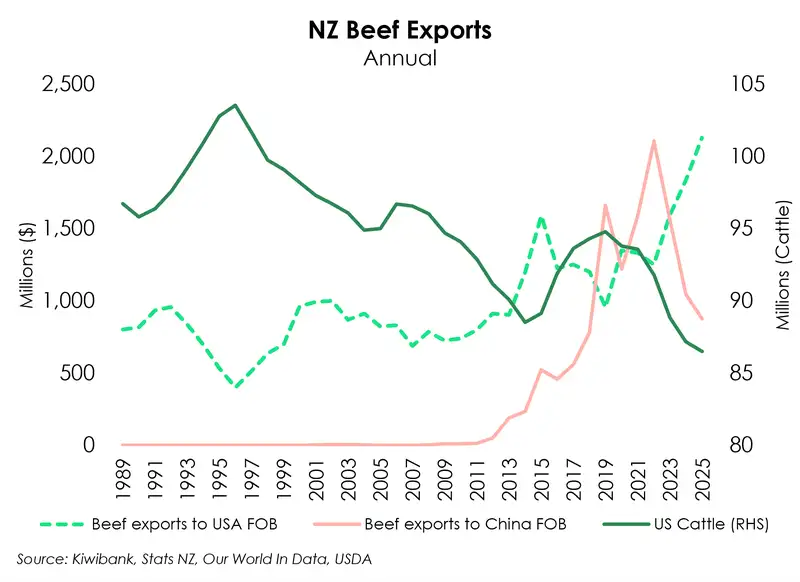
New Zealand has had a good run of luck with its beef exports. Strong US demand for meat picked up the slack left by a sharp decline in beef exports to China. The fall in beef exports to China was partly due to lower demand from Chinese consumers, and partly because China started importing a lot more of its beef from South America.
America’s appetite for beef cannot be satisfied with domestic production alone. A historically low supply of American cattle means that imported beef is needed to fill the gap. The falling number of cows in the US is driven by rising farm costs, environmental conditions, consolidation in the industry and international competition.
A screwworm parasite in Mexico led the US to suspend imports of live cattle from Mexico in May 2025. Mexican cattle accounted for over half of US cattle imports between 2020 and 2024. With Mexican cattle temporarily removed from the US supply chain, it had a negative impact on the US cattle herd size.
New Zealand beef exporters have benefitted from a soft Kiwi dollar, relative to the USD. This has effectively made New Zealand beef a little cheaper. New Zealand beef also fills a key gap in the US market. Much of America’s demand for beef comes from burger patties and sausages. Pasture-raised lean beef is a key ingredient in those products, with New Zealand being a major producer of it.
High global beef prices also helped boost our export performance. Stats NZ’s measure of exports is called FOB, which stands for "free on board." FOB represents the current market value of goods in the country of origin including all costs necessary to get them onboard the vessel or aircraft on which they are exported. A 68% increase in global beef prices between 2020 and 2025 would have fed into a higher FOB for New Zealand beef exports.
The risk for New Zealand is that the US supply shock is temporary. US cattle herd numbers may pick up again in time due to the recent announcement that the US is removing the ban on cattle imports from Mexico. This may offset some of the gap left in the American market which New Zealand beef exports filled.
Even so, the size of the US cattle herd is exhibiting a downward trend that more closely resembles a structural decline rather than a temporary shock. So although the stellar beef exports of June 2026 may be in the rear-view mirror soon enough, New Zealand is still likely to play a significant role in supplying meat-loving US consumers with beef.
For Kiwi consumers, record beef exports to the US comes at a time where the price of mince and steak here at home is painfully high. Beef prices are up 45% between the beginning of 2020 and June 2026 in New Zealand. For as long as Kiwi households are competing with meat-loving Americans for New Zealand beef, barbeques will increasingly become a luxury.
All content is general commentary, research and information only and isn’t financial or investment advice. This information doesn’t take into account your objectives, financial situation or needs, and its contents shouldn’t be relied on or used as a basis for entering into any products described in it. The views expressed are those of the authors and are based on information reasonably believed but not warranted to be or remain correct. Any views or information, while given in good faith, aren’t necessarily the views of Kiwibank Limited and are given with an express disclaimer of responsibility. Except where contrary to law, Kiwibank and its related entities aren’t liable for the information and no right of action shall arise or can be taken against any of the authors, Kiwibank Limited or its employees either directly or indirectly as a result of any views expressed from this information.