
The war in the Middle East has wreaked havoc on shipping through the Strait of Hormuz. Shipping volumes dropped off, decreasing to near zero in March 2026. They remained subdued even during apparent ceasefires and peace negotiations. Since mid-June, we’ve had some signs that a resolution was on the cards. Of course, these peace signals have been mixed. It’s been two steps forward one step back.
Ship volumes through the Strait of Hormuz illustrate how the risks are stacking up.
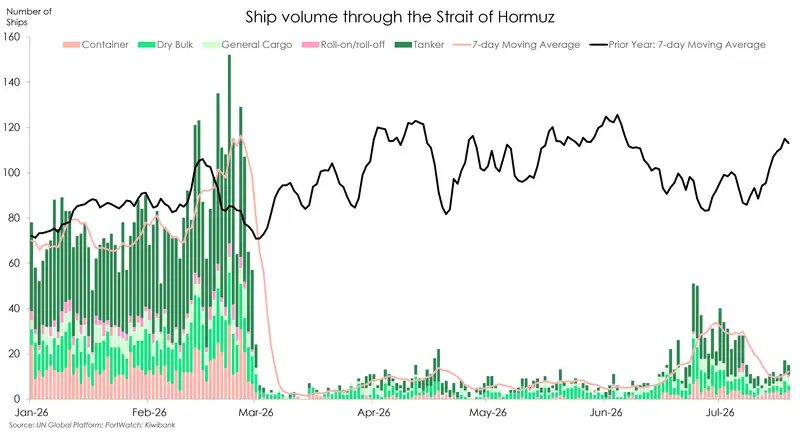
The peace deal to strike a peace deal was signed on 17 June, leading to an instant reprieve in oil prices. Indeed, the price of crude oil dropped to pre-war levels within a week! Shipping volumes however? Lagging behind. So why the divergence? The risk of sending ships through the Strait was still high, insurance premiums still elevated, and crews reluctant to risk their lives. The peace deal was seen as tenuous and fragile. It’s one thing for a market to react, it’s another thing for people (and massive tankers) to make moves.
Despite an initial move up in volumes, small by comparison to pre-war levels, it took several weeks for shipments to pick up steam. Even so, we never even made it halfway to the 5-year average of weekly shipping through the Strait. This is illustrated in our chart of the week by the pink and black lines, and the chasm between them.
The small opening and optimism didn’t last.
Shipping volumes quickly plunged again and have remained low while the ceasefire was violated several times in the past month. No one knows how long the escalations will last, or if they are truly over, as the news has reported over the weekend.
Another reprieve (be it long or short-lived) is likely to see a boost in shipping volumes again and trigger another fall in the oil price (yay!).
We can see that even though shipping decreased after the ceasefire temporarily broke down, it didn’t reach quite the lows of May to July. A few things are contributing. First, people are adjusting to the new level of risk. Becoming more desperate and more desensitised. Second, optimism is higher now that a peace deal is closer than before.
The more ships that make it through, the more will follow suit. This will lead to a lower oil price, which feeds directly into our domestic fuel prices. A bit of relief at the petrol (or diesel) pump will help bring inflation down in the third and fourth quarters of this year.
All content is general commentary, research and information only and isn’t financial or investment advice. This information doesn’t take into account your objectives, financial situation or needs, and its contents shouldn’t be relied on or used as a basis for entering into any products described in it. The views expressed are those of the authors and are based on information reasonably believed but not warranted to be or remain correct. Any views or information, while given in good faith, aren’t necessarily the views of Kiwibank Limited and are given with an express disclaimer of responsibility. Except where contrary to law, Kiwibank and its related entities aren’t liable for the information and no right of action shall arise or can be taken against any of the authors, Kiwibank Limited or its employees either directly or indirectly as a result of any views expressed from this information.