
- The Treasury pulled back the curtain covering the Government’s finances and economic outlook.
- Compared with The Treasury’s last forecast in May, the picture is mixed. The Government’s finances look better than expected in May. A return to surplus is still expected in 2028. But some economic indicators have been downgraded such as higher for longer unemployment.
- Government bond issuance is expected to be $15 billion lower over the next four years compared with what was signalled in May.
We all know that things can get complicated when you’re managing your finances. But we also know how important it is. The same is true of the Government. The Government has money coming in, and money going out.
Twice a year normally, and three times in an election year, The Treasury gives the public a glimpse into the Government’s finances.
Given 2026 is an election year, we get three. We had the first in May when the Budget was announced. This week we had the second, called the Pre-election Economic and Fiscal Update (PREFU). And in December we’ll get the Half Year Economic and Fiscal Update (HYEFU).
As Economists, we naturally find these sorts of releases interesting. But they’re long, dry, and full of numbers. So here are the numbers and facts that really matter.

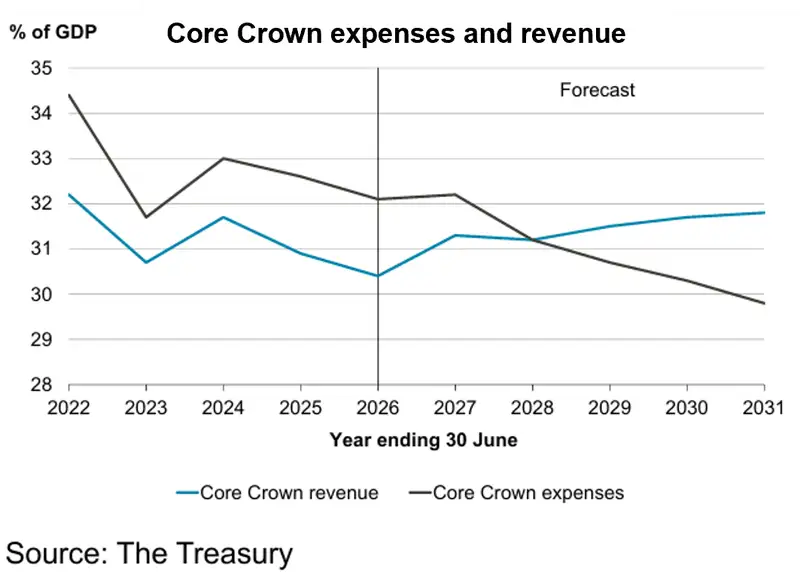
The overall financial position of the Government is better than expected in May. The margins have widened, but not by a lot. In the year to June 2026, the Government’s OBEGALx deficit was $3.3bn smaller than expected. The OBEGALx deficit is simply the gap between what the government earns (mostly through taxes) and what it spends, excluding revenue and earnings from the Accident Compensation Corporation (ACC).
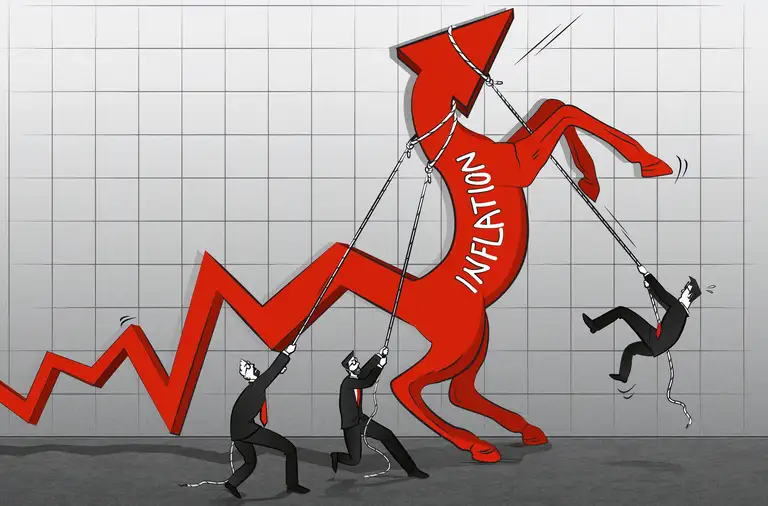
New Zealanders may not be thrilled to hear that a key driver of that smaller gap between Government revenue and expenses was driven by inflation. Because prices have gone up a lot so far this year, the Government collected more tax than expected.
The Government deficit, running since 2020, is forecast to turn into a surplus in 2028/29 (note that these are Government financial years ending June). That expectation is unchanged from May. But the size of that surplus is now expected to be $4bn, up from $2.6bn (0.8% of GDP vs 0.5% of GDP).
Net core crown debt is expected to peak in 2028 when measured as a percentage of GDP, at 43.9%. But in absolute terms, it peaks in 2030 at a value of $232.8bn. That’s lower than was expected in May, representing an improvement.
The Government expects to issue $15bn less in bonds over the next four years. That signals the Government is expecting to need less debt to fund its spending, with decreases of $4bn per year compared with the Budget forecast in May for the next three years and by $3bn in the fourth year.
Medium term economic drivers remain unchanged. The Treasury noted that productivity, net migration and terms of trade continue to be critical for New Zealand’s economic performance over the medium term. Furthermore, most economic indicators including unemployment, inflation and economic growth did not have materially different outlooks over the medium term.
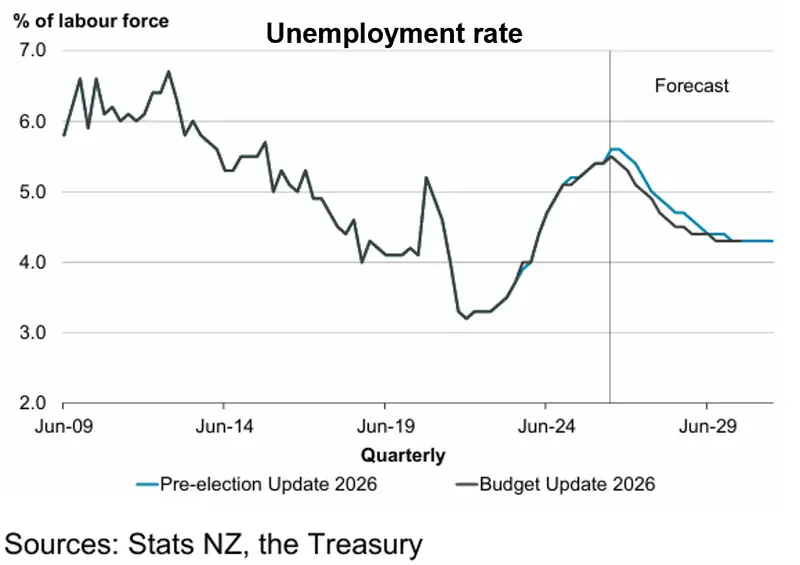
Unemployment and inflation are expected to remain a bit higher for longer. The main uncertainty and risk to both the labour market and inflation, continues to be the elevated price of oil. Energy prices are not showing signs of easing. The stop-start nature of the conflict in the Middle East is creating volatility and risk for us domestically.
With elevated prices comes decreased spending on goods and services outside of fuel and energy. So, household spending could be more subdued for longer. That will continue to weigh on the labour market.
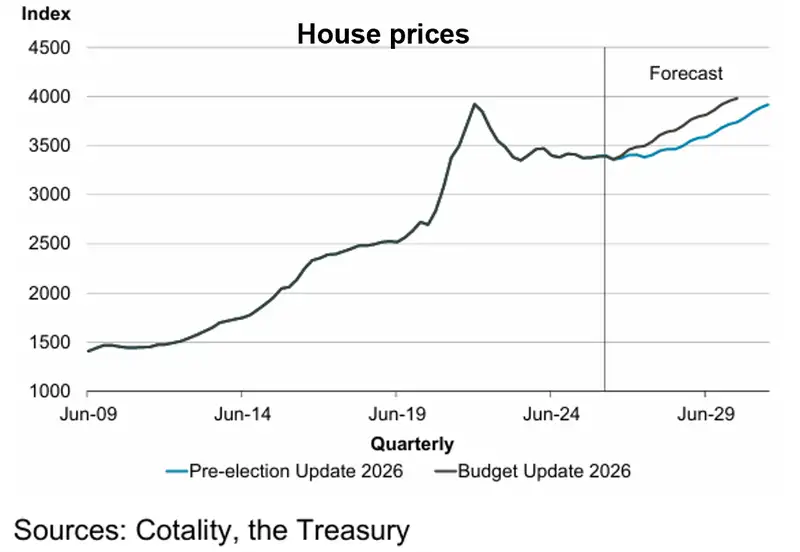
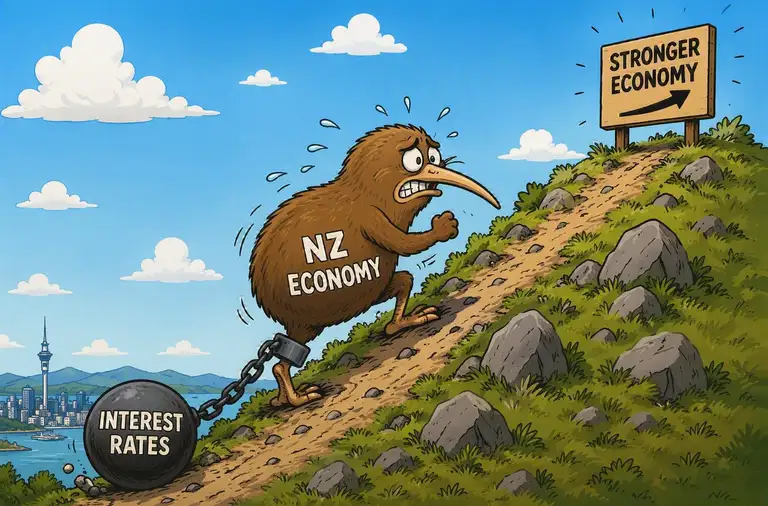
Predictions for house price growth have been slashed. The housing market has been in a slump. In May, Treasury forecasts saw this slump starting to reverse sooner. The higher interest rate environment, higher housing supply, and lower than predicted migration flows, have all dampened Treasury’s optimism.
By and large, we didn’t expect this update to bring sparks, and we must keep in mind that there are a lot of “ifs” involved in Treasury’s forecasts. Not least of all, the outcome of the November elections. There’s nothing in this update to change our view on the best course for the Reserve Bank or for the near future of the Kiwi economy.
All content is general commentary, research and information only and isn’t financial or investment advice. This information doesn’t take into account your objectives, financial situation or needs, and its contents shouldn’t be relied on or used as a basis for entering into any products described in it. The views expressed are those of the authors and are based on information reasonably believed but not warranted to be or remain correct. Any views or information, while given in good faith, aren’t necessarily the views of Kiwibank Limited and are given with an express disclaimer of responsibility. Except where contrary to law, Kiwibank and its related entities aren’t liable for the information and no right of action shall arise or can be taken against any of the authors, Kiwibank Limited or its employees either directly or indirectly as a result of any views expressed from this information.