
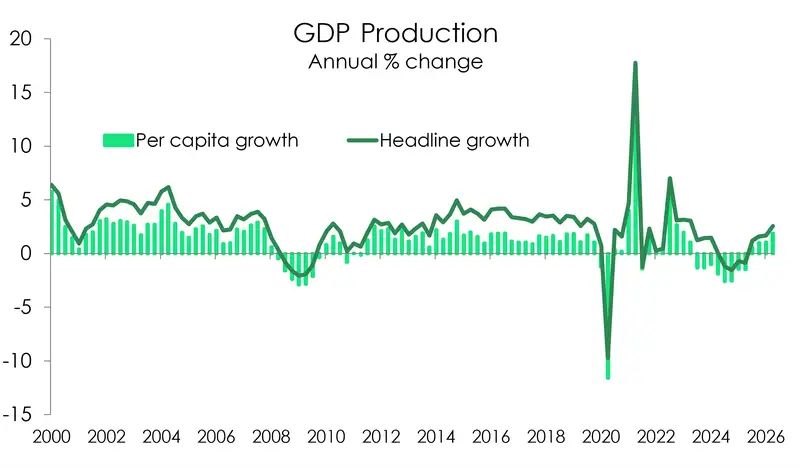
- The New Zealand economy grew by 0.2% over the June quarter. Compared with 0.9% quarterly growth in the March quarter (revised from 0.8%). In annual terms, the economy grew 1.7%. Growth was a touch higher than our forecast and market expectations.
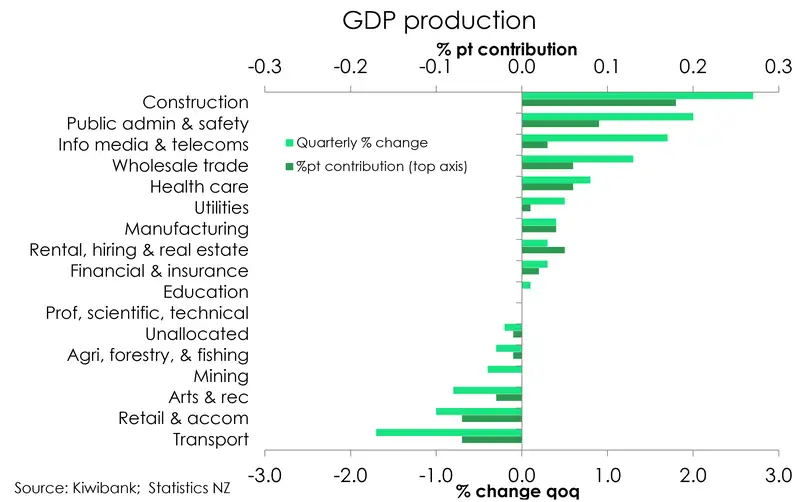
- Construction was the key driver of the economy's expansion. The construction industry grew by 2.7% and was the biggest contributor to the headline GDP figure. It also contributed to an upward revision of the March data.
- A weak consumer was evident, with weakness in sectors such as retail and the arts, suggesting consumers pulled back amidst higher fuel prices. However, household consumption still grew, albeit at a much slower rate of 0.1% versus March's 0.6%.
The New Zealand economy fared better than we expected over the June quarter. The economy grew by 0.2%, lower than the upwardly revised 0.9% quarterly growth rate for the March quarter (previously 0.8%). June's 0.2% growth rate is slightly higher than our forecast of 0.1%. The economy grew by 1.7% in annual terms, also a touch higher than our 1.6% forecast.
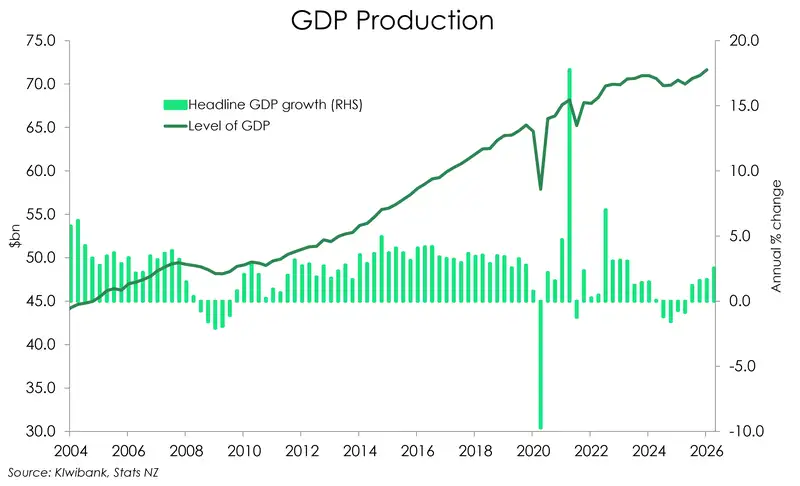
Even though the economy grew a lot slower in the June quarter than it did in the March quarter, we are pleased to see that it still grew at all. The global backdrop has been challenging, to say the least. With the oil shock landing firmly in the June quarter, we initially feared we would see a contraction. Luckily, the economy is proving much more resilient than that. Nine out of the 16 industries measured, grew. The clear winner was construction. And not by a small margin.
Production in the construction industry grew by 2.7% in the June versus March quarter, fuelled by construction services and residential building. Construction had the largest contribution to the total economic growth for the quarter, offsetting weakness in other sectors including retail and transport. However, in annual terms, construction output still fell by 1.1%.
New Zealand seems to have built its way into economic growth, with the revision to March data also driven by construction activity. Stats NZ commented that updated information from construction companies led them to revise up GDP for the March quarter. Eight other industries also showed modest upward revisions in the March quarter, while only three had downward revisions. This makes a higher than expected growth rate in the June quarter even more impressive.
Weakness was evident in discretionary spending, likely a reflection of Kiwi shoppers tightening their purse strings after fuel price pain. Arts and recreation as well as retail and accommodation both weighed on economic growth.
A surprise was that the primary sector did not come through as being the strong performer we expected. Agriculture, forestry and fishing production declined by 0.3% over the quarter. Looking at agriculture by itself, it saw a 0.5% drop. Overall, the primary industry group shrank while goods producing and services industries both grew.
What this lower agricultural production is reflecting is lower volumes of goods sold. There’s no doubt that farmers have benefitted from high commodity prices for their products.
Expenditure boosted by exports
On the expenditure side, we saw a 0.4% lift over the June quarter. That lift was entirely thanks to our exports. Domestic expenditure was down 0.5% due to flat private consumption and lower government spending. But with expenditure from exports up a strong 3.3%, that domestic weakness was offset. A cheap NZD, strong global demand for the stuff New Zealand makes, and comparatively strong economic performance of our trading partners, all provided us with much-needed support.
Household consumption growth fell from 0.6% growth in March to 0.1% in June. While it’s positive to see that consumer spending grew, the slow-down in growth compared with March suggests Kiwi households responded to higher fuel prices with pulling back discretionary spending. Something we’ve been wary of all year. Flat or negative services and non-durable goods spending is evidence of the pull-back.
New Zealand’s exports of goods grew by 4.9% while exports of services declined by 0.7%. Very strong growth in meat exports reflects solid international appetite for New Zealand meat. On the imports side, goods imports increased modestly while services imports decreased by 3.7%.
What does that mean for us going forward?
Overall, we've managed to eke out 0.2% growth over the June quarter, and only 0.1% on a per capita basis (measured in 2009/10 prices). This is a good result in the context of the oil crisis that has rocked the world over the past few months. However, New Zealand's economy still has the smallest growth of the nine other countries (and country groups) that Stats NZ compares us to.
The path forward into the rest of the year will be determined by whether the momentum we seem to have carried forward into June, will continue. In particular, Kiwi shoppers will need to keep filling their baskets, to sustain higher growth rates.
The recent up-tick in the oil price will also not be lost on the economic growth outlook for the rest of the year. The economic shock that began in March is still rippling through the economy. Some bigger waves are heading our way once again, with domestic petrol prices jumping up once more. You’ll be glad if you fuelled up early in the week.
A slight nudge higher in growth for the economy in the second quarter of the year will not alter the RBNZ's resolve to take the interest rate up to 3% by the end of 2026. Nor will it give them impetus to push the interest higher any faster.
Although the positive growth rate will have been a pleasant surprise relative to their 0% growth forecast, the second quarter growth numbers are not a hot reading. The reality is that the labour market is still weak, there is still substantial spare capacity in the economy and we still have a weak consumer. A strong result for the construction industry aside, the economic recovery is not fully actualised. All the factors that fed into the Reserve Bank’s September Monetary Policy Statement still hold true.
The embers of economic growth are definitely present. With a bit of luck, we could see ourselves building a proper bonfire this time next year.
All content is general commentary, research and information only and isn’t financial or investment advice. This information doesn’t take into account your objectives, financial situation or needs, and its contents shouldn’t be relied on or used as a basis for entering into any products described in it. The views expressed are those of the authors and are based on information reasonably believed but not warranted to be or remain correct. Any views or information, while given in good faith, aren’t necessarily the views of Kiwibank Limited and are given with an express disclaimer of responsibility. Except where contrary to law, Kiwibank and its related entities aren’t liable for the information and no right of action shall arise or can be taken against any of the authors, Kiwibank Limited or its employees either directly or indirectly as a result of any views expressed from this information.