
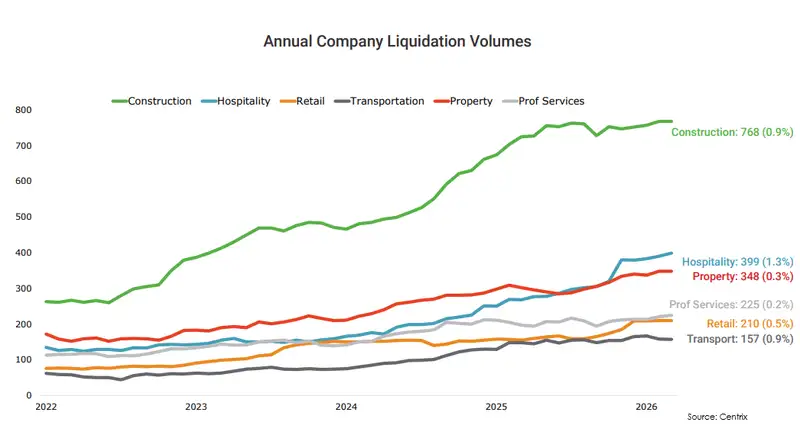
The construction sector is doing it tough. We’ve talked about it a lot already, but new data shows just how bleak reality is. Liquidations are trending up across the board in many industries. In fact, total year-on-year company liquidations are up 15%.
The April Credit Indicator Report released by Centrix last week shows high liquidation volumes in the construction sector. With over 700 construction companies liquidating in the last 12 months. That’s bleak.
As a proportion of the total construction sector, it’s only 0.9% of firms, which is a silver lining. Hospitality is worse-off on that front, with 1.3% of firms in that sector liquidating (that’s just shy of 400 businesses).
The transport industry had the lowest volume of liquidations, but a high proportion of total companies, also 0.9%.
So, what’s happening? Why are so many construction companies shutting up shop?
One argument is that the weakest companies are getting culled off while the strong survive. And the decrease in credit defaults (down 21% for the construction sector) seem to play into that story.
The other, more pessimistic, view is that we used to build a lot more stuff in NZ than we are right now. And companies are shutting down because there aren’t enough funds flowing into infrastructure pipelines and building work is flatlining.
They say you can tell the health of a city by the number of cranes on its horizon, and the Kiwi cityscape is by-and-large crane-free right now. That’s not good.
In order for our Kiwi economy to continue to grow and flourish, we need to invest in the foundations now. The key problem is that big projects require lots of up-front investment and often don’t pay off for decades. If the projects are never started in the first place however, we end up even worse off… some of that is already happening today.
Infrastructure projects that should have started decades ago were postponed, too expensive, not urgent enough… and now we have a city (Wellington) with failing suage systems. That’s just one example. We can think of many more.
All content is general commentary, research and information only and isn’t financial or investment advice. This information doesn’t take into account your objectives, financial situation or needs, and its contents shouldn’t be relied on or used as a basis for entering into any products described in it. The views expressed are those of the authors and are based on information reasonably believed but not warranted to be or remain correct. Any views or information, while given in good faith, aren’t necessarily the views of Kiwibank Limited and are given with an express disclaimer of responsibility. Except where contrary to law, Kiwibank and its related entities aren’t liable for the information and no right of action shall arise or can be taken against any of the authors, Kiwibank Limited or its employees either directly or indirectly as a result of any views expressed from this information.