
You might have finished you your latest grocery shop and noticed that your dollar just doesn’t stretch as far as it used to. You might be asking, is it just me? A close look at the numbers tells us it’s not. All Kiwis are staring down the barrel of increased food prices. And no, we don’t mean the oil barrel. This has been going on for much longer than the fuel crisis.
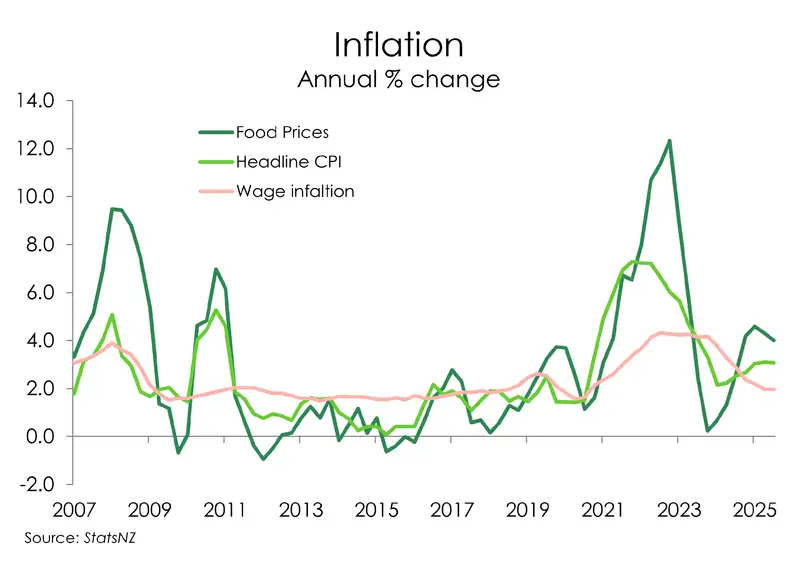
Our chart of the week shows how wage growth compares to headline inflation and then again to food prices. When inflation is higher than wage growth, we get into a cost-of-living crisis. Wages just aren’t growing fast enough to keep up with the increase in costs in the economy, so Kiwis feel poorer, even after a wage increase.
Between late 2011 and early 2016, things were looking good. Wages were growing at the same rate, if not faster, than inflation. Every dollar earned could buy you more goodies. And with food prices increasing less than wages, even decreasing in 2012 and 2015 (take me back!), that meant more goodies in the grocery cart as well. Life felt good.
But something happened in 2020… I’m sure we all remember the covid pandemic and lockdowns that had us quacking in our boots. The pandemic heralded a new area of price growth, with wages left behind. Between 2020 and 2023, prices (and especially food prices) hugely out-paced wage growth.
When food prices increase faster than headline inflation, you get a double hitter. Not only is everything more expensive, but we feel it disproportionally in our grocery trolleys. Food price inflation peaked at 12.3% year on year after covid, with the impacts being felt most between September of 2022 and September of 2023. The price of everything else went up too, but headline inflation peaked at 7.3% in June 2022 before coming back down again. We thought we were catching up in 2024, for a minute, but it didn’t last long. And all along the way, wage growth has been in the 2-4% range. Kiwis feel poorer and poorer as the years go by.
Cumulatively, prices have gone up over 27% since March 2020, but food prices alone have gone up 31%. Compare that to wages, up only 19%. That means that every dollar Kiwis earn today will buy them 12% fewer groceries than a dollar earned before March 2020.
Food is a necessity. Most Kiwi households still have room to substitute the things on their grocery list. We can switch to buying cheaper brands or buying a less premium cut of protein. But the Kiwis who are worst off have been doing that for years. They have trimmed the fat away and thus the only option left is to start skipping meals completely.
All content is general commentary, research and information only and isn’t financial or investment advice. This information doesn’t take into account your objectives, financial situation or needs, and its contents shouldn’t be relied on or used as a basis for entering into any products described in it. The views expressed are those of the authors and are based on information reasonably believed but not warranted to be or remain correct. Any views or information, while given in good faith, aren’t necessarily the views of Kiwibank Limited and are given with an express disclaimer of responsibility. Except where contrary to law, Kiwibank and its related entities aren’t liable for the information and no right of action shall arise or can be taken against any of the authors, Kiwibank Limited or its employees either directly or indirectly as a result of any views expressed from this information.