

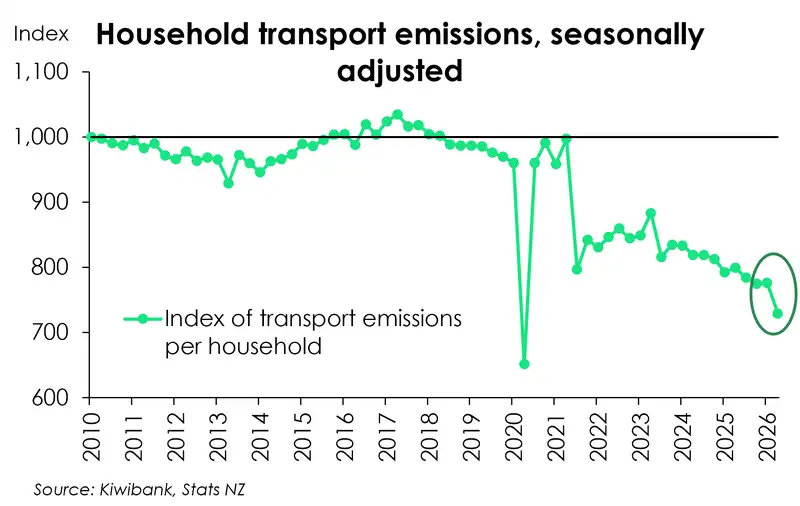
Oil prices remain treacherously high, driving record petrol prices, but a ‘green’ lining has become evident. Household transport emissions are at their lowest levels since the initial nationwide Level 4 Covid lockdown.
The June quarter of 2026 saw a 6% fall in per household transport emissions, reaching below 75% of 2010 Q1 levels.
This is likely a reflection of consumers switching to more fuel efficient or zero emissions vehicles and cutting back on car travel.
Much has been said on the topic of fuel. Current and future oil prices remain painfully high. Global shipping costs have ballooned. All of which contribute to New Zealand’s record-high petrol prices.
Supply hasn’t been as big of an issue as many initially feared. Within the Asia-Pacific region, New Zealand is among the wealthier countries. We can afford to continue importing fuel from South Korea and Singapore, even at premium prices. MBIE’s fuel stock data shows that even at its lowest point, New Zealand still had approximately 45 days’ worth of petrol either onshore or on its way. And 40 days’ worth of diesel.
It’s the demand response that’s shifted materially, instead.
When 91 petrol reaches $3.70 per litre, and more in some parts of the country, consumers pull back. Working from home, carpooling, using public transport, switching to low or zero emission vehicles, and cutting back on non-essential travel are all ways in which individuals can reduce their dependence on fuel. And it shows up in the data.
Import volumes of fuel were down 9% over the June quarter. Seasonally adjusted retail sales volumes for fuel were down by an even more dramatic 13% in the June quarter.
A recently released dataset from Stats NZ shows that household transport emissions on a seasonally adjusted basis are at their lowest levels since the June quarter of 2020.* For those who need a reminder, that covers the bulk of the period in which New Zealand was plunged into a nationwide Covid lockdown. So not a lot of travel happening then…
The drop in the June quarter of 2026 was sizeable. Household transport emissions fell by 6% on a per household basis compared to the March quarter. And that’s a drop from an already historically low level. After the second and third major Covid lockdowns in 2021, household transport emissions never recovered. Quite the contrast to the first major lockdown in early 2020 which saw transport emissions bounce back rapidly afterwards.
That’s a serious structural shift that is worth more analysis. At a high level, the rise of working from home, higher fuel prices due to the Russia-Ukraine conflict, and a switch to cleaner vehicles supported by the Clean Car Subsidy are probable contributors.
The gradual downward trend over the past few years reflects the slow and steady re-balancing of New Zealand’s vehicle fleet towards newer, more fuel-efficient vehicles as older vehicles are gradually phased out.
While lower emissions are good news, it does come at the expense of everyday Kiwi who foot the bill. For those who can easily reduce fuel dependence, that’s a minor inconvenience. But the majority of New Zealand’s vehicle kilometres travelled are in rural areas according to NZTA. It’s much harder to hitch a ride to the supermarket, bus into town, or work from home when you work on a remote farm.
* We adjusted household transport emissions by the estimated number of households in New Zealand per quarter (also from Stats NZ data). We then indexed the data to the first period of available data, 2010 Q1.
All content is general commentary, research and information only and isn’t financial or investment advice. This information doesn’t take into account your objectives, financial situation or needs, and its contents shouldn’t be relied on or used as a basis for entering into any products described in it. The views expressed are those of the authors and are based on information reasonably believed but not warranted to be or remain correct. Any views or information, while given in good faith, aren’t necessarily the views of Kiwibank Limited and are given with an express disclaimer of responsibility. Except where contrary to law, Kiwibank and its related entities aren’t liable for the information and no right of action shall arise or can be taken against any of the authors, Kiwibank Limited or its employees either directly or indirectly as a result of any views expressed from this information.