
- Markets are volatile as the AI trade unravels. Investors are nervous, and we’ve seen money being ripped out of higher risk investments, in favour of the safe(r) havens. The Kiwi dollar has been hit, dropping below 55c. The Aussie is also down in the risk-off move, and is set to underperform the Kiwi over 2027.
- Exporters, including farmers, growers and tourism operators, are enjoying a weaker Kiwi currency… importers are not. Everything we import is now even more expensive, including fuels, furniture, EVs and most things we want to put under the Christmas tree.
- The cost-of-living crisis remains a big restraint into 2027. And businesses want (need) to pass on higher costs.
Well, last week was bad… markets are challenging. The market volatility index surged to 35.89 by Nov 20th's close, its highest level this year. Definitely not a good time to check your KiwiSaver balances.

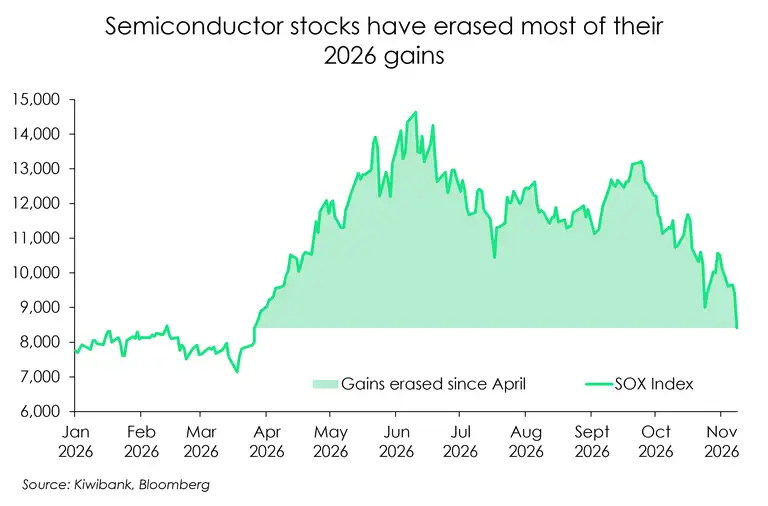
There was a sharp reversal in AI-related stocks. The Nasdaq 100 posted its worst week since March 2020, falling 5.6% on Friday alone. The S&P500 has dropped 5.64% since Nov 18th; the Dow Jones is down 4.09%; the DAX is down 3.63% and even our humble NZX retreated, down 1.10%.
The Anthropic IPO also added some volatility to trading at the end of last week, with a share price that popped up over 30% on its debut. That was before the market brought it solidly down to earth again. Still a record-breaking IPO, but the implied valuation of US$1.6 trillion came down to $1.175 trillion.
Most of the move can be attributed to fear in (of) AI. At least part of the sell-off was motivated by the Federal Reserve remarks that the outcome of the US midterms, could reshape the regulatory landscape for AI-focused firms. More regulation means less profit and more risk.
Safe-haven moves have seen the USD strengthen, and US treasuries have also come down a touch as investors buy into “safe” US Government debt. The Kiwi dollar lost even more ground against the USD last week and it’s not looking pretty. Given that petrol, diesel and jet fuel are all priced in USD… that’s very frustrating for our economy. We’re paying more Kiwi dollars for every US dollar, on top of already elevated fuel prices. In October, New Zealand recorded a ~$3 billion trade deficit. Our exporters might be doing well, but not enough to offset what we’re importing.
On the bright side, the Kiwi dollar is gaining on the Aussie, a trend we see continuing into 2027. Australia is facing some significant headwinds including its first potential recession in over 30 years. Their housing market is experiencing the same sharp correction ours did just after Covid. In a sense, they’ve been delaying the inevitable… We hope this will finally help reverse the tide of Kiwi workers flying across the Tasman. Already we’ve seen the flow slowing over the last two years. Maybe 2027 will finally be the year we see Kiwi staying in Aotearoa for work… watch this space.
On the domestic price side, we get a feeling of the unevenness in the economy from the selected price indexes out last week. The October data shows that outside of the transport group, gas and electricity are accelerating the fastest at 11% and 9.4% respectively on an annual basis. Eating out is also getting pricier, up 3.4% on October of last year. The cost of energy and transport combine to increase the cost of doing business, it’s only a matter of time before businesses across the board have to pass those costs on. We’re seeing it in the restaurant space, but the pressure is on in all sectors.
Demand in the economy is mixed. Exporters are benefitting from elevated commodity pricing, especially dairy and meat, helped along by our weak currency. Businesses dealing with tourists are also doing well. Some businesses are getting on with it, and that will support our economic growth into 2027. However, we can’t understate that the increase in prices will only dampen demand further. It’s not looking like we’re revvin’ into 2027 anymore… it seems like we’re about to take a bit of a detour on our road trip to recovery.
Financial Markets
The comments below were provided by Kiwibank traders. Trader comments may not reflect the view of the research team.
In Markets – International drivers
Another eventful week where the prominent drivers were primarily offshore with local data and inputs providing only minor distractions in the broader scheme of things. For the week our curve was seen lower and steeper with the 2-year IRS marked at 3.76% (-7bp w/w), 5-year at 4.05% (-6bp), and 10-year at 4.41% (-5), while at the front of the curve, implied December RBNZ OCR maintained its stance firmly in the tightening camp at 2.965%, while 1-year ahead was marked a touch lower on the week at 3.51% (-6bp).
First up domestically we had local data on the services sector and the release of Statistics NZ’s selected price indices (SPI). The PSI maintained its foothold in expansionary territory printing at 51.7 against a 50.9 in September suggesting a gradual services sector improvement, while the following day the SPI, which accounts for near 50% of the CPI basket, proved to be its usual collection of somewhat mixed monthly increases and decreases, though with some areas of strong price growth such as domestic air transport for instance higher by 13.6% alongside higher petrol and diesel prices. Overall, this was seen as likely consistent with a print in the 4%’s – higher than the 3.9% for Q4 anticipated by the RBNZ in its last MPS. Comments from RBNZ Governor Breman appeared balanced, though with market pricing leaning heavily into a December meeting tightening as a strong certainty, briefly reintroduced some meeting risk into the equation, though only briefly as pricing retraced by week end. The M14 survey of expectations followed by the H1 – the household sector equivalent, both appeared to show somewhat anchored longer term inflation expectations, which would have been viewed as supportive of the cautious approach adopted by the RBNZ to date, with this further reinforced by a still tepid Q4 growth prediction by the GDPNow model at 0.1%.
The dominant themes were international. US Federal Reserve speakers continued to take and talk a strong line to inflation, with the murmurings of a sharper move at the December reinforced by the release of the minutes from the last meeting and pricing that continued to see Fed Funds futures trade through the theoretical +25 break-even. In fact, movements further out the futures curve have shown volatility over the week, where year-ahead pricing, despite the hawkish rhetoric, finished our week by removing a priced tightening that had been added the prior week post CPI, as continued equity market nervousness asserted itself more as the week continued.
The persistent official commentary on inflation was also a global problem, with similar commentary from officials at the BoE and ECB talking to policy potentially not as restrictive as required and the need for further adjustment. Continued stock market volatility, particularly around the AI and related technology sectors has become an increasing theme, with this space additionally pressured of late by a likely evolving regulatory landscape – this added volatility providing a counter to a curve attempting to price in near-term tightening given the persistent above-band inflation outlook against viewed increased risks to the economy further out. This situation also playing out and evident in Australian indicators, where employment data provided a counter to recent firm CPI and wages data, with their monthly employment change shocking the market with a -44k print where expectation had centred on a 25k gain while the headline unemployment rate jumped to 4.9% from 4.7% despite the support to the headline figure that the decline in the participation rate should have provided. Their curve on the day seeing a sharp adjustment with three- and ten-year bond futures rallying by 17 and 12 points respectively, while their implied cash rate curve further inverted, pricing significant probabilities of easing starting early 2027 with year-ahead at or around 4.51% - some 34 points below the current target rate. That could all change however though given Australian inflation data is due this week.
So, where does this leave us? As noted on a number of occasions, the RBNZ have taken a cautious to the tightening cycle to date, and we would assume that they will likely continue to do so. The have shown a willingness to adhere to a plan particularly around the tightening approach using the formal MPS with the associated projections to lay out a path and remind that the path in rate is higher in order to attempt to anchor expectations around inflation. Given ‘okay’ data in the form of the forward looking surveys on the manufacturing and services sectors coupled with still elevated and persistent near-term inflation, this would likely see the maintenance of this cautious approach, though with the chance that the guidance further out, for instance Q3 and Q4 2027, moves to tidy the non-committal implied average quarterly rates of 3.12% and 3.15% by perhaps lifting these to indicate a firmer likelihood of tightening. Recent moves and volatility offshore however may see December pricing pressured to back-off the near-certainty priced – though given the protracted gap between the December and February meetings, may see this limited to a degree barring any significant market changing event. Graham Hughes – Trader, Financial Markets
In FX – Kiwi under pressure, but the Aussie story is turning
The Kiwi remained firmly under pressure against the US dollar last week, with NZD/USD trading in a 0.5470–0.5560 range. The pair opened last week around 0.5520 before falling to a weekly low of 0.5465 on Friday and recovering modestly to around 0.5475. The move was largely driven by renewed US dollar strength rather than any material deterioration in the NZD.
Fed commentary remained firmly hawkish, with policymakers continuing to signal that inflation remains too high and further tightening may be required. Both the Fed and RBNZ meet on 9 December, with markets pricing around a 92% chance of a 25bp Fed hike and around an 85% chance of a 25bp RBNZ hike as we open the week. Additional tightening is still priced further out the Fed curve, which continues to keep the USD well supported.
Another key headwind for NZD/USD has been the sharp deterioration in global risk sentiment. Global markets ended the week firmly in risk-off mode as doubts over the sustainability of the artificial-intelligence boom triggered a bruising technology selloff. The S&P 500 entered a technical correction, the Nasdaq fell sharply and investors rotated into defensive assets. US Treasuries rallied strongly, haven currencies outperformed and the flight to safety provided further support for the USD, leaving the Kiwi under sustained pressure. As mentioned in our last FX Tactical, 0.5470/80 remains a key multi-year low for NZD/USD. A sustained break below this level sees very little in the way of meaningful technical support until 0.5070 and thereafter the psychological 0.5000 level. From there it’s the GFC low at 0.4895. For now, any meaningful recovery in the Kiwi will probably require some stabilisation in global risk sentiment.
As for NZD/AUD, it told a very different story, rallying sharply from 0.8160 to 0.8270 by Friday’s close, a gain of around 1.35% for the week. The cross was the standout mover, driven predominantly by AUD weakness rather than outright NZD strength. The Lucky Country, which has managed to avoid recession for almost three decades from 1992, is starting to feel the pinch as weakening economic data, higher interest rates and softer commodity prices begin to bite. October employment unexpectedly fell by 43,500, against expectations for a 25,000 increase, pushing the unemployment rate to a five-year high of 4.9%. The weak jobs print triggered a sharp repricing, with markets now beginning to price in the possibility of RBA rate cuts in 2027. AUD/USD subsequently gave up all of its 2026 gains. The commodity backdrop is also adding another layer of pressure. Chinese iron ore futures fell to a four-year low last week amid weaker steel consumption and production, squeezed Chinese steel mill margins and increasing global iron ore supply. Weakening Australian data combined with softer commodity prices is making for an increasingly difficult backdrop for the AUD.
The relative-rate story is also becoming increasingly supportive for NZD/AUD. Markets are pricing around 65bps of RBNZ tightening through to June 2027, compared with around 20bps of RBA easing over the same period. This sees the AUD-NZD rate spread compress from around 187bps in December 2026 to 127bps by June 2027, a narrowing of around 60bps across the curve. With the RBNZ still expected to tighten while markets start to contemplate RBA easing, that prospective rate differential is increasingly moving in the Kiwi’s favour.
The cross is shaping up to reverse more of the significant move lower we’ve seen over recent months as we head into 2027. With the Australian backdrop weakening and the relative-rate story increasingly shifting in the Kiwi’s favour, we expect NZD/AUD to continue to slowly grind higher from here. Adrian Lodge – Senior Dealer, Financial Markets.
The Week's Key Events
- Today will see the publication of the quarterly Retail Trade Survey from Stats NZ, and later in the week we should have some consumer confidence data.
- PMIs for Australia, UK, Japan, US and the EU will also be out.
- Aussie CPI and US PCE inflation are major datapoints from overseas.
- And we will supposedly get the results of the New Zealand General Election at the end of this week.
All content is general commentary, research and information only and isn’t financial or investment advice. This information doesn’t take into account your objectives, financial situation or needs, and its contents shouldn’t be relied on or used as a basis for entering into any products described in it. The views expressed are those of the authors and are based on information reasonably believed but not warranted to be or remain correct. Any views or information, while given in good faith, aren’t necessarily the views of Kiwibank Limited and are given with an express disclaimer of responsibility. Except where contrary to law, Kiwibank and its related entities aren’t liable for the information and no right of action shall arise or can be taken against any of the authors, Kiwibank Limited or its employees either directly or indirectly as a result of any views expressed from this information.