- Of all the letters of the alphabet, “A” and “I” are probably two that we are all collectively sick of hearing in 2026. But AI has been one of the defining market movers of 2026.
- Much like Icarus, AI investment seems to have flown a little too close to the sun. After a historic rise in the value of semiconductor (chip) stocks, the Philadelphia Semiconductor Index (SOX) more than doubled in 2026.
- But the wings that took chip stocks soaring to historic highs were made of wax, and melted away almost all of the gains made throughout the year.
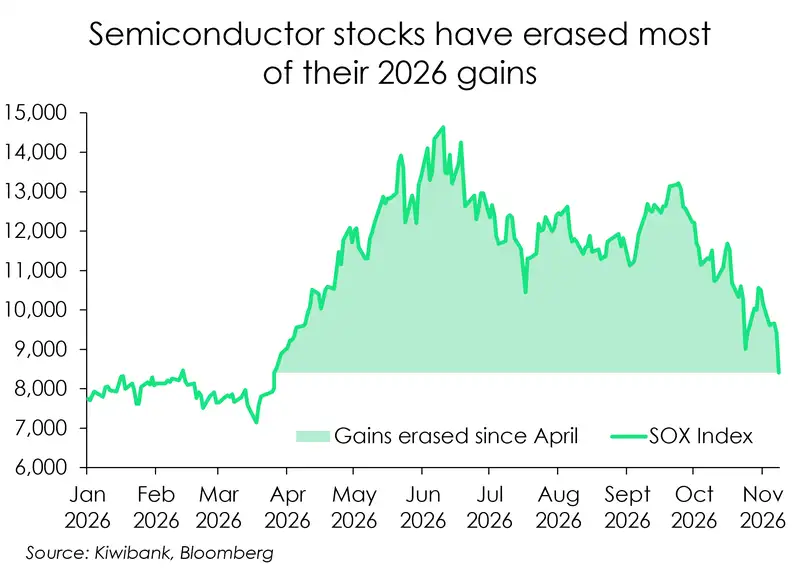
The Philadelphia Semiconductor Index (SOX Index) is one of the most closely watched measures of the global chip industry's health. And the chip industry underpins our favourite two letters, AI… The SOX tracks 30 of the world's leading semiconductor companies including names like NVIDIA, Taiwan Semiconductor Manufacturing (TSMC), and Broadcom. When the SOX rises, it generally signals that investors are optimistic about demand for chips and the technology that depends on them. When it falls, it often reflects fears about oversupply, slowing demand, or broader economic uncertainty.
2026 has been a dramatic year for the index. A massive boom followed by an awkward bust.
The index began the year buoyed by optimism that the semiconductor industry was about to go gangbusters, driven by surging demand for AI-related chips. However, the early months were turbulent. Memory chip prices were rising sharply. That was good news for chip producers but squeezed the profits of companies that buy chips.
The turbulence came to a head on March 30, when the index hit its lowest point of the year. A sharp sell-off was triggered in part by news that Google had announced a technological breakthrough that analysts believed could reduce demand for certain types of chips. Memory and storage companies bore the brunt, with some stocks falling as much as 10% in a single session.
What followed was one of the most remarkable recoveries in the index's history. From its March low, the SOX more than doubled in value over the next three months, reaching an all-time high of approximately 14,635 points on June 22. That’s a gain of roughly 105% in under three months.
The rally was fuelled almost entirely by AI euphoria. Investors poured money into chip companies on the belief that the AI boom would require vast quantities of semiconductors for years to come.
The peak did not last. From its June high, the index began a prolonged retreat as investors started questioning whether the AI-driven demand story had been overpriced. Concerns mounted that too many investors had crowded into the same trade.
November brought a cascade of bad news that sent the index into freefall. The US midterm elections delivered a Democratic sweep of Congress which rattled chip investors who feared the new political landscape could slow approvals for AI data-centre construction. The scandal surrounding NVIDIA’s now ousted CEO Jensen Huang did no favours for the world’s most valuable chip company and the wider industry. And recently announced US export restrictions on chips bound for China added another punch to the gut.
The result was the SOX's worst single week in 25 years. On November 20 alone, the index fell 10.7%, erasing an estimated $1.3 trillion in market value in a single session. The index closed that day at approximately 8,409 points, effectively wiping out all the gains made since the April recovery began.
All content is general commentary, research and information only and isn’t financial or investment advice. This information doesn’t take into account your objectives, financial situation or needs, and its contents shouldn’t be relied on or used as a basis for entering into any products described in it. The views expressed are those of the authors and are based on information reasonably believed but not warranted to be or remain correct. Any views or information, while given in good faith, aren’t necessarily the views of Kiwibank Limited and are given with an express disclaimer of responsibility. Except where contrary to law, Kiwibank and its related entities aren’t liable for the information and no right of action shall arise or can be taken against any of the authors, Kiwibank Limited or its employees either directly or indirectly as a result of any views expressed from this information.