Petrol prices in New Zealand have reached record levels. From Kaitaia to Invercargill, Kiwi drivers across the country are feeling the pain at the pump.
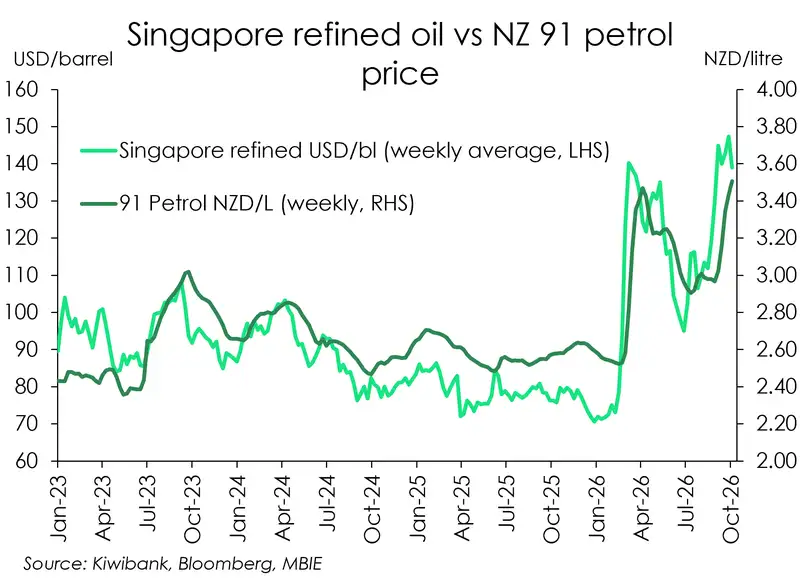
This chart will look familiar to regular readers. But given these record levels, we just had to update it. The price of 91 here at home has followed the price of Singapore refined fuel. Up.
Geopolitics is the core culprit. But how geopolitical instability translates to price increases is nuanced. A key driver of price right now is shipping costs. And they are through the roof.
New Zealand imports every drop of petrol it uses. That means that when global oil markets are disrupted, we feel it at the pump. Right now, several forces are combining to keep prices elevated. Understanding them helps explain why relief has been slow to arrive.
The petrol price New Zealanders pay is closely tied to the cost of refined fuel traded in Singapore. Singapore is the region's dominant fuel trading hub, and New Zealand importers buy their petrol based on prices set there. When that Singapore price rises, so does what you pay at the pump, typically with a short lag.
Getting crude oil to Asian refineries and then getting refined petrol to Aotearoa requires ships. Lots of them. The conflict in the Middle East has effectively closed the Strait of Hormuz, the narrow waterway through which roughly a fifth of the world's seaborne oil normally passes. And Houthi attacks against ships in the Bab al-Mandeb Strait at the mouth of the Red Sea has effectively closed that route, too. This has forced tankers onto longer, slower routes around Africa.
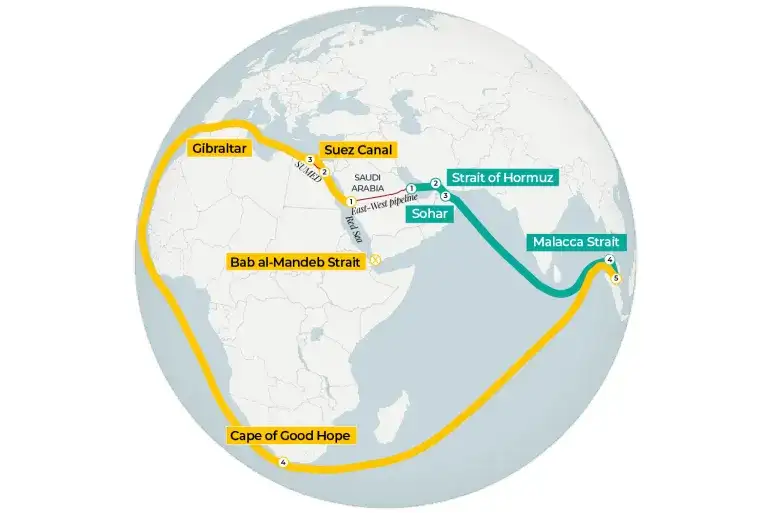
Source: Al Jazeera
Ships that once completed a round trip to Asia in three weeks now take two months or more. So, the same fleet of vessels can do fewer trips per year.
The result is a shortage of available ships. Hiring a super tanker on the benchmark route from the Persian Gulf to Asia reportedly reached more than $1 million per day in recent weeks. More than ten times the rate of a year earlier. Those costs do not disappear. They are passed through the supply chain and ultimately show up in the price of petrol at the pump.
Brent crude futures (the global benchmark most people follow) reflect what traders expect the price of oil to be in roughly a month's time. Right now, those futures are elevated because the market is pricing in ongoing risk. Risk that shipping disruptions worsen, that supply routes remain constrained, or that geopolitical tensions escalate further.
The Singapore fuel price, by contrast, reflects what is actually available to buy today in the physical market. Singapore's fuel stockpiles have been recovering in recent weeks, which has softened the immediate spot price even as the futures market remains anxious about what comes next. Demand destruction from emerging economies has contributed to that recovery in stockpiles. In short, futures are pricing tomorrow's fear, spot prices are clearing today's supply.
Until shipping routes normalise and the tanker market loosens, freight costs will continue to act as a floor under petrol prices independent of what happens to crude oil itself. For a country that imports all of its fuel and sits at the far end of a long and currently expensive supply chain, that is a significant challenge.
All content is general commentary, research and information only and isn’t financial or investment advice. This information doesn’t take into account your objectives, financial situation or needs, and its contents shouldn’t be relied on or used as a basis for entering into any products described in it. The views expressed are those of the authors and are based on information reasonably believed but not warranted to be or remain correct. Any views or information, while given in good faith, aren’t necessarily the views of Kiwibank Limited and are given with an express disclaimer of responsibility. Except where contrary to law, Kiwibank and its related entities aren’t liable for the information and no right of action shall arise or can be taken against any of the authors, Kiwibank Limited or its employees either directly or indirectly as a result of any views expressed from this information.