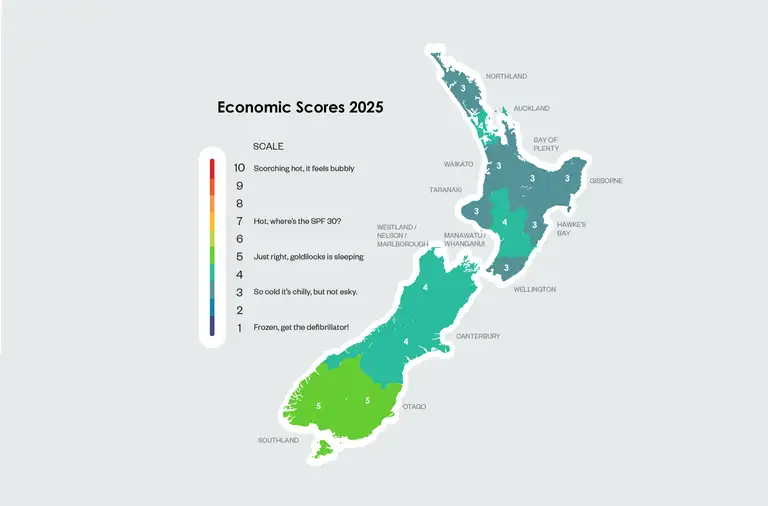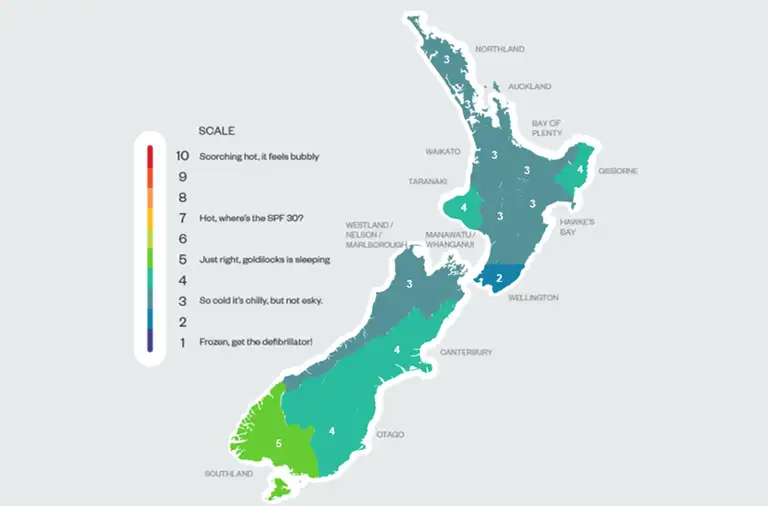

The Kiwi housing market is no longer moving as one. The latest data highlights a striking (and growing) regional divide, with the South Island pulling away from the North.
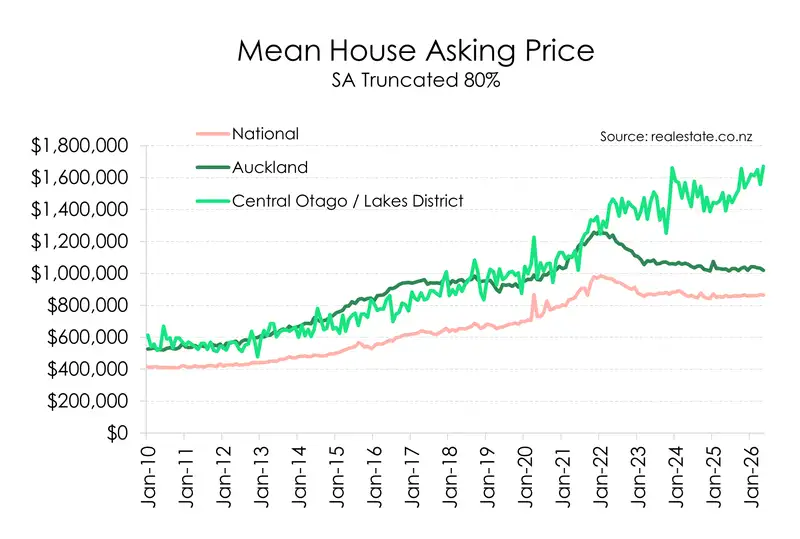
At the centre of it all is Central Otago and the Lakes. Average asking prices have surged to around $1.67m, a fresh record and more than 20% higher than a year ago. A decade ago, this region was cheaper than Auckland. Today, it’s roughly $650k more expensive. That’s not just a shift—it’s a structural reordering of the housing ladder.
The drivers are well understood. Queenstown and Wānaka continue to command premium prices north of $2m and $1.7m respectively, powered by lifestyle appeal and a steady inflow of high-income buyers. Hybrid working has only amplified that trend. Location is no longer tethered to employment in the way it once was.
Meanwhile, Auckland tells a very different story. Prices are broadly flat, sitting just over the $1m mark, with little momentum. The market has stabilised after a sharp correction, but there’s no clear catalyst for a strong rebound. Higher interest rates, stretched affordability, and cautious buyers are keeping a lid on gains.
Wellington is softer still. Weak population growth, a cooling labour market, and ongoing public sector restraint are weighing on housing demand. While other regions are finding their footing, the capital remains stuck in a low-energy phase.
Then there’s the broader South Island story. Otago, Southland, and Marlborough are all seeing solid price growth and, in some cases, record highs. Even as national prices track sideways, these regions are quietly outperforming. Importantly, this isn’t just about prices—listings are rising sharply in parts of the South, signalling confidence among sellers and sustained turnover in the market.
So, what does the chart show? A widening gap. Not just between Auckland and Central Otago, but between the North and South more generally, and between regions with strong lifestyle appeal and those facing economic headwinds.
In short, the housing market is fragmenting. And in this cycle, it’s the South Island (led by Otago) that’s out in front.
All content is general commentary, research and information only and isn’t financial or investment advice. This information doesn’t take into account your objectives, financial situation or needs, and its contents shouldn’t be relied on or used as a basis for entering into any products described in it. The views expressed are those of the authors and are based on information reasonably believed but not warranted to be or remain correct. Any views or information, while given in good faith, aren’t necessarily the views of Kiwibank Limited and are given with an express disclaimer of responsibility. Except where contrary to law, Kiwibank and its related entities aren’t liable for the information and no right of action shall arise or can be taken against any of the authors, Kiwibank Limited or its employees either directly or indirectly as a result of any views expressed from this information.