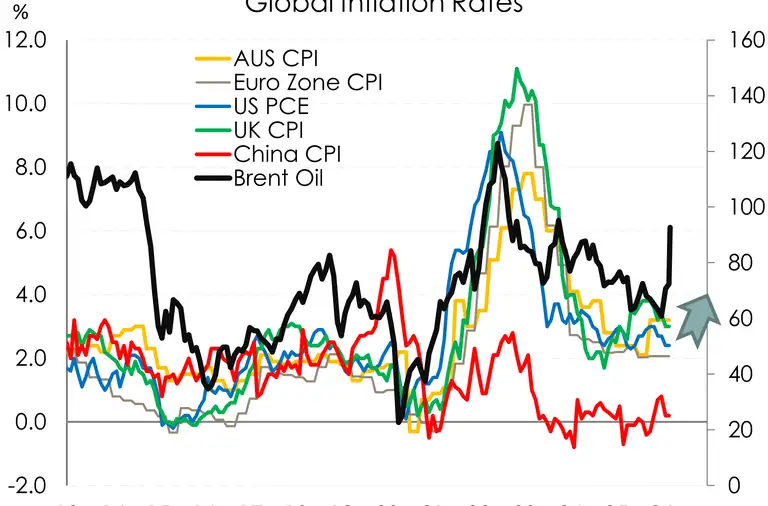


- The RBA hiked interest rates for the first time in over two years as inflation continues to climb. The RBA joins the Bank of Japan as the only developed central banks currently tightening policy. Kiwi inflation has climbed, but we don’t think the RBNZ should be in a rush to follow.
- Locally, our focus last week was on the Kiwi jobs market. There are encouraging signs that the appetite for labour is improving. But with an influx of people dusting off their CVs, we saw the unemployment rate rise to a decade high of 5.4%.
The RBA delivered its first rate hike in more than two years, taking the policy rate to 3.85%. Just six months ago, the RBA cut interest rates. But with this latest move, they now join the Bank of Japan as the only developed central banks currently tightening policy. The policy pivot was unanimously decided by the Board on count of the continued climb in inflation. At 3.8%, inflation has well exceeded the RBA’s 2-3% target band, and evidence points to a strengthening in private demand as the driving force. The RBA upgraded its inflation forecasts accordingly. Given a supply-constrained economy, the February statement left the door open to further hikes. Although, Governor Michelle Bullock somewhat tempered expectations of back-to-back moves.
While the RBA may be hiking, the RBNZ should be in no rush to do so here. We simply do not have the same demand pulse that is driving inflation concerns over in Aussie. The Kiwi economy instead continues to operate with a significant degree of spare capacity. And last week’s labour market report reflected just that (see our full review here).
The unemployment rate lifted from 5.3% to 5.4% at the end of last year – the highest in over a decade. Meanwhile the underutilisation rate, a broader measure of slack in the market, remained unchanged at 13%. And with such slack evident in the market, wages continued to cool too. The private sector Labour Cost Index (LCI) dropped to 2% (1.98% if we round to two decimal places) - the lowest rate since March 2021. The RBNZ should take some comfort in that with wage growth far from a source of inflationary pressure.
There are signs that the appetite for labour is improving with employment growing 0.5% over the quarter. It’s stronger than we expected, but not strong enough to absorb the new talent entering the market. And we saw quite the influx of fresh talent rejoin the labour force. The labour force grew 0.6% over the quarter, with the participation rate rising to 70.5% from 70.3%.
2026 should show further improvements for employment growth. But it’s a slow burn with labour demand typically lagging the broader economy. After economic downturns, employers generally want to see a steady stream of demand before expanding headcount. And we’re only at the start of our economic recovery. But at least we’re at the starting line now.
Financial Markets
The comments below were provided by Kiwibank traders. Trader comments may not reflect the view of the research team.
In rates, it was a week of two halves
“For the first half of a short week the RBA meeting loomed over the kiwi market. This had many wary to step into kiwi rates and saw yields grind higher. RBA delivered a hike as widely expected, being around 70% priced going into it. The statement was interpreted as quite hawkish with their inflation forecast lifted such that they will only hit their target in 2027. However, press conference was more measured with statements steering away from back-to-back hikes.
RBA out of the way, NZ Employment data was highlight for the second half. Headline unemployment number was higher but details were stronger. This saw a relief rally, with 2yr coming back 7bps from recent high and some balance come back into the NZ market. Carry still remains attractive for receiving Kiwi so would imagine still interest out there at these levels.
Looking ahead to the MPS next week, the tightening in financial conditions and improvement in TWI provide some offset for the RBNZ. No major domestic data this week so expect moves to be largely offshore driven.” Matthew Crowder, Balance Sheet Manager – Treasury.
In currencies, the Kiwi continues to consolidate
“In a resumption of normal market transmission, a broader risk off tone kept the US Dollar firmly supported last week, while softer 4Q NZ employment data eased domestic rate pressures and pushed the NZD lower as markets pushed out the timing of any RBNZ tightening. Friday’s equity market rebound helped NZDUSD stabilise off the lows, leaving the pair churning through a wider 0.5928–0.6063 weekly range. Opening this week back above a 60c-handle sees the Kiwi sat firmly within last week’s range as investors focus turns the delayed US Payrolls data on Thursday morning NZT. The balance in outlook for the week ahead is neutral as the Kiwi continues to consolidate on its recent run higher. NZDAUD also came under renewed pressure, sliding back toward its mid January trough of 0.8552 as Australia’s hawkish RBA hike clashed with New Zealand’s softer labour data. The opposing signals widened rate differentials decisively in Australia’s favour, and speculative futures activity piled on. Latest CFTC data details hedge funds extended AUD longs to their strongest levels since 2017 while trimming NZD shorts only modestly, underscoring how one way the demand skew has become. Even so, the cross has so far managed to avoid a clean break lower, with pockets of Kiwi demand emerging as NZDAUD tested well worn support. For now, the balance of risks still leans toward further AUD strength, but the near term consolidation above 0.8560 shows Kiwi buyers aren’t throwing in the towel just yet.” Hamish Wilkinson – Senior Dealer, Financial Markets.
Weekly Calendar
- The RBNZ's latest survey of inflation expectations is due out this week, and is the last key release ahead of the Monetary Policy Statement. Headline inflation has recently accelerated beyond the upper-end of the RBNZ's target band. Near-term inflation expectations will like lift in sympathy. The medium- and long-term expectations however should remain closely anchored to the midpoint as domestic inflation pressures continue to cool - albeit slowly. Focus for monetary policy will be the 2-year ahead outturn.
- Offshore, the focus is on the double whammy data release from the US. First up is (delayed) January payrolls. The consensus estimate is a 70k increase in jobs over the month and an unchanged unemployment rate at 4.4%. But brace yourself for some big revisions. The US Stats Bureau is set to publish its annual benchmark revisions, which may show a few months in 2025 with negative payroll prints. To round out the week, Jan CPI is expected to cool to 2.5%yoy. The price effect from tariffs is slowly feeding through and keeping inflation elevated. But the focus will be on core services inflation which is proving sticky.
See our "Weekly Calendar" for more.
All content is general commentary, research and information only and isn’t financial or investment advice. This information doesn’t take into account your objectives, financial situation or needs, and its contents shouldn’t be relied on or used as a basis for entering into any products described in it. The views expressed are those of the authors and are based on information reasonably believed but not warranted to be or remain correct. Any views or information, while given in good faith, aren’t necessarily the views of Kiwibank Limited and are given with an express disclaimer of responsibility. Except where contrary to law, Kiwibank and its related entities aren’t liable for the information and no right of action shall arise or can be taken against any of the authors, Kiwibank Limited or its employees either directly or indirectly as a result of any views expressed from this information.