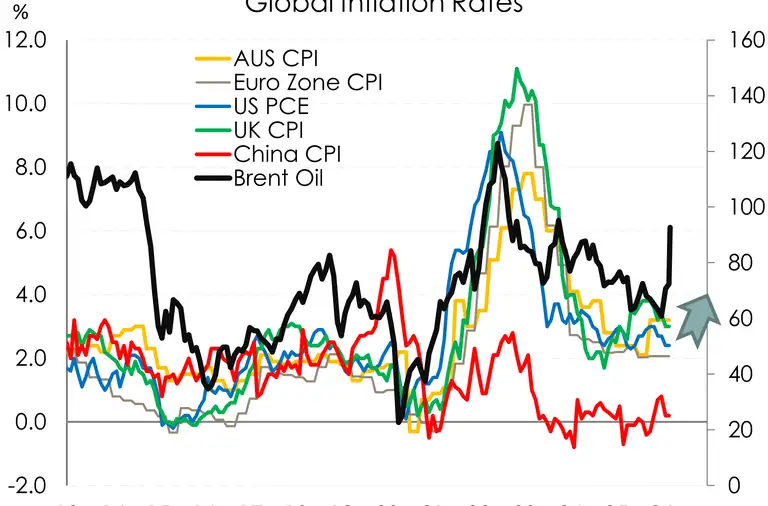

- The war in the Middle East continues with no signs of de-escalation. Oil prices remain elevated. And markets are shifting into risk-off mode. This week will be key. Several central banks will assess the economic damage and evolving risks around the conflict and the surge in oil prices.
- It’s completely outdated, but Thursday’s data will show us how the Kiwi economy finished 2025. Running the numbers, we expect the economy to have expanded 0.3% over the December quarter, up 1.5% over the year. But the outlook for growth has darkened with the oil price shock. There are downside risks to global growth and Kiwi growth.
- Our Charts of the Week looks at tourism. We’re seen a near full recovery as tourist arrivals back to 97% of pre-Covid levels. But with the rapid rise in risks offshore, the sector faces fresh and frustrating headwinds.
Entering week three of the war in the Middle East, markets remain choppy without any signs of de-escalation.
It has been another rollercoaster ride in oil prices over the last week. Big surges up, then down, then back up again. We started last week in dramatic fashion. As we opened the week Brent Crude surged nearly 30%, (on top of the 30% jump the week before) peaking at just under $120pb. By Tuesday, however, crude had fallen back under $100pb settling into a high‑80s to mid‑90s range. President Trump claimed the war could be over soon and ahead of schedule. But as we all know, Trump loves headlines, and with no actual signs of de‑escalation, the move lower didn’t last.
More merchant tankers were attacked in the Strait of Hormuz over the week. And on Thursday Iran’s new Supreme Leader, Motjaba Khamenei, delivered his first public statement. Motjaba made it clear the Strait of Hormuz would remain closed, signalling that Iran would use the strait as leverage in the war.
With the hopes for de‑escalation seemingly off the table, oil began pushing higher again. Markets even shrugged off a record release of 400m barrels of emergency reserve oil from the International Energy Agency. And we closed the week back above $100pb.
We’re bracing for another volatile week. We could easily see oil push back above the $119 peak seen last week. Trump confirmed strikes over the weekend on Iran’s Kharg Island — the central hub for nearly all of Iran’s oil exports. The strikes targeted military sites, but Trump also threatened to go after Iran’s oil infrastructure, if safe passage through the Strait isn’t restored.
Amid all the turmoil, global rates continue to push higher on rising inflation fears. It’s all about how central banks will respond. We’ll hear from several policymakers this week, including the Fed, RBA, BoE, ECB, and BoJ. All, bar the RBA, are expected to keep policy on hold. And traders will be listening closely to their assessments of the economic damage. We’ll be watching how policymakers balance near‑term inflation spikes against deteriorating growth. Because, as we said last week, higher oil prices will create inflation and may become a huge demand shock.
It's the demand shock that worries us for New Zealand. We have a weaker starting point, and are in the very early stages of recovery. Such a shock will deflate growth expectations, and is yet another wave of uncertainty for Kiwi households and businesses. There is a very real risk that offshore developments derails our recovery… in the same way Trump’s liberation day tariffs did last year.
Higher oil prices act like a tax on consumption. And every economy will be impacted, causing a global slowdown. All Kiwi exports may come under pressure… and it’s the Kiwi exporters leading much of our recovery to date. Domestically, we’ll face the same hit to consumption and business activity. We’ve already started to feel the pain of the conflict on our shores, with petrol prices rising rapidly. Prices may rise further as importers start paying replacement rates for fuel. The softening Kiwi dollar will not help here. But it will help our exporters.
As good economist’s we should point out that New Zealand’s December quarter GDP data is out this Thursday. But to be honest, we don’t really care. The data is more than three months old, and dated. In light of everything offshore, the outlook is clouded and simply darker. Here’s a quick round up of how we think the Kiwi economy performed over the last quarter of the year…
Running the numbers, we expect the Kiwi economy to have expanded 0.3% over Q4. (See our full review here). Compared with the strong 1.1% rise recorded in September, Thursday’s print may look less impressive. But much of the difference reflects base effects and the ongoing volatility in the data, with disruptions in seasonal patterns post‑Covid.
While the quarterly headline rate remains subject to volatility and revisions, the story beneath the surface points to broad-based strength. On an annual basis, the Kiwi economy likely expanded 1.5%. And most industries are set to post gains. But the standout is likely to be sectors tied to tourism, with stellar tourist arrivals over the quarter (see our COTW for more). It’s not all roses, with construction continuing to lag as preliminary building‑volume data signals another quarterly decline to end the year. And with the housing market still looking stale, that weakness isn’t likely to fade quickly.
Financial Markets
The comments below were provided by Kiwibank traders. Trader comments may not reflect the view of the research team.
In rates, yields push higher
“Start of the week saw yields sharply higher as globally markets started to place more weight on headline events in the Mid-east conflict in a shift from the relatively orderly approach of the prior week. Weekend developments that saw renewed volatility in stocks and a spike in oil to USD120/barrel provided the backdrop for a sharp reassessment of likely policy paths and term rates. Comments from RBA Deputy Governor Hauser also provided another reminder as to the RBA’s intent, whereby he noted, amongst other things, that it was worth us continuously reminding ourselves just how toxic inflation is, and failing to raise rates to the level they need to be and allowing inflation to get out of control would be a clear problem. Implied rates paths generally moved to tighten policy expectations, with this particularly evident in Australia where March meeting tightening probabilities lifted markedly from around one quarter priced to two-thirds, while US reaction to conflict-related inflation concerns saw year-end Fed Funds futures contracts some 20-points weaker and the 2-year note through the effective rate. Changes in our implied path saw the year-end cumulative moving to price two-plus 25-point moves from one and one half the prior week, which when looked at on the same basis as the RBNZ in their recent MPS implied Q3 and Q4 OCR averages of 2.48% and 2.68% - around 20 and 30 points above forecast.
As noted, NZ IRS started the week higher on Monday, initially opening up 3-4 points with the selloff gaining momentum steadily throughout the session, finishing higher by around 20-points across 2-10-year. The Australian market, which had already done a fair bit of work lately, was higher by around 12-points on the day. Mid-curve underperformed while at the front of the swap curve, a widening bills-2-year gap provided some support particularly for those who may be eyeing some accrual pick up against the expectation of a wait and see RBNZ. Overall, movements over the week were dominated by offshore factors, with the market exhibiting a fair degree of volatility from day to day, though bearish flattening was the resultant overarching theme of the week. For the week, 2-year IRS looked to close at 3.33 (+22), 5-year 3.89 (+22) and 10-year 4.30 (+19).
Mid-east developments aside, first up in the week focus will be on the RBA where expectation has shifted quickly to reprice the tightening path, after renewed inflation concerns internationally have compounded with RBA action and messaging of late. The speed at which this has occurred and the degree that priced tightening has been brought forward, may present an element of statement risk – similar to the GDP release where the market had got itself into the position whereby ‘as expected’ was seen as mildly disappointing – with consequences for the currency and front of the curve. NZ GDP for Q4 is due Thursday, the market response, and indeed the actual or perceived RBNZ interpretation will be interesting given that the recent global developments may have overtaken the historic nature of the data. From a rates perspective, while ongoing headlines will continue to impact, I would suggest factors closer to our shores will start to factor more heavily into the thinking - the gap between bills and short-swaps, RBA statement risk, or even the chance of a comment from RBNZ officials at any of their upcoming speaking engagements indicating that they remain comfortable with their most recent projections.” Graham Hughes , Trader – Financial Markets.
In currencies, war headlines remain the driver
“For the first half of last week, the Kiwi dollar managed to stick within the 0.5850/0.5950 range, largely close to the 0.5900 level. The US Dollar index was trading around 99.00-99.50, but towards the end of the week, the US Dollar surged higher as the Middle East situation continued to escalate. Once the DXY hit the 100 levels (the high was 100.54), the Kiwi dollar sunk below 0.5800, hitting a low of 0.5775 on Friday. With headlines over the weekend providing nothing to assuage concerns of further escalation in the conflict, we expect that the Kiwi dollar will remain on the backfoot to start the week. The NZDAUD cross has been under further pressure, with the Aussie dollar continuing to outperform the Kiwi when we do see some brief stabilisation. The NZDAUD cross had been trading at 0.8330/0.8350 earlier last week, but Friday’s sell off in risk assets saw the cross hit a low of 0.8253 on Friday. Trading in the cross has been choppy, with some of this move now unwound, trading at 0.8280 on Monday morning. Adding fuel to the fire, are expectations that the RBA may deliver a hike at their meeting tomorrow. A hike is currently priced at circa 65% probability. If this does come to fruition, we may see the NZDAUD cross test the 0.8200 level. And vice versa, should they remain on hold, then the cross should head back towards 0.8350. At the time of writing, the Financial Markets and Economics team were 8:4 split across the team as to whether the RBA hike tomorrow (ironically matching market pricing). Watch this space. Outside of war related headlines, we have multiple central bank meetings this week. Aside from the RBA, the Federal Reserve, BoE and ECB all have policy decisions this week. Given the moves in rate markets of late, these decisions will potentially have impact on the currency markets. This is the biggest oil shock in many years, so what we are seeing in terms of pricing upside risks is somewhat warranted given recent central bank focus on inflation. However, the growth story is potentially of more concern, and hawkish central banks may continue to hold for the time being.” Mieneke Perniskie– Senior Dealer, Financial Markets.
Weekly Calendar
- Most market attention will continue to be on new headlines and developments from the Middle East. But importantly we have a plethora of Central Bank monetary policy decisions this week which will gather much attention. Not from the decision itself, as most are expected to keep policy on hold. But rather emphasis will be on how central banks assess the evolving risks from the Middle East conflict and the surge in oil prices. The Fed, RBA, BoE, ECB, and BoJ are just some of the big names taking the stage this week. And we’ll be closely watching how they balance near‑term inflation pressures against deteriorating growth risks. Markets have been heavily focused on the upside inflation risks, but we’d expect central banks to also lean into the downside risks to growth. Overall, it’s reasonable to expect to hear a consistent message of heightened caution and continued data‑dependence across the board.
- Now we said almost all Central Banks meeting this week are expected to keep policy on hold... But there is one exception: the RBA. Markets have roughly a 65% probability priced for a 25bp hike to 4.10% tomorrow, a shift that has only emerged over the past week. Previously, the next RBA move wasn’t expected until May. But after Deputy Governor Hauser delivered another warning on inflation last week, and with the surge in oil prices, several major banks brought their calls forward into March. So, it’s definitely one to watch. And if the RBA doesn’t go, well brace for a pretty big unwinding move in markets. While we’re talking about Aussie, Thursday also brings labour market data. It’s likely to receive less attention given it follows the RBA meeting, but for reference the unemployment rate is expected to hold steady at 4.1% with consensus pointing to around 20k jobs added over the month.
- Here at home, attention turns to the increasingly dated GDP report for the December‑25 quarter, due on Thursday. As outlined in our weekly, we’re expecting a 0.3% lift in activity over the quarter, nudging annual growth up to around 1.5%. But given how much darker the outlook has become, this week’s figures are unlikely to generate much reaction. We also get monthly price data from Stats NZ tomorrow for the February period. It’s highly unlikely we’ll see any impact from the recent spike in oil prices, given the conflict only broke out at the very end of February. Any meaningful pass‑through is far more likely to show up in the next release.
See our "Weekly Calendar" for more.
All content is general commentary, research and information only and isn’t financial or investment advice. This information doesn’t take into account your objectives, financial situation or needs, and its contents shouldn’t be relied on or used as a basis for entering into any products described in it. The views expressed are those of the authors and are based on information reasonably believed but not warranted to be or remain correct. Any views or information, while given in good faith, aren’t necessarily the views of Kiwibank Limited and are given with an express disclaimer of responsibility. Except where contrary to law, Kiwibank and its related entities aren’t liable for the information and no right of action shall arise or can be taken against any of the authors, Kiwibank Limited or its employees either directly or indirectly as a result of any views expressed from this information.